The Annunciation to Mary According to Blessed Fra Angelico (Part III)
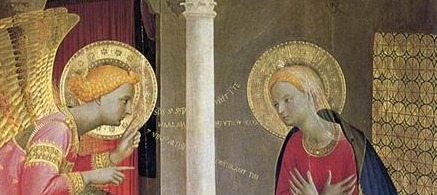
The words we know from the Gospel of Luke have given way to the Presence of the Logos, and the dialogue is painted without words in the two frescoes and in the panel. In Cortona there are still some words painted in the air (Lk 1:35, 38), iconic words between Gabriel and Mary, painted in two stages: from the Angel’s mouth to the Virgin: The Holy Spirit will come upon you, with the Dove above her head; and from the Angel’s mouth to the Virgin’s womb: The power of the Most High will overshadow you.
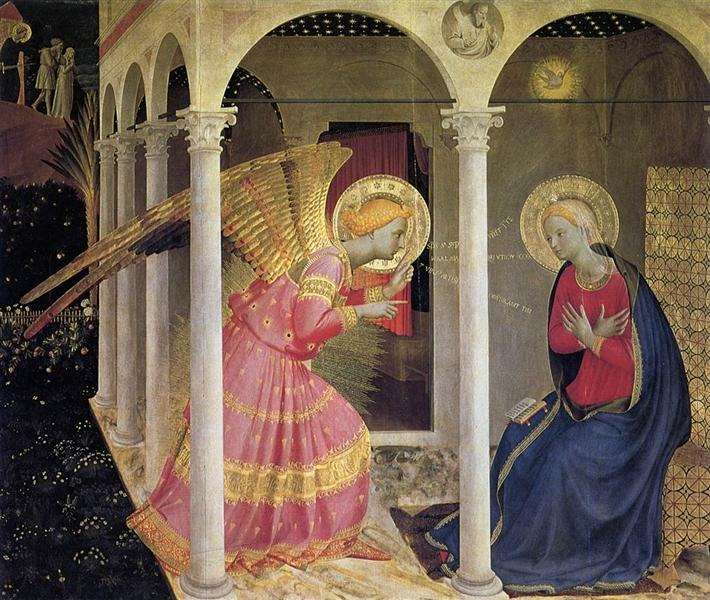
A dark-blue sky starred with gold over the whole outline of the setting, and words on the gilded tablet in relief between Mary and Gabriel, painted upside down so that God the Father, placed at the top, may read them, but also to signify the irruption into history of the God who raises the lowly from the dust and opens them to hope. From the Virgin’s mouth to the Angel’s mouth runs the inscription: Ecce ancilla Domini, fiat mihi secundum verbum tuum. On the embroidered hem that edges the red tunic, along its graceful border, the same words are painted right side up so that they can be read properly.
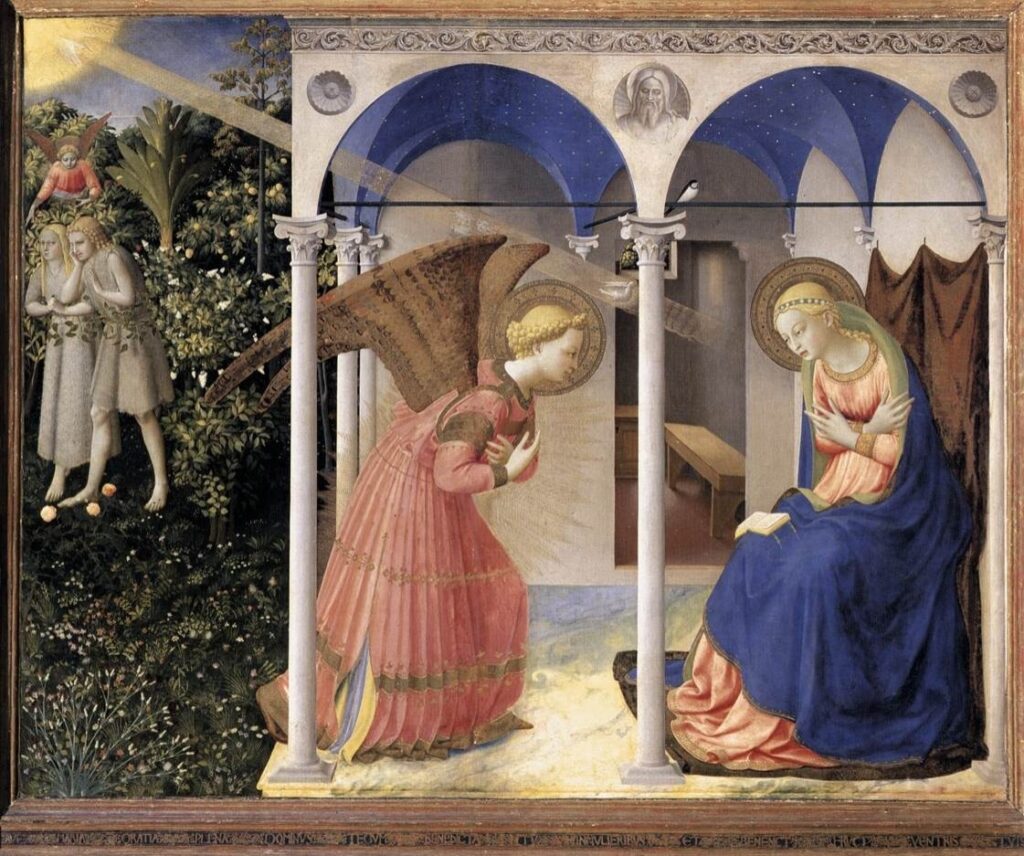
The painter’s art shows itself here to be angelic, because it represents the highest expression of spiritual values, of humanist ideals, and of the new vision of reality brought by the Renaissance through the pioneering early work of Brunelleschi and Masaccio, read here by Blessed Fra Angelico in a Mariological key. There is a heightened interest in the rhythmic exploration of space and in the elegance of the portico where the sacred event takes place, with exquisite early Renaissance architecture of very pure lines. In the altarpieces of Cortona and the Prado, the bright green of a flowering garden is a splendid setting, depicted with botanical scrupulousness and absolute realistic precision, and in the background Adam and Eve are going away, suffering because of it.
The sacrament of the new Presence of the Logos lies entirely in the hands of the Angel and the Virgin, the true focus of the three icons. But in the convent cell the book in Mary’s hand is also a sacrament of the Word: held in the right hand pressed against her heart, kept open by the thumb and resting on the middle finger, it is shown by the index finger to be unwritten. The book, a symbol of prayer and of familiarity with Sacred Scripture, indicates the presence of the Word who becomes flesh in Mary’s womb, just as He had already made Himself present in Sacred Scripture. With this visual analogy between Mary and Sacred Scripture (Virgo liber Verbi), the event of the Incarnation is clothed in light, and Mary is designated as the book on which God wrote His Word.
The book on the Virgin’s knees recalls the prophecy of Isaiah: “Therefore the Lord himself will give you a sign. Behold, the virgin shall conceive and bear a son, whom you shall call Emmanuel” (Is 7:14). Moreover, in Marian patristics the Virgin is frequently associated with the image of the book, and is called Liber Generationis Christi (Ernest of Prague) and Liber Dei manu scriptus (Ephrem the Syrian). She is regarded as a mystical book, which offered the word of God to the knowledge of men.
Catherine of Siena writes:
“The glorious Virgin Mary was that sweet field in which the seed of the incarnate Word of the Son of God was sown. In this blessed and sweet field of Mary, this Word was scattered in her flesh like seed cast into the earth, which germinates by the heat of the sun, and between the flower and the fruit the savor of the earth remains. So it truly came about through the heat and fire of the divine charity that God had for the human race, when He sowed the seed of His Word in the field of Mary”.
The composition of the Annunciation painted in all these places is offered with attention to the Mariology of Thomas Aquinas:
“The announcement made to the Most Blessed Virgin concerning her conception of Christ was an event of fitting dignity. First, for the sake of congruity in uniting the Son of God to the Virgin, that is, so that she might be instructed in mind before conceiving Him in the flesh; better still, she was divinely instructed. Also, so as to offer God the free gift of her reverence, and she presented herself ready, answering: Here is the handmaid of the Lord. Finally, so that it might be clear that a kind of spiritual marriage was being established between the Son of God and human nature. For this reason the announcement asked for the Virgin’s consent” (a. I).
“Saint Bede says that it was most fitting for the Virgin to be consecrated to the divine birth by an angel sent by God. Indeed, the first cause of human perdition had come from a similar creature, when the serpent was sent by the devil to deceive the woman” (a. 2).
“And the name, says Gregory, was entirely consistent with his office. Indeed, Gabriel means Strength of God, and He who came to conquer the powers of evil, the Lord of powers and Mighty in battle, was announced by the Strength of God” (a. 2 ad 4).
“The announcing angel appeared to the Mother of God in a bodily vision. Indeed, he came to announce the Incarnation of the invisible God. Even the apparitions of the Old Testament were all preordained to the coming of the Son of God in the flesh. And it was a vision befitting the dignity of the Mother of God, who was receiving the Son of God not only in her mind but also in her body. Not to mention that whatever falls before the eyes is grasped with greater certainty than what is the object of an image alone. That is why Chrysostom says that the Angel was visible before the Virgin. And since the Angel was making a very great revelation, a most solemn vision was offered to the Virgin” (a. 3).
Among the many Annunciate Virgins painted by Angelico, the most brilliant in light and color are the one in the Prado
and the Montecarlo altarpiece, now in S. Maria delle Grazie in S. Giovanni Valdarno. The former had already existed for some time when the church was consecrated in October 1435. The layout is entirely Renaissance in structure and perspective, and in the abolition of the gold background. But something remains unsaid in the figures: the columns are very slender, and the Garden of Eden is very close to the two progenitors, so large and not very distant that it seems contemporary with the Gospel scene.
In the Annunciation of S. Giovanni Valdarno, on the other hand, the progress, even in the theological sense, is more evident.

Space is decisively mastered; the architecture of the portico is well proportioned and has an eloquent perspective in the arches receding upward, on the left, where the expulsion from the earthly paradise appears in tiny, distant dimensions. The figures are alive; they speak to each other with gestures and glances, so much so that the written words seem a superfluous Gothic refinement. The Virgin, modest and serene after the Angel’s reassuring words, wears a transparent veil and a wedding ring on her finger, and she is modeled in the hands and head with an admirable sense of volume, emerging from the curved lines of the outstretched neck and of the body standing out from the back. An open book lies in her lap. The intensity of the color and the richness of the finely descriptive details of the setting satisfy the gaze of the one who prays.
In all the paintings and frescoes of Blessed Fra Angelico, the hands, always beautiful, have an extraordinarily psychological and spiritual function. In the Annunciation of S. Giovanni Valdarno, the hands are joined at the waist and at the same time spread open like a palm. Against the red background of the Virgin’s dress, the middle finger rises slightly out of the perspective of the whole and seems to point to the figure of Isaiah in the central scroll. On Mary’s knees has been placed the book of the Sacred Scriptures, the Word of God, almost in a gesture of surprise at the apparition of the angel Gabriel. Everything seems gathered in the elegance of Mary’s blue mantle, which outlines the figure with the gentle movement of its folds and its golden border, in its enchanting chiaroscuro. In the liturgy, the gesture of the hands or the movements of the whole body, the instrument and expression of the soul, are fundamental. Above all, the face and the hand are the instrument and the mirror of the soul.
Indeed, if we observe a person in a moment of joy, amazement, or expectation, we notice how these feelings are also manifested in the hands at the same time. The hands, after the face, are the most spiritual part of the body. Hands that are firm and vigorous can be instruments of work, but also of attack and defense. But when they are as fine and delicate as Mary’s, they can reveal the soul and at the same time welcome the soul of others.
We also always do this with our hands: is it not welcoming the soul of another when we clasp the hands that a person holds out to us? So it also happens in the liturgy, where a true language is at work before God: the soul receives God and wishes to give itself. The Virgin’s hands, likewise open and spread, correspond to Gabriel’s hands, spread and joined. Both are united and gathered in receiving the Gift of God and in adoring this Gift. Looking at the hands of Mary and of the Angel, it is natural to think that the hands of God are intertwined with those of His creatures in the Lord Jesus.
Final Note
When we look from the Annunciations of Fiesole (the one now in the Prado) and of Cortona, dazzling with light and color, to the one in the cell of the dormitory of S. Marco, the leap is enormous: the gold, the bright colors, the expulsion from Eden, and the words of the dialogue between the angel and Mary have all disappeared. Nature is set somewhat apart, as if outside the dialogue, though it must be acknowledged that the hortus conclusus, a well-known symbol of the virginity that prepared Mary for the divine motherhood, also plays its part. Even the architecture, though strengthened, opens fully to reveal the mystery and to welcome the heavenly message, whereas before it restricted the view. The two figures are defined by chaste colors: the iridescent wings of the heavenly messenger are matched with the deep blue of the Virgin’s mantle, open like a book to the divine Word.
Postgraduate Program in Mariology
Would you like to deepen your formation in Mariology? Discover the Postgraduate Program in Mariology of Locus Mariologicus: an academic formation that unites theological rigor, spiritual life, and the living tradition of the Church.



Responses