Annunciation by Leonardo da Vinci (1472-1475)
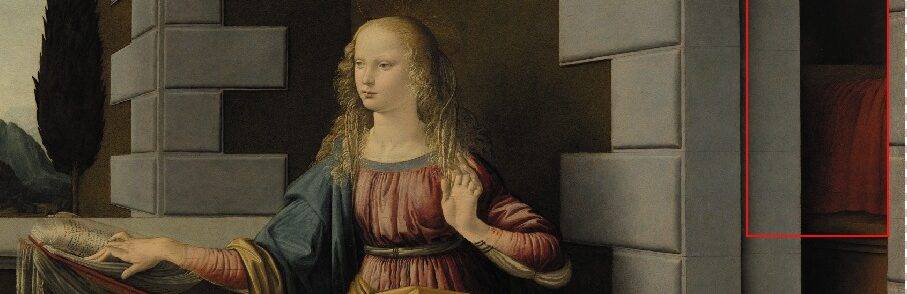
Leonardo consciously departed from the traditional iconography of the theme of the Annunciation, setting the scene in a garden outside Mary’s house, rather than the usual loggia or room.
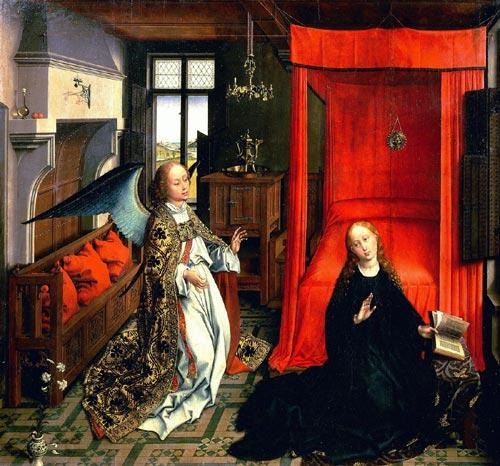
According to medieval tradition, the setting was always placed indoors, at least regarding Mary, in order to include iconographic elements such as a bed, while the Angel could be positioned outdoors but within a hortus conclusus, or enclosed garden with high walls alluding to Mary’s womb.
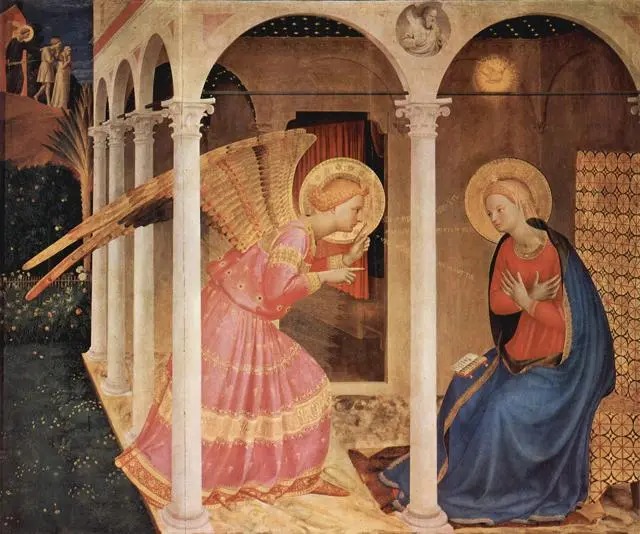
Da Vinci is traditional in other ways too, as we can indeed find the positioning of the two figures (Mary on the right and the Angel on the left) for instance in the Annunciation by Beato Angélico.
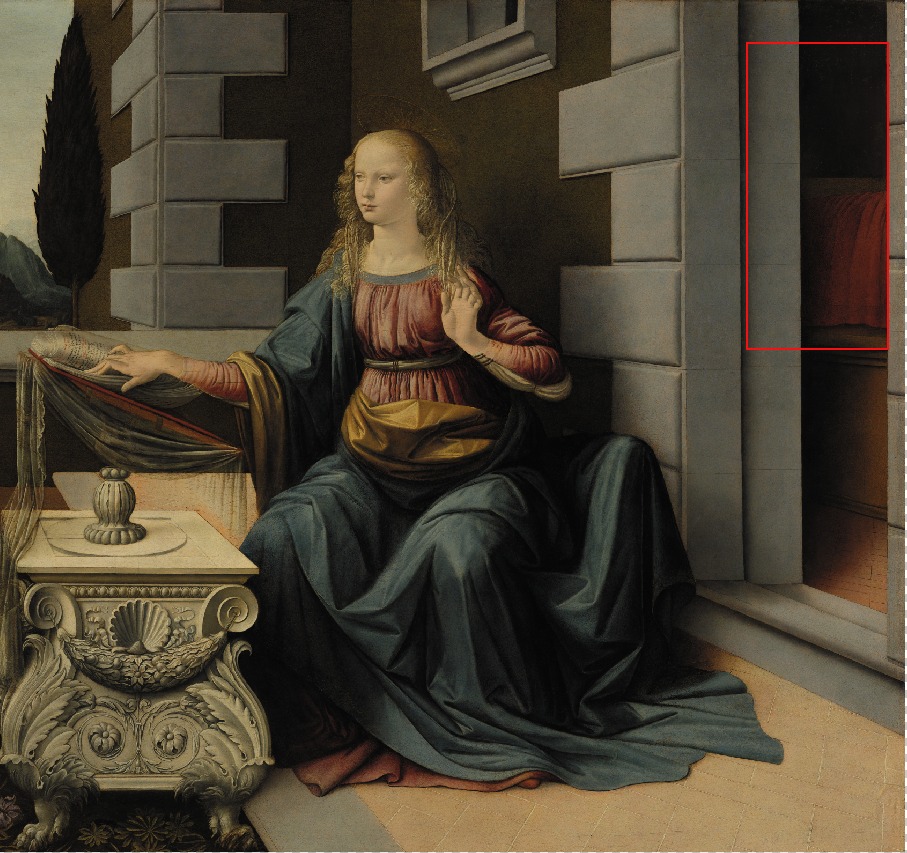
Moreover, to maintain the secrecy of the encounter, Leonardo painted Mary in a corner of the building, yet allowing a glimpse of the bed from the portal. Then, a low wall delimits the small garden, but with an opening. The bulk of the scene dedicated to nature seems to underscore how the divine Incarnation, as well as human Mary, involves all creation.
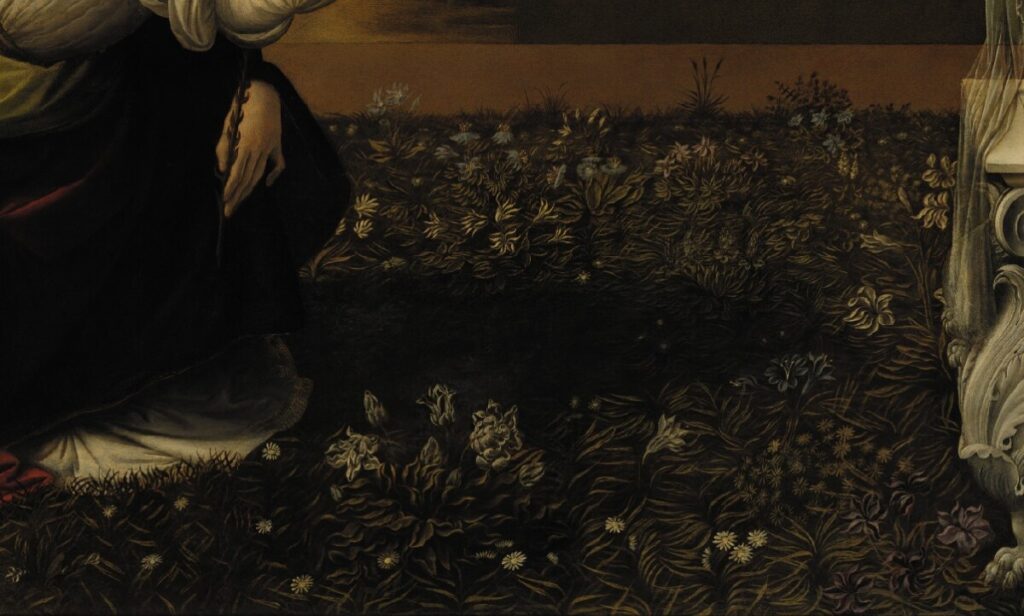
The Painting: A Botanical and Aerial Perspective Study with an Angel
A significant focus is given to the botanical description of flowers and other plant species both in the meadow and in the background—a tribute to the diversity and richness of divine creation. The prairie flowers, in particular, are studied with life-like lens, capturing their detail with precision through lenticular imaging.In the distance, beyond the wall, a river meanders with boats, mountain ranges dotted with towers and trees. The light is crisp, almost morning-like, softening the outlines of figures, hinting at a subtle atmosphere.The spatial arrangement deviates from geometric perspective of the 15th century (evident in the architectural details and proportions of the building, floor, and pulpit, with a vanishing point centered on the table). Instead, it emphasizes color gradation, especially in the background.Leonardo employed aerial perspective, a technique that yields a softer, more nuanced coloring for distant elements, as if shrouded in mist. He understood that multiple layers of atmospheric dust overlap between the eye and distant objects, blurring their edges. Conversely, nearby objects are meticulously rendered with precision because they become more discernible as they draw closer.This youthfulness is evident in the abrupt transition beyond the nearest trees, starkly contrasting with the background. The cypresses stand like columns, dividing the scene almost mathematically.The Angel
The angel is depicted in a classic pose, as if just glided in with wings flapping moments before closing. His robe, unlike other examples (like Simone Martini’s Annunication), has fully fallen to the ground, its weight visible in the grass where it seems to capture the air movement from his landing.The Angel and Mary
Unlike traditionally depicted angels with peacock wings (considered sacred and symbolizing immortality), this angel possesses authentic bird wings, studied through avian anatomy and ornithology.However, there is a peculiar anomaly as the original wings were shorter. Later, someone added an extension, not understanding that Leonardo intended to portray the angel alighted, thus closing his wings. This correction compromised Leonardo’s entire study of birds and the realistic representation of the wing.The angel presents a lily, a symbol of purity and chastity, to the Virgin Mary. The cypress tree (in the background) is associated with images of the Virgin Mary, Christ, and the Church, likely due to its characteristic of growing tall towards the sky.Leonardo’s pose configuration is classic, featuring wide, smooth folds in the drape. Sometimes, he would create models of figures in clay, wrap them in soft cloth soaked in plaster, and then patiently reproduce the drape’s course. The hand positions are natural: the right hand announces God’s unity and Trinity, along with Jesus’ divine and human nature, while the left holds the lily, symbolizing purity.The gaze is fixed on Mary, in the act of announcement.There is a perplexity regarding the angel’s head: the complexion is pale and flattened, lacking Leonardo’s classic transparencies. A significant difference is noted compared to the angel in the Baptism of Christ: here, the hair does not fade but appears as a compact mass of curls, suggesting an assistant painted the forehead.
The Annunciation by Leonardo is undoubtedly one of the most renowned works. Much has been written about the artwork, but little has been said about its Mariological aspect, mainly because Mariological analyses of art still lack wider dissemination.
This work emerged as one of Leonardo’s earliest pieces while he was still in Verrocchio’s workshop. The original location and commissioning of this piece are unknown. It reached the Galleria degli Uffizi in 1867, having previously been in the sacristy of San Bartolomeo a Monteoliveto, outside the gate of San Frediano. One can already discern Leonardo’s meticulous attention to atmospheric changes in the landscape, which he would further develop in subsequent works.
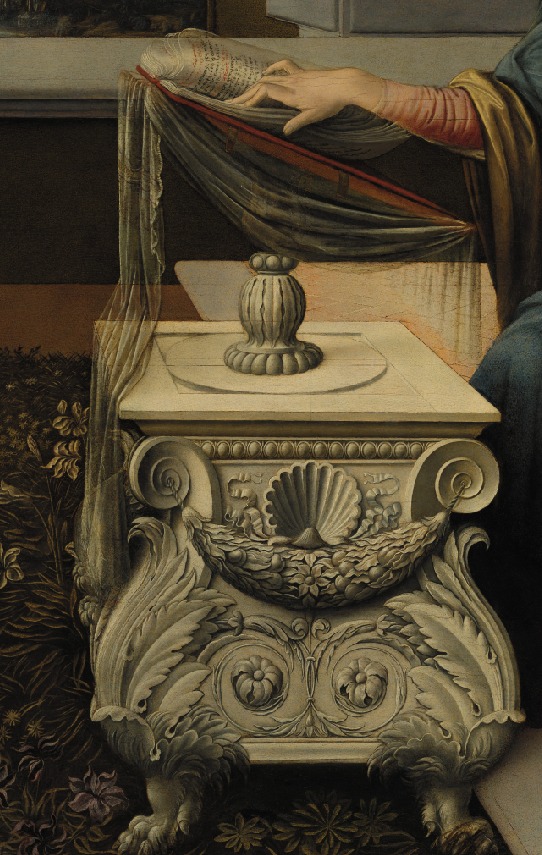
Mary stands behind a marble altar on which rests a pulpit. The altar showcases Leonardo’s influence from Verrocchio’s teachings: it is adorned with classical motifs, reflecting a monument to his master, the tomb of Giovanni and Piero de’ Medici in the former Sacristy of San Lorenzo. Similar are the lion-foot supports that develop into vegetal elements, spirals, and volutes on the sides. Above the upper clusters, which echo the Ionic order, stretches a garland with leaves, fruits, and flowers, topped by a shell between fluttering ribbons, symbolizing the new Venus, Mary, and eternal beauty. The veil, semi-transparent under the book of Sacred Scriptures that the Virgin was reading, is of exquisite craftsmanship and symbolizes prophecies from the Old Testament (in this case, it depicts a passage from Isaiah), fulfilled by Mary’s acceptance.
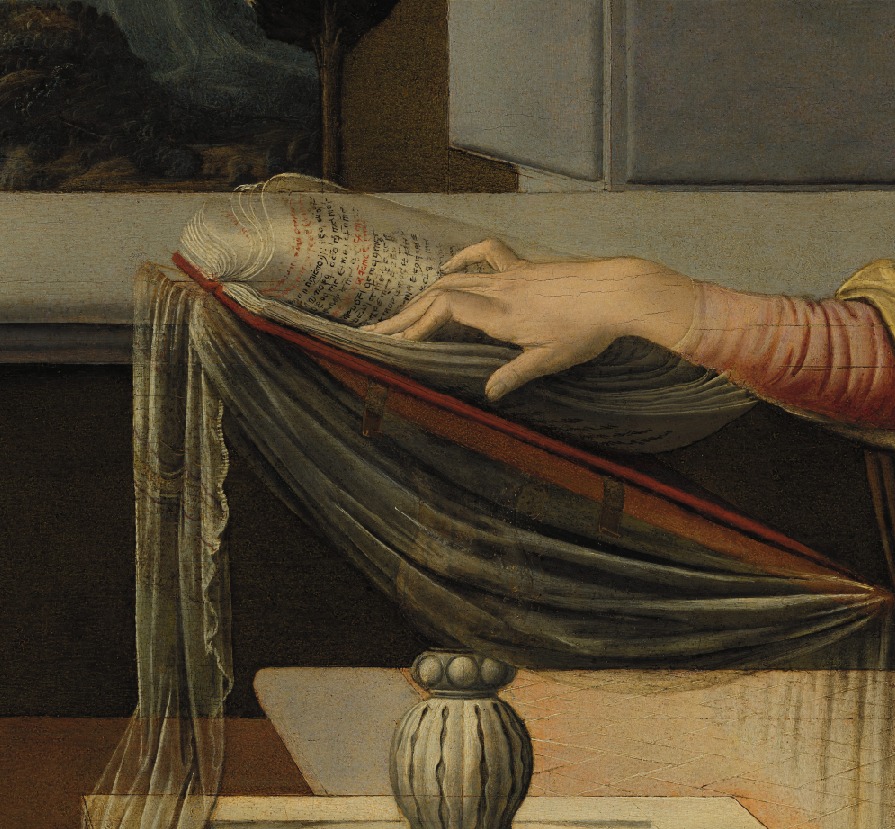
Mary has her right hand resting on the book as if trying to prevent it from closing (perhaps due to the wind caused by the angel), while her left hand is raised in a sign of acceptance of her vocation. The wide mantle, blue in color, covers her legs, also falling over the seat, giving a strong sense of plasticity and emphasizing the hidden form of her legs.
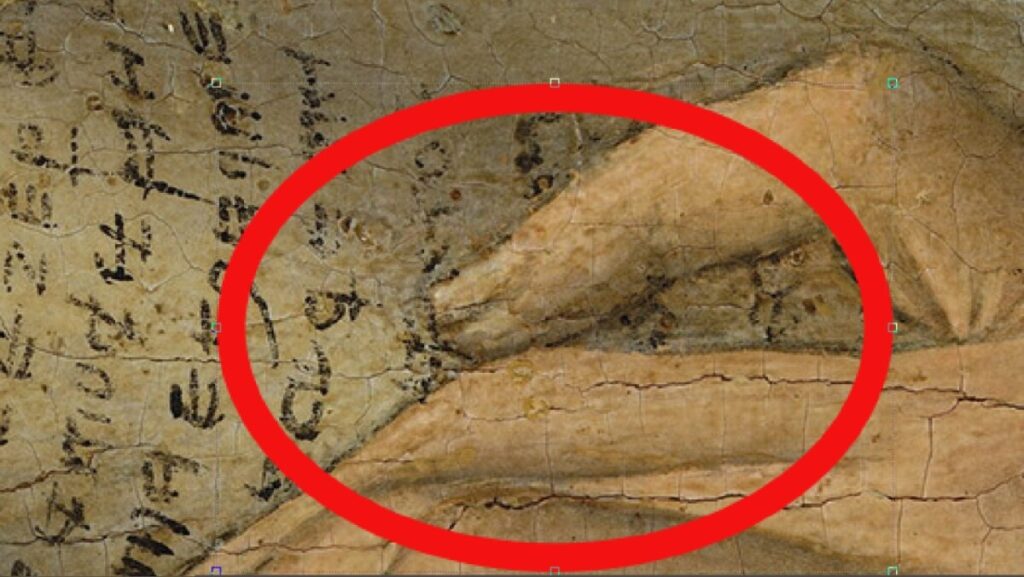
Conclusion in Mariology
Having contemplated the complexity of this Announcement, we can draw several conclusions regarding the artist’s perception of the figure of the Virgin Mary.First, the Virgin is depicted not in a posture of humility with her hands at her chest facing the ground, but rather in a typical Christian humanism pose, standing freely and confidently. This element of Mariology emphasizes the freedom and responsibility of man to offer his consent to God.Second, the book and the Virgin—or more precisely, the Word and the Daughter of Israel—present a comprehensive view of scriptural importance in shaping our Mariological interpretation. Whether through the hand gesturing towards continuity before and after the angel’s appearance, or by recalling the revelation that prophetically announces the Messiah now dwelling within the Virgin.Third, the open space of the garden is no longer a *hortus conclusus* (enclosed garden) emphasizing Mary’s perpetual virginity, but rather a horizontal space of human choice that intersects with God’s action in history. The Garden of Eden of yesteryear has become the new creation, not as a place of sin, shame, or repentance, but as the convergence point of all history. The New Adam resides within the Virgin, who is the New Eve, bringing God present through the divine messenger, who had previously been used to expel the human progenitors and now announces to the new progenitors of the *New Creation* according to the Spirit.Fourth, we observe Mary’s face, her hierarchical position, even her majestic stance. We do not see fear or confusion, but rather a vision along the horizon of one offering consent. Mary does not look at the Angel, but towards space, offering her consent on behalf of creation and with creation to the God who is revealed. Eventually, it seems she offers her consent, through the position of her hand, more towards the horizon than the angel.Graduate Studies in Mariology
Desire to deepen your formation in Mariology? Discover the Graduate Studies in Mariology from Locus Mariologicus, an academic formation that combines theological rigor, spiritual life, and the living tradition of the Church.





Responses