The Geometric Mariology of Piero della Francesca (Part 4)
By Prof. Dr. Daniel C. Afonso · Updated
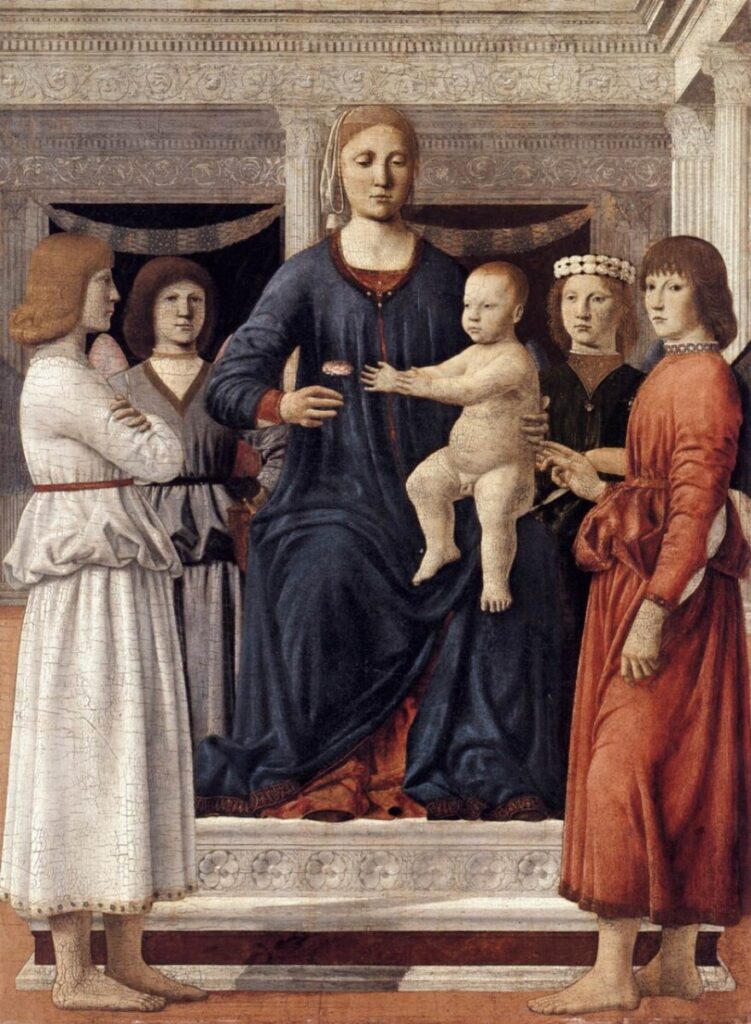
A Madonna and Child, recently attributed to Petrus de Burgo and thought for centuries to belong to Piero della Francesca, weaves the connection with the landscapes created through a painting of light, divine proportions and a contemplative gaze, where mathematics and painting are mysteriously united in a new certainty of spaces, in which men and the things of the world descend from a kind of dreamlike spatial foresight. They remain absorbed, impassive and silent guardians of these laws, privileged guardians of a joyful poetry of the minimal in which the breath of a new intimacy of distances resounds among things, events and states of mind.
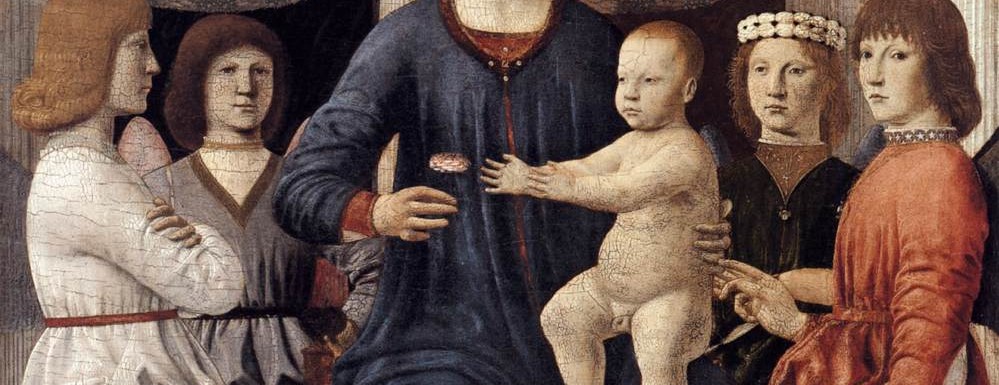
Our Lady offers a red rose, apparently white because of the reflection of the light, to Jesus, who sits naked on her lap, in a symbolism that recalls the Passion. An angel dressed in red points to the Child. Around the Virgin Mother, the angels line up in a semicircle, composed and sober in their usual sculptural yet regal quality.
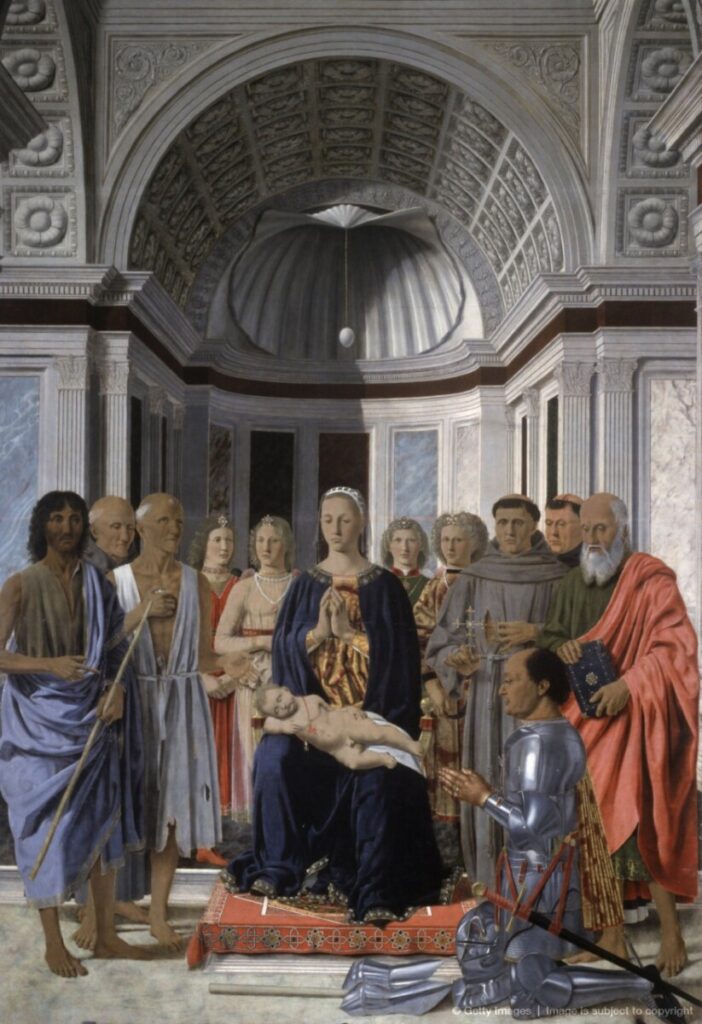
Perhaps Piero’s best-known painting is the Brera Altarpiece, because of the place where it is kept and because its subject is a sacred conversation.
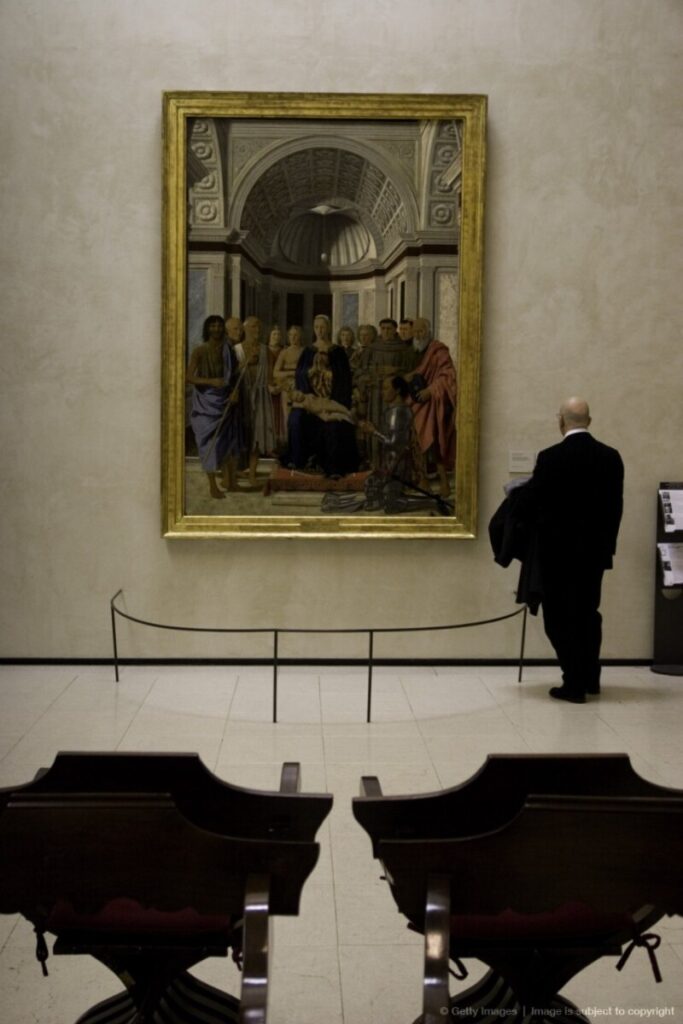
This name designates paintings that show Our Lady with the Child in her arms, in the company of saints and, at times, even of mere mortals.
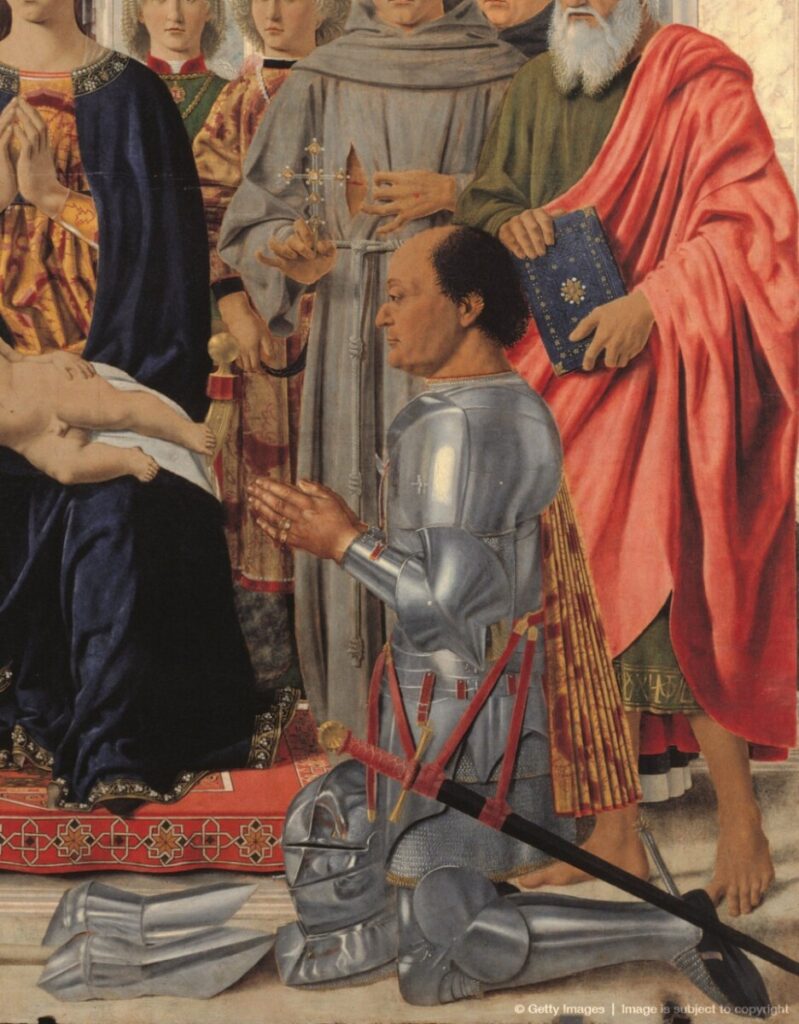
In this case, the panel also features Federico da Montefeltro, who commissioned the work, clearly recognizable in the man in armor kneeling on the right. It should be noted that the position of the figures generally respects a precise hierarchy: Our Lady is the only one seated, the saints are standing, the patrons are kneeling.
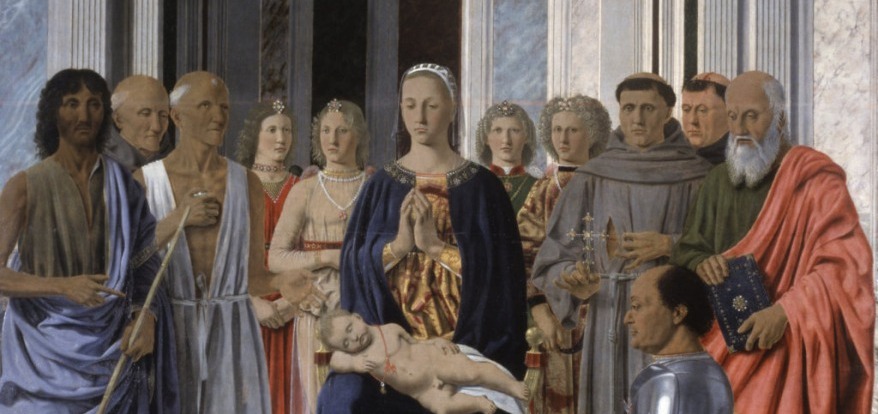
The panel depicts four angels, close to the Mother of the Lord, and six saints, three on each side: on the left are Saint John the Baptist, Saint Bernardine of Siena and Saint Jerome, on the right, Saint Francis, Saint Peter Martyr and Saint John the Evangelist.
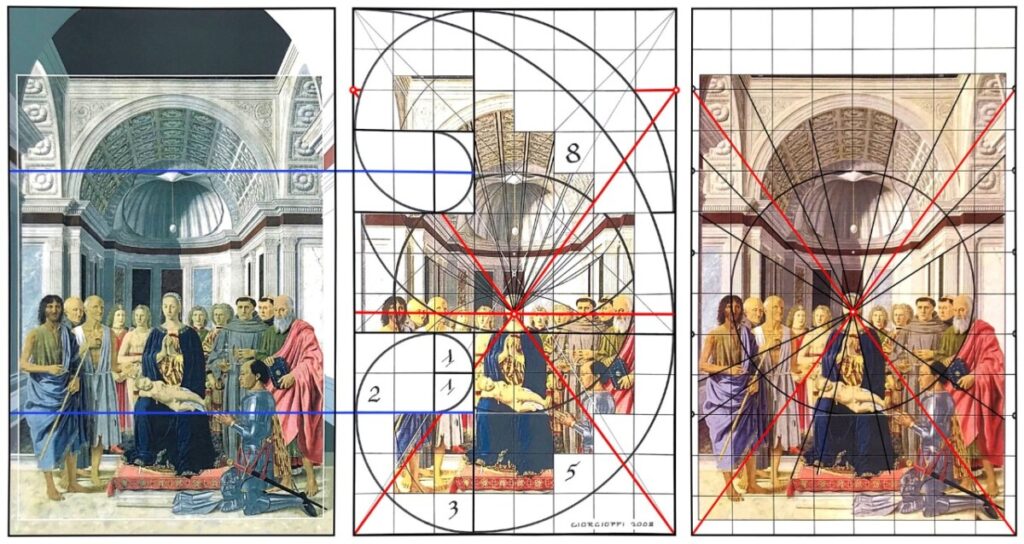
The work is an admirable example of that formal order which is something more than a simple stylistic choice: it is confidence in a universe based on a harmony of rational and mathematical origin. Everything is symmetrical and precise, especially the architecture in the background. We are inside a church, at the crossing of the nave and the transept, right in front of the apse. The space is, therefore, a representation not only of a sacred place, but of a cosmic order based on clarity and rationality.

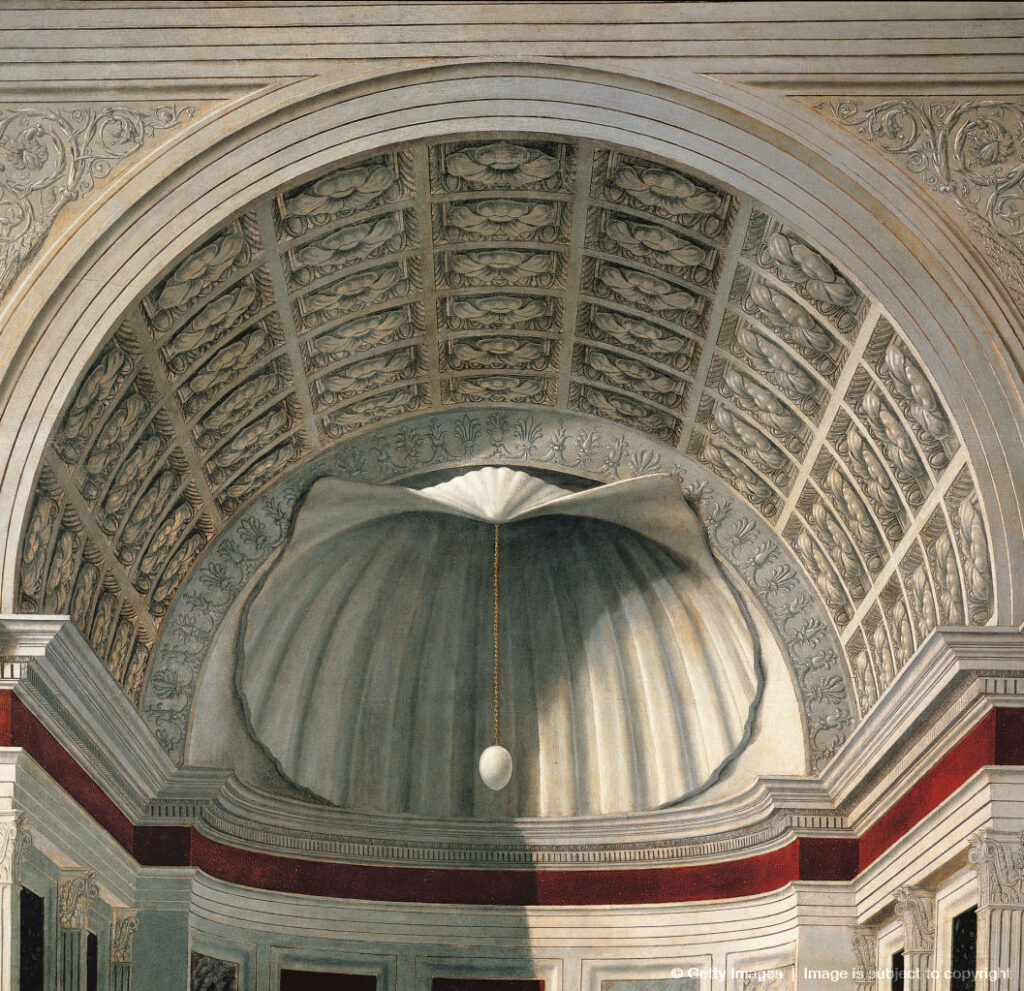
An original detail of this space is the shape of the apse vault, a shell. An ostrich egg hangs from the top. The meaning of the egg lies in a medieval belief according to which ostrich eggs were hatched by the heat of the sun and were therefore a symbol of Mary’s virginal motherhood.
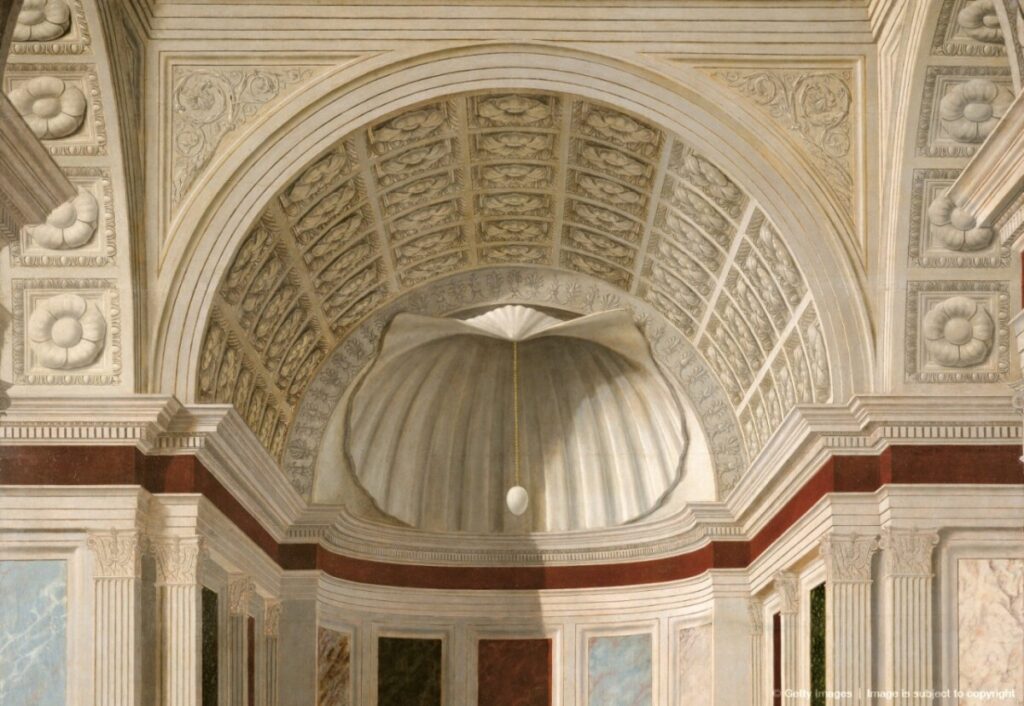
The shell probably also points to the same meaning, since it was believed that the pearl was formed inside it, without male intervention, by the lightning of storms. These details point to the mystery of the birth of Jesus, understood as a miracle that offers salvation to man.
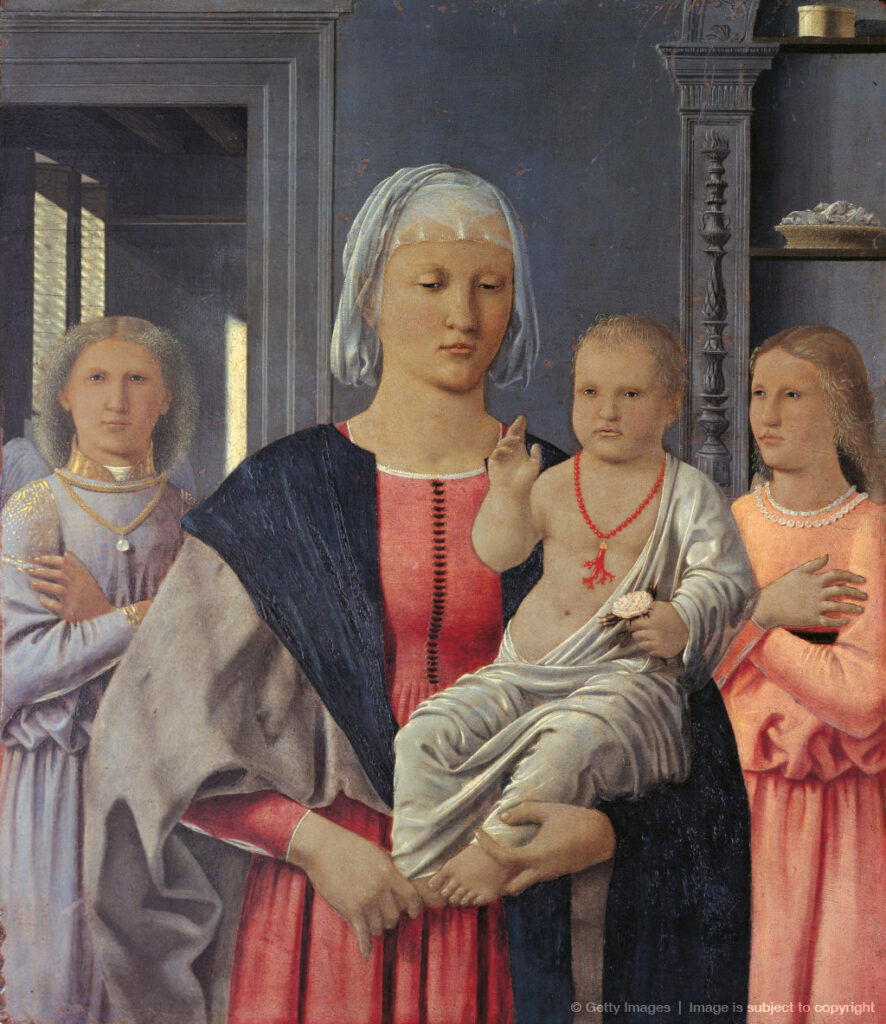
The work La Madonna di Senigallia is a piece of fundamental importance for reconstructing the artistic development of its author, since it attests to the passage from tempera to oil painting, inspired by Flemish painters such as Jan Van Eyck, known at the time at the courts of Ferrara, then at Urbino. It was Flemish painting that brought the use of oil painting to Italy, offering the possibility of a more refined control of light.
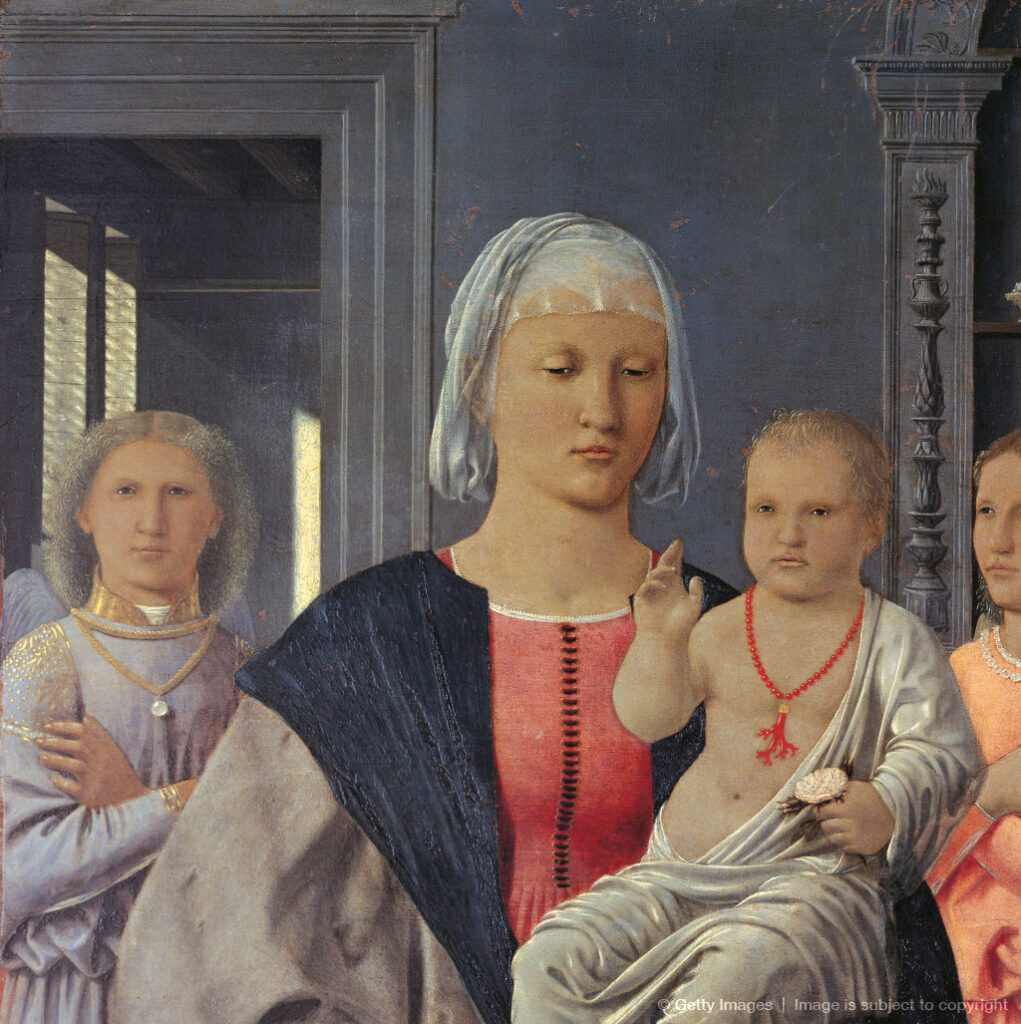
Piero della Francesca, therefore, builds images with color and builds color with light. The hour of his pictorial meditations is noon, when the light of the zenith erases the shadows of the earth. In Piero, colors seem to be born for the first time as elements of an invention of the world. The Master of San Sepolcro learned the first lesson in this sense during his stay in Florence, assimilating the great lesson of Domenico Veneziano: a luminous painting that builds the figures in light, not superimposed, but harmoniously integrated into the drawing.
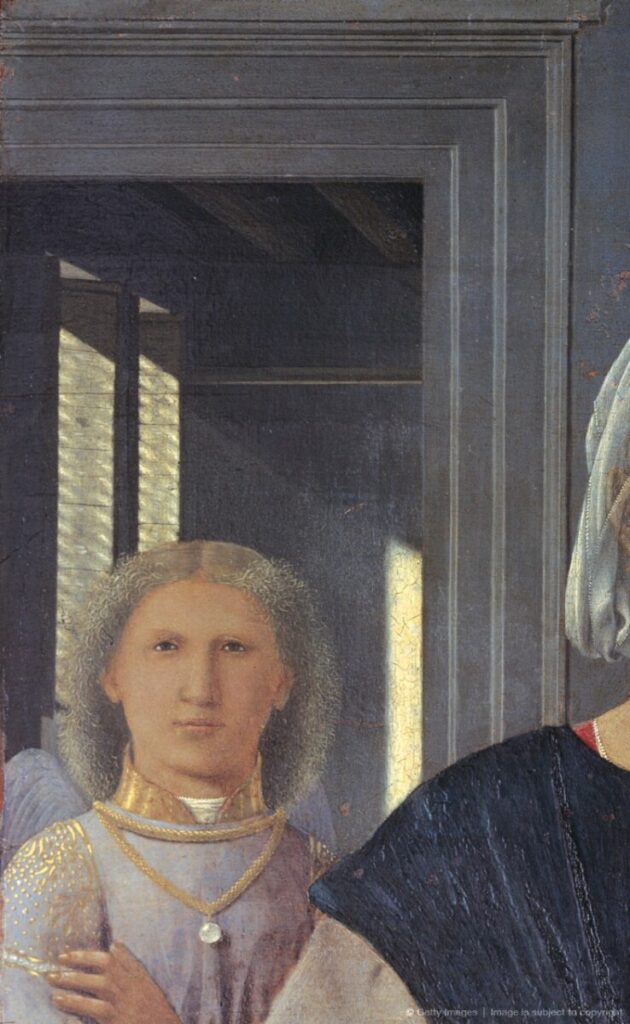
The Madonna of Senigallia proves even richer because it captures the slanting light of any ordinary day, that light which, filtering through the windowpanes on the left, reveals the interior of a majestic but not opulent house, where a very young Our Lady, attended by two adolescent angels, presents her melancholy son with a sweet, sad gravity, as though clouded by forebodings.
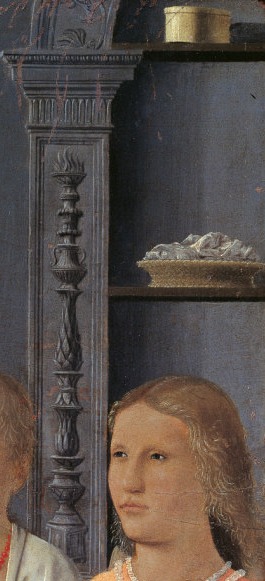
An atmosphere of extreme concentration pervades the simple room. On the shelves there is a jar that was meant to hold hosts and thus allude to the Eucharist, and a basket, a reminder of the purity and saving role of Mary, who receives Jesus in her womb as the basket received Moses (cf. Ex 2:3-6).
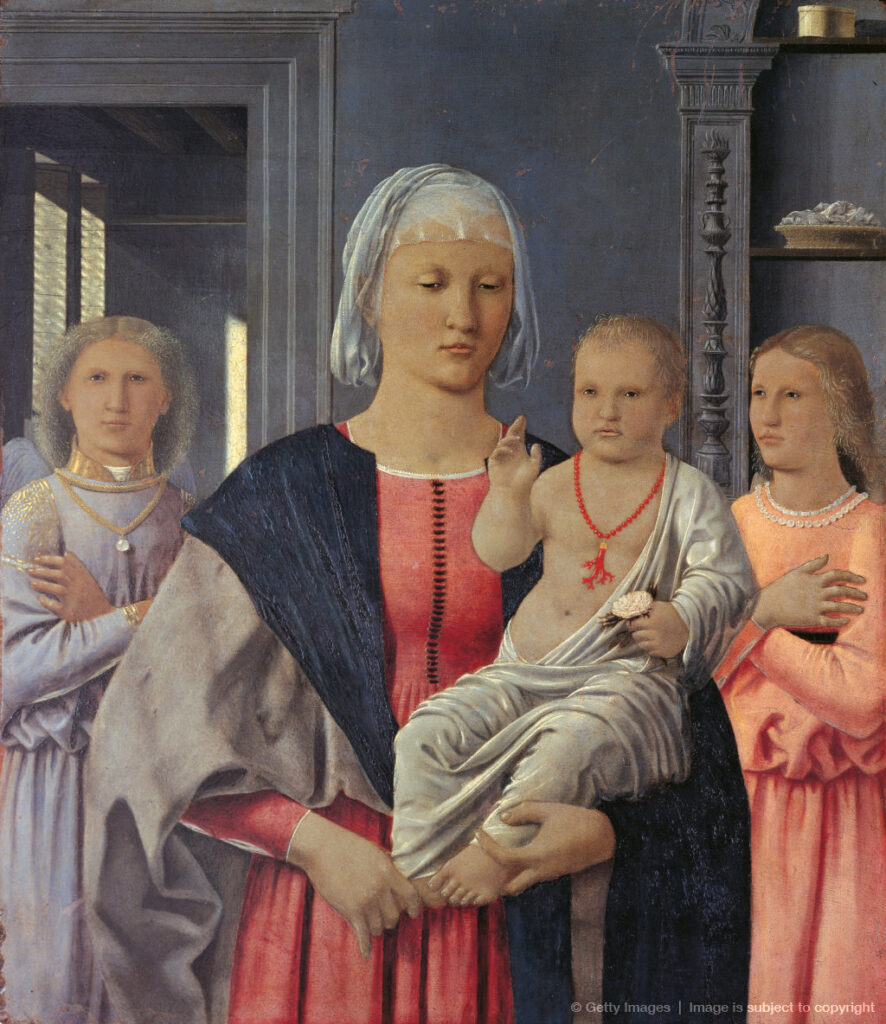
The work combines the monumental and the intimate, the two lines in which his poetry is expressed. Monumental are the volume of the bodies, the composure of the figures and the sobriety of the garments, which nevertheless open up to the elegance of the angels’ jewels and the refined transparency of the Virgin. The atmosphere of this fifteenth-century house interior is intimate, almost domestic. The architecture cut by the light coming in from the left allows Piero to dwell on the effects of illumination, a clear reference to the Flemish world. The work as a whole appears clean, essential, fixed in that typical static silence that constitutes the charm of this painter.
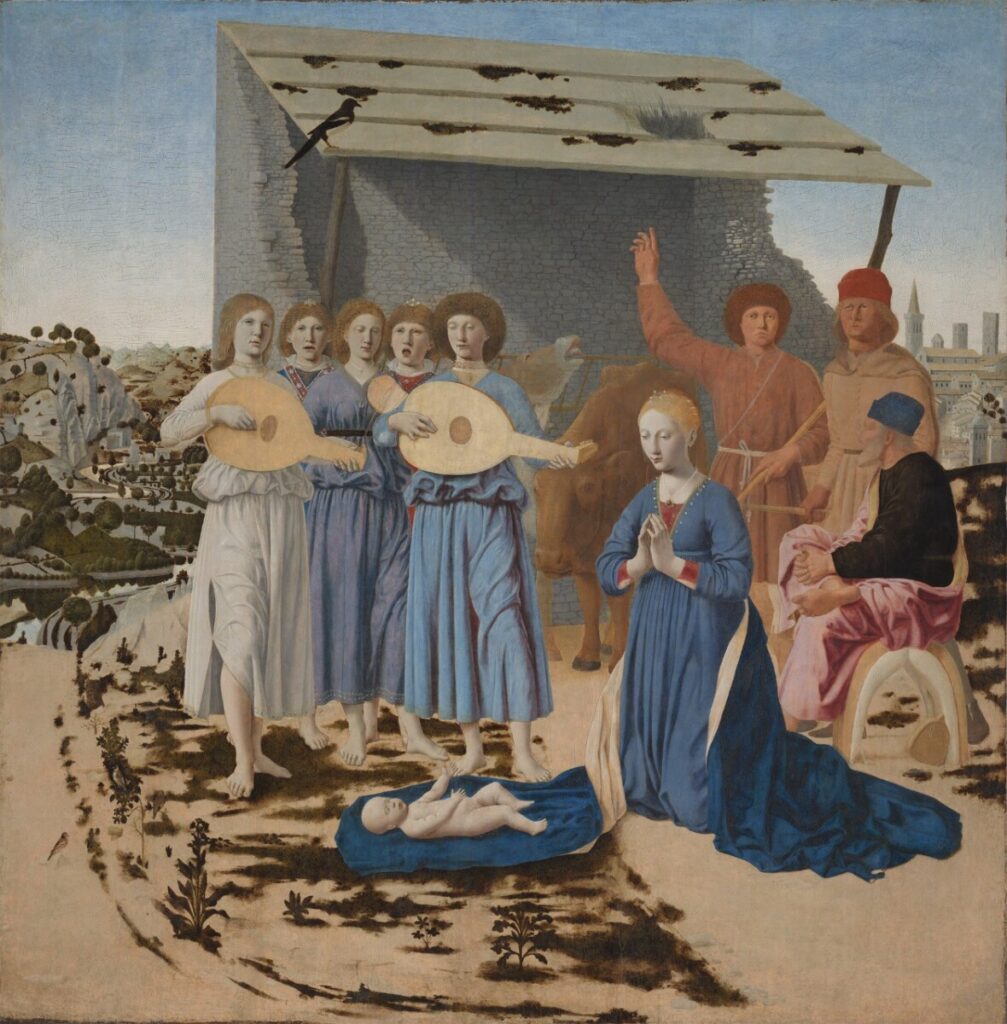
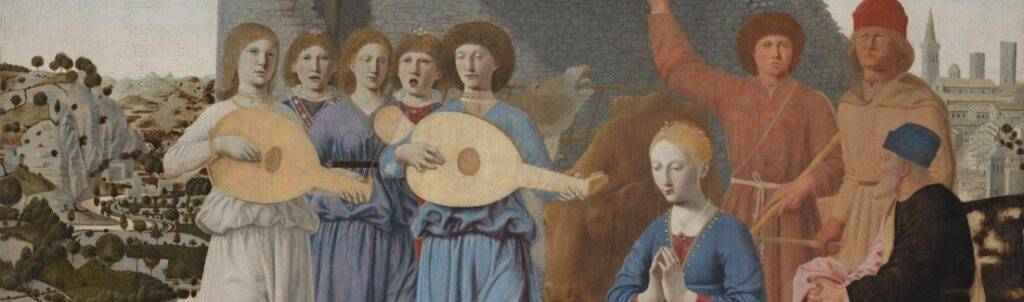
The London Nativity is perhaps the last work of the Master of Sansepolcro. The Child lies on the ground, on a corner of Mary’s mantle, according to the traditional Northern iconography, which is also reflected in the features of the Child.
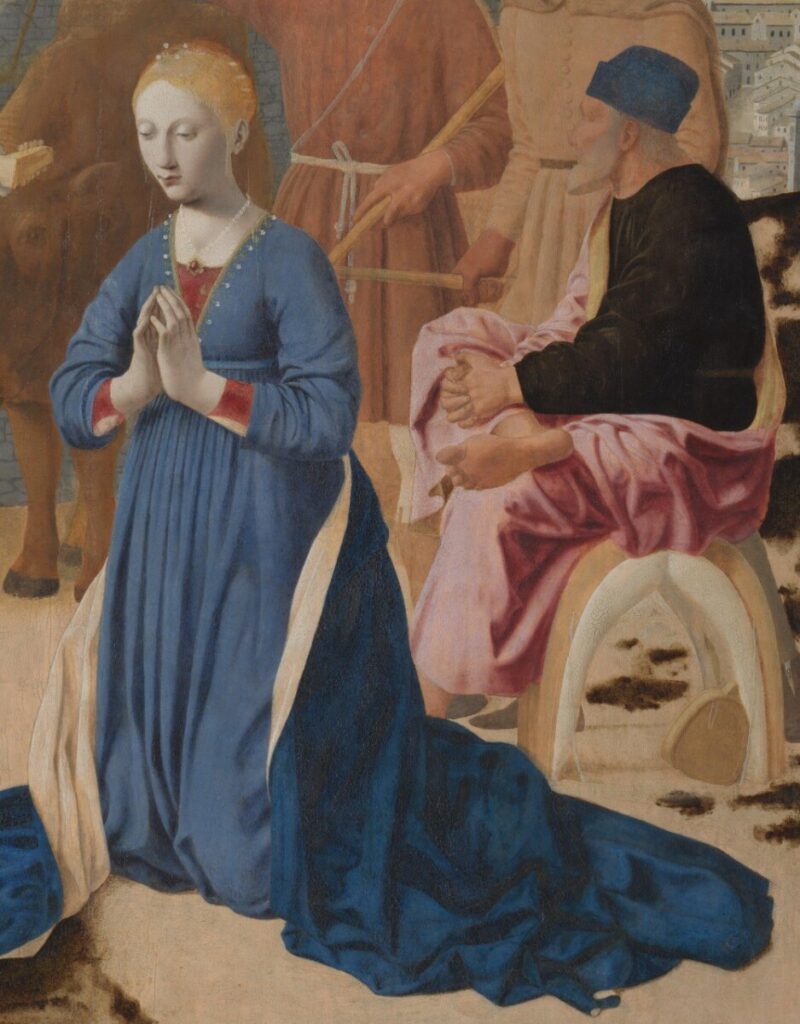
The Mother, soft and delicate in form, an extremely elegant ivory figure, contemplates the Child lying on a flap of her mantle.
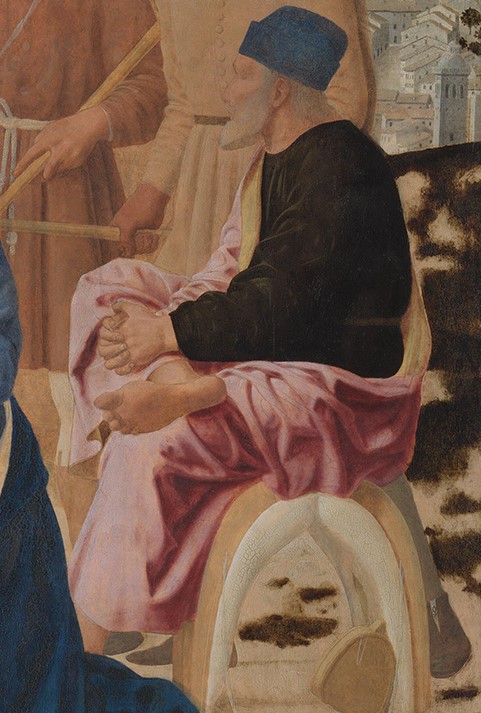
Saint Joseph sits casually on a saddle, in a pose of domestic flavor, utterly intimate.
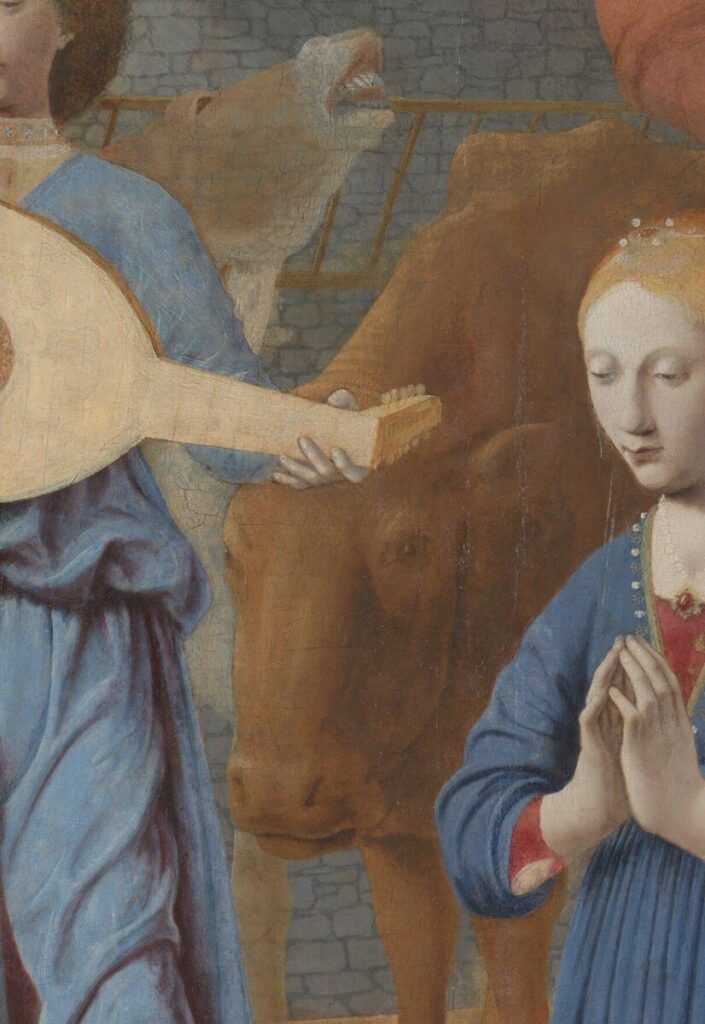
The two animals in the background are depicted with great realism.
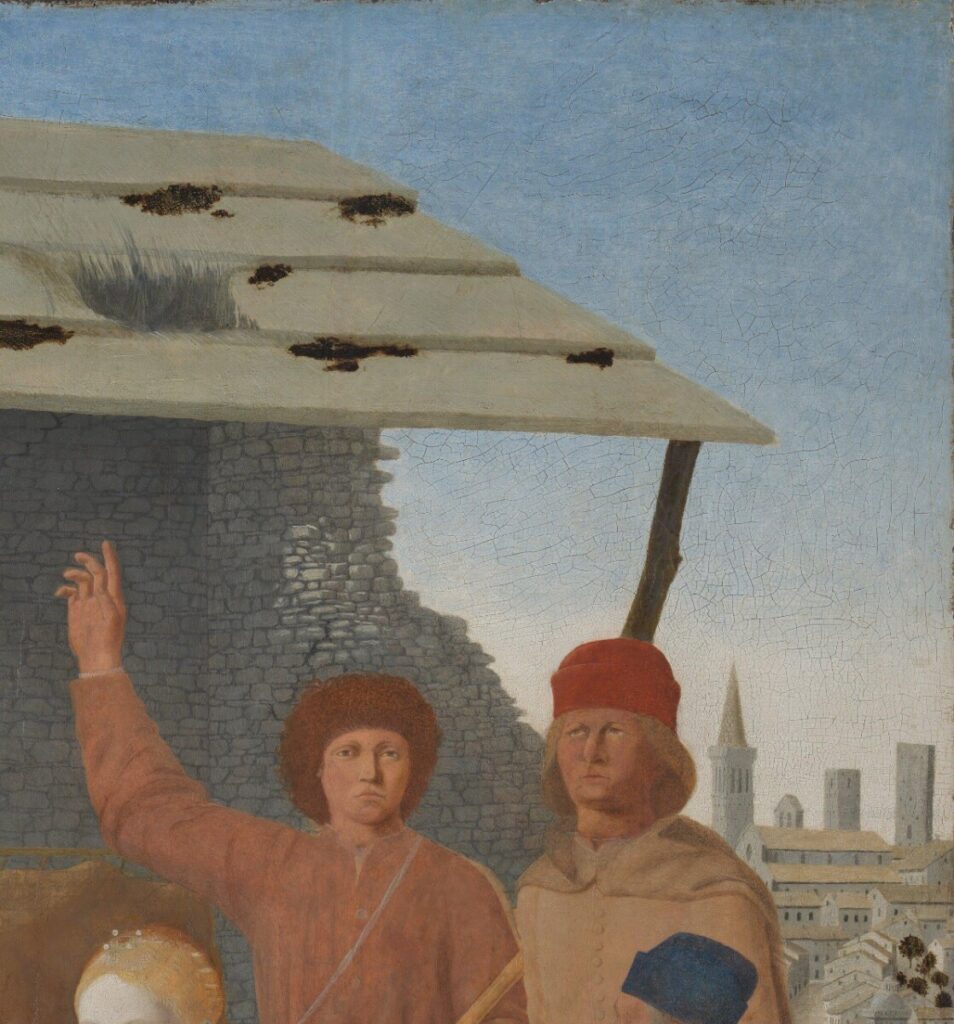
Behind, one of the shepherds points to the comet.
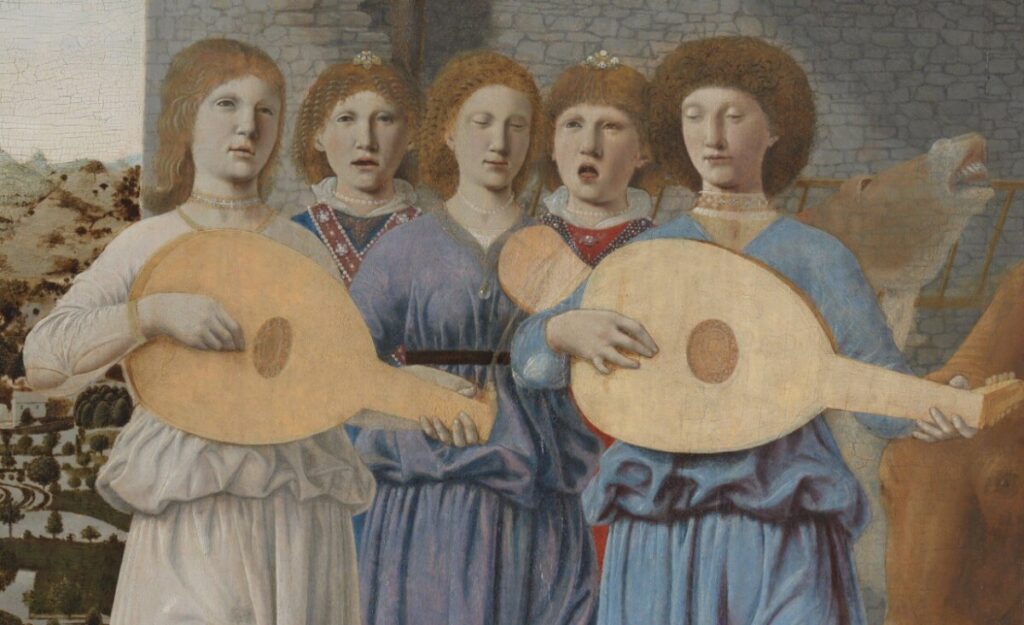
A group of musician angels sings, but they play instruments without strings.
The vanishing point is slightly raised, as in the Brera Altarpiece, and gives an almost aerial view of the spectacular river landscape, which stretches into the distance with trees, shrubs and jutting walls that recall some drawings by the young Leonardo. Piero’s work, almost square, is beautiful to the point of arousing intense emotion. It reveals religiosity and mysticism and a profound sense of mystery, together with nostalgia for past experiences, which are evoked as alive and present.

The braying donkey is added to the choir of angels, a perfect quintet that plays and sings at the entrance of the hut to give glory to God. In short, the presence of the donkey would mean that all creatures, each in its own way, share in the joy at the birth of Christ, that is, at the coming of God to earth. But the donkey’s bray corresponds to the dissonant note in the harmony of the angelic choir. At the very moment of the birth of the divine Child, joy is mingled with sorrow, because the plan for the redemption of men, willed by God, will lead Christ to the cross. The other animal creatures present in the work, however, do not share in the jubilation of this extraordinary birth.
One can see the ox beside the donkey, a magpie on the roof of the hut and a goldfinch in the foreground. None of these animals, however, lows or sings. It follows that the presence of the braying donkey has its reason for being in an unpleasant, out-of-tune sound. Popular wisdom also contrasts the donkey and its bray with music and its harmony. Now, Piero’s donkey is very close to the angel playing the violin or lira da braccio. If we add to this that the donkey’s coat is red (a sign of the devil), that the magpie on the hut often alluded to the devil and that the goldfinch with thistles in the foreground points to the sufferings of Christ’s martyrdom, the meaning of the painting seems clear.
The architecture here is only hinted at in the ruin and in the background, where Borgo Sansepolcro can be glimpsed. The space is punctuated by the landscape, by the bends of the river in which the trees are reflected, in a luminous and adoring opening that brings heaven to earth, the song of the angels into the poverty of the manger.
Let yourself be enchanted by a word of the Lord, be surprised once again by the manger and the Cross, learn to marvel at the Logos that is within all flesh, at the Eternal that slips into the instant, at the Bread that becomes Body, at a God who smiles; make Mary a silent teacher of wonder, she who keeps and ponders in her heart. For the story of a child is written first of all in the heart of his mother. She kept the Good News. She kept it with care, because even the fragments are precious to the memory of the heart.
Having gone blind in his last years, Piero della Francesca died in Borgo San Sepolcro on October 12, 1492, the day of the discovery of America. His images of the Virgin, calm, stable, silent, essentially hieratic, marked by a sense of grave and solemn sacredness, bring back to the heart the echo of a poem:
Ark of the new covenant
between man and nature, return,
in the caravel that carries the Lord beneath the white sail
(David Maria Turoldo).
Postgraduate Program in Mariology
Would you like to deepen your formation in Mariology? Discover the Postgraduate Program in Mariology of Locus Mariologicus – an academic formation that unites theological rigor, spiritual life and the living tradition of the Church.
Would you like to study Mariology seriously?
This article is born from the works in the Locus Mariologicus library. The Postgraduate Program in Mariology takes you to the same source, with academic guidance: Scripture, the Fathers of the Church and the Magisterium, from the first dogma to contemporary questions.
Responses