The Annunciation by Leonardo da Vinci (1472-1475)
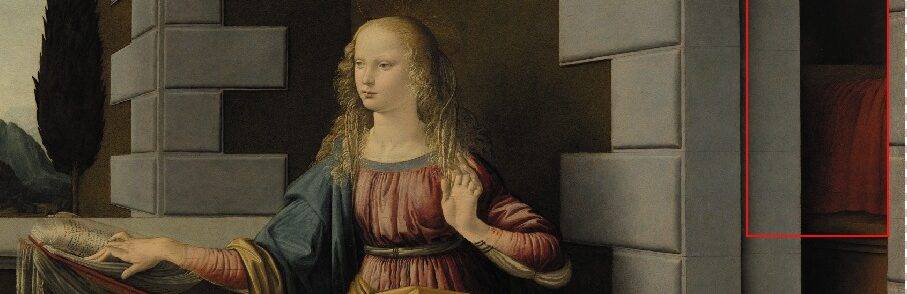
The Setting
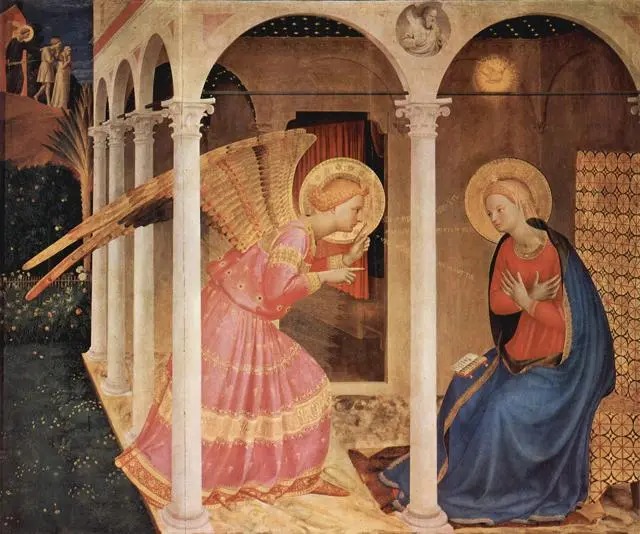
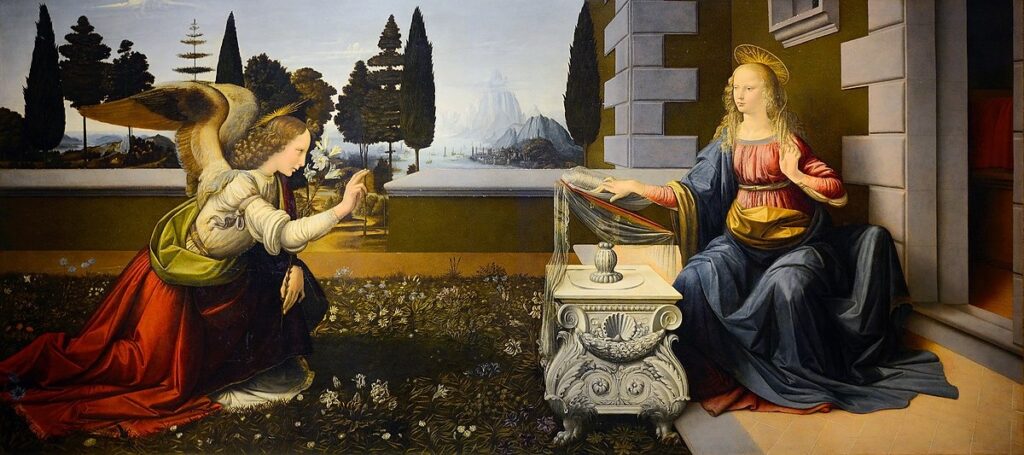
Leonardo consciously departed from the traditional iconography of the Annunciation, setting the scene in a garden outside the Virgin’s house instead of the usual loggia or Mary’s bedroom.
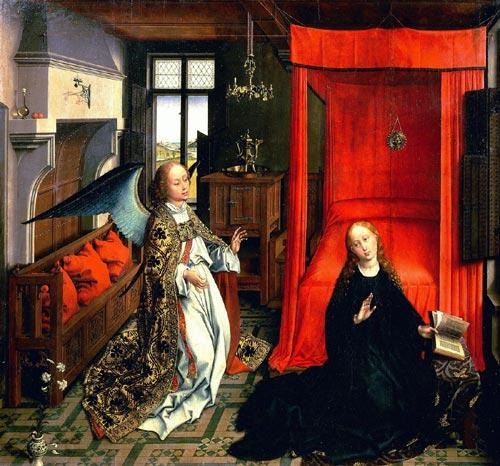
According to medieval tradition, the scene was always set in an enclosed place, at least as far as the Virgin was concerned, so as to include iconographic elements such as the bed, while the Angel could be positioned outside, but in a hortus conclusus, that is, a garden enclosed by high walls alluding to Mary’s womb.
Da Vinci is traditional in other ways, for we do in fact find the same placement of the two figures (Our Lady on the right and the Angel on the left) as, for example, in the Annunciation of Fra Angelico.
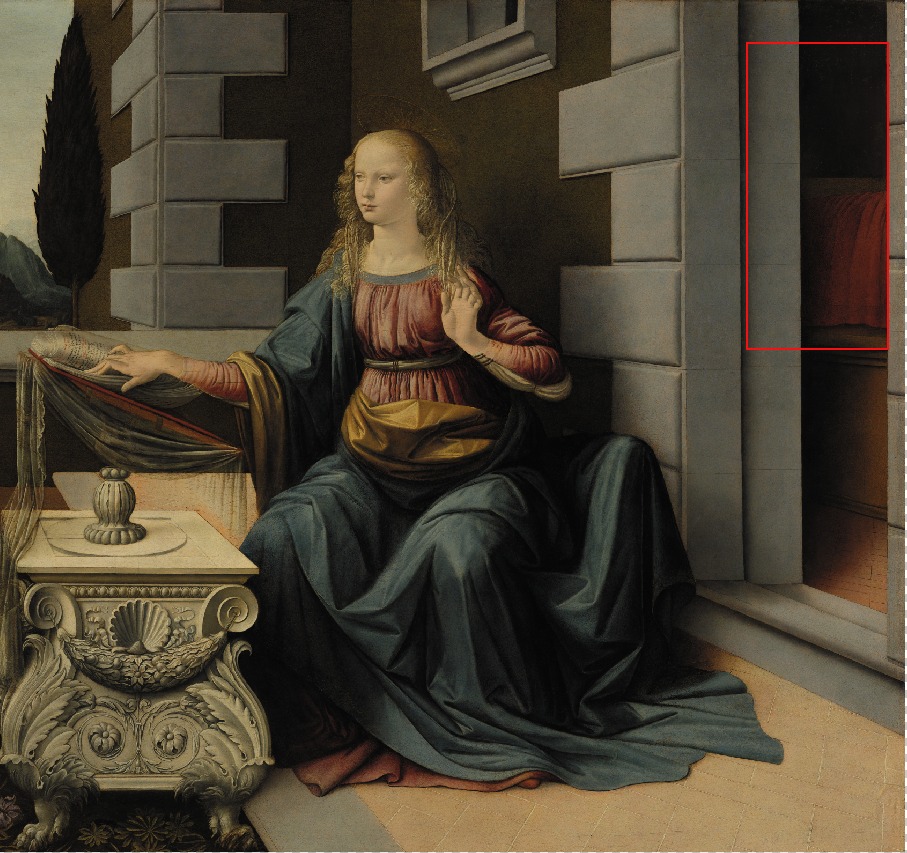
Moreover, to preserve the secrecy of the encounter, Leonardo painted Our Lady at a corner of the building, yet allowed a glimpse of the bed through the doorway. Then a low wall bounds the small garden, though with an opening. The large portion of the scene devoted to nature seems to underline how the miracle of the divine Incarnation involves, together with the human Mary, the whole of creation.
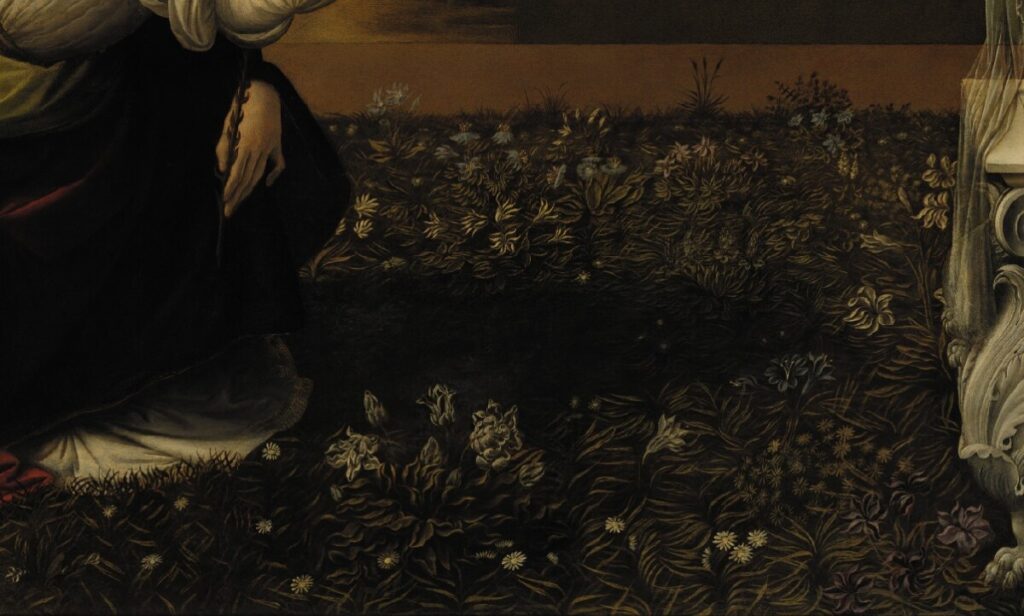
Great attention is given to the botanical description of the flowers and other plant species, both on the lawn and in the background: it is a tribute to the variety and richness of divine creation. The meadow flowers, in particular, appear to have been studied from life, with lenticular precision.
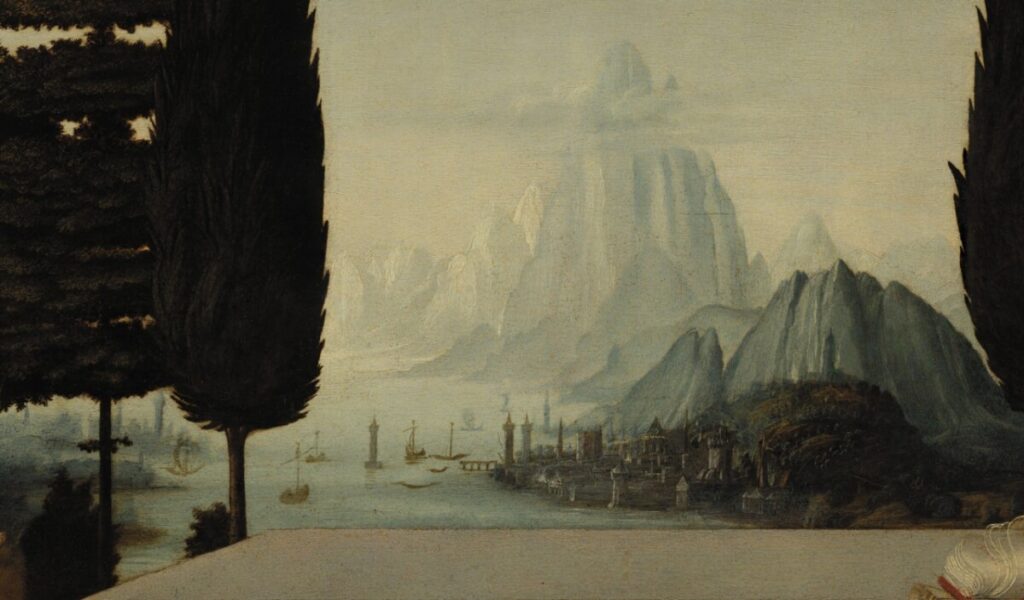
In the background, beyond the wall, one sees a winding river with boats, and mountains dotted with towers and trees. The light is very clear, as if it were morning, and it softens the contours of the figures, foreshadowing the nuance.
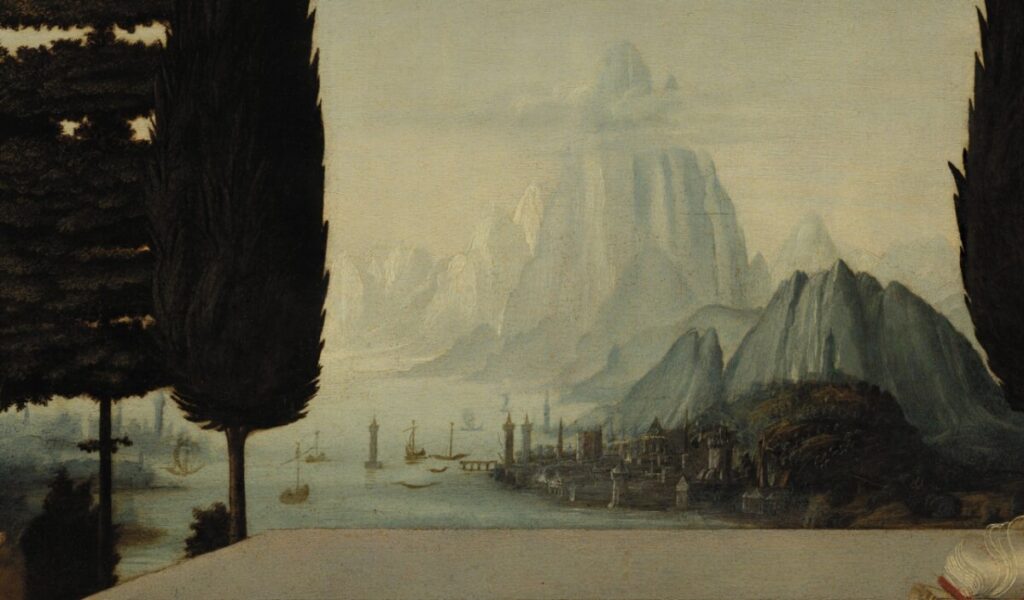
The spatial arrangement, rather than being conveyed by fifteenth-century geometric perspective (which is also present in the ornamentation of the architectural details and in the proportions of the building, the floor, and the lectern, with a vanishing point at the center of the table), is rendered above all through the gradation of colors, especially in the background.
Leonardo used aerial perspective, a technique that gives fainter and more muted coloring to the more distant details, as if they were wrapped in a mist. In fact, he knew that many layers of atmospheric dust lie one upon another between the eye and a distant object, making its edges less sharp and sometimes blurred. Nearby objects, on the other hand, were meticulously portrayed precisely because the closer objects are, the more clearly they can be seen.
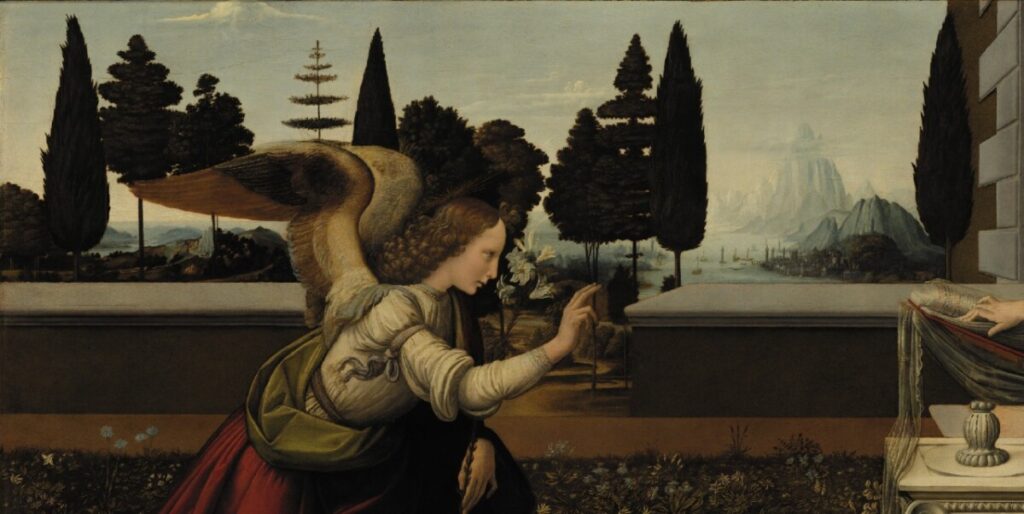
One can tell that this is a youthful work from the fact that the aerial perspective is not rendered gradually; instead, there is a break beyond the nearest trees, very pronounced in relation to the background. Among these trees, the cypresses are arranged like columns and seem to divide the scene mathematically.
The Angel
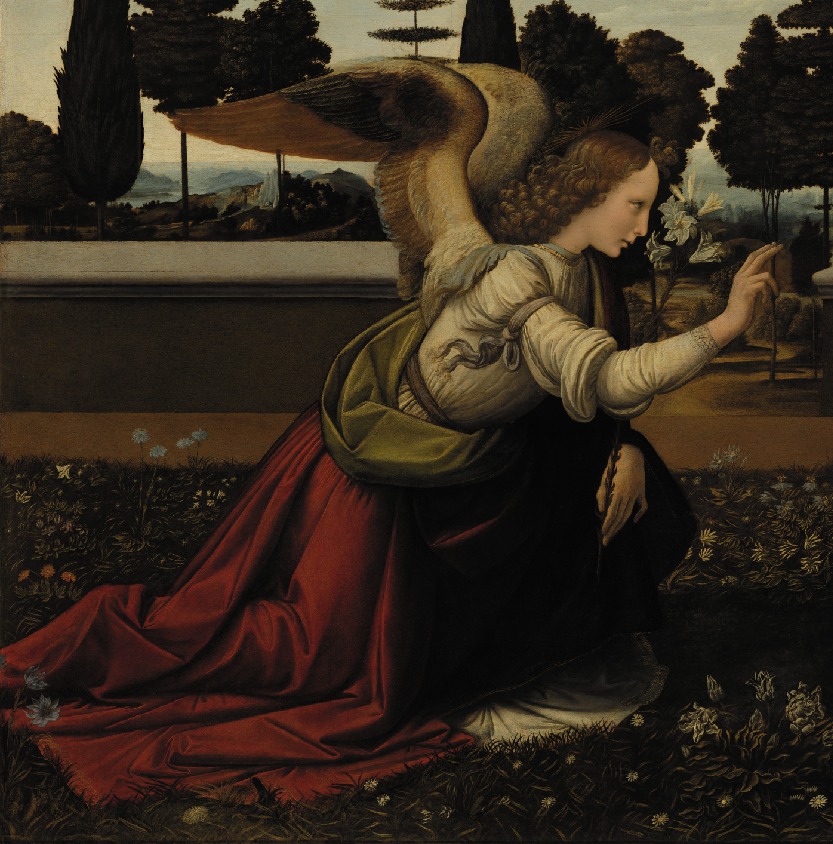
The Angel is portrayed in a classic position, as if he had just glided down with beating wings, shortly before folding them. His garment, however, unlike other examples (such as the Annunciation of Simone Martini), has already fallen completely to the ground and shows its weight on the grass, where one also seems able to perceive the displacement of air caused by the landing.
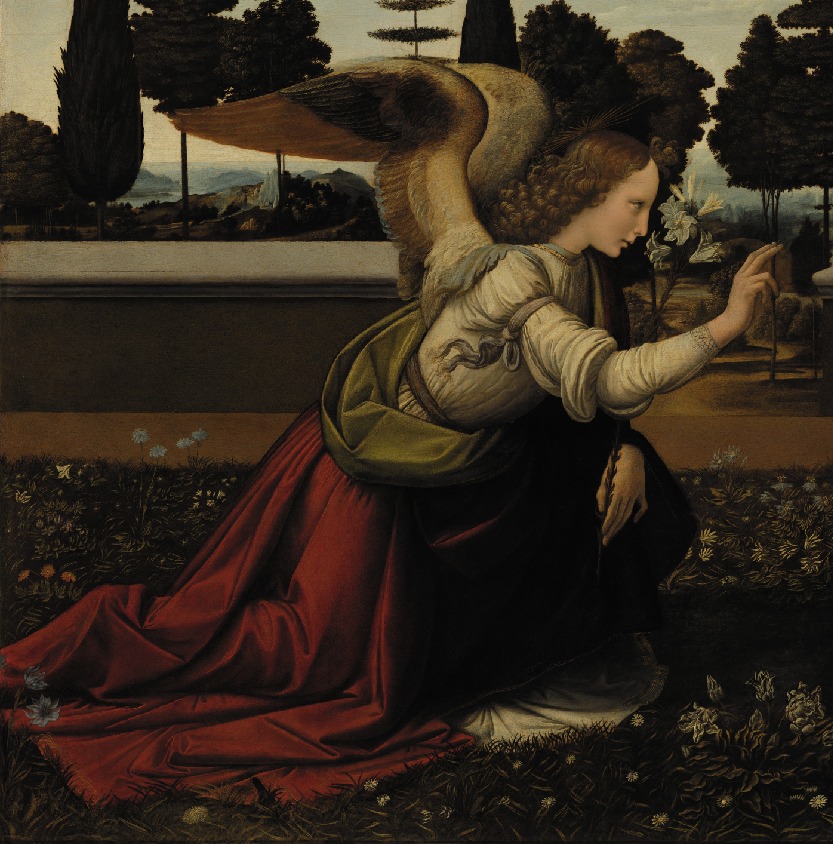
Unlike angels as they are usually depicted, the Angel does not have peacock wings (the peacock being considered a sacred animal and a symbol of immortality), but real bird wings, studied through the anatomy of birds, that is, ornithology.
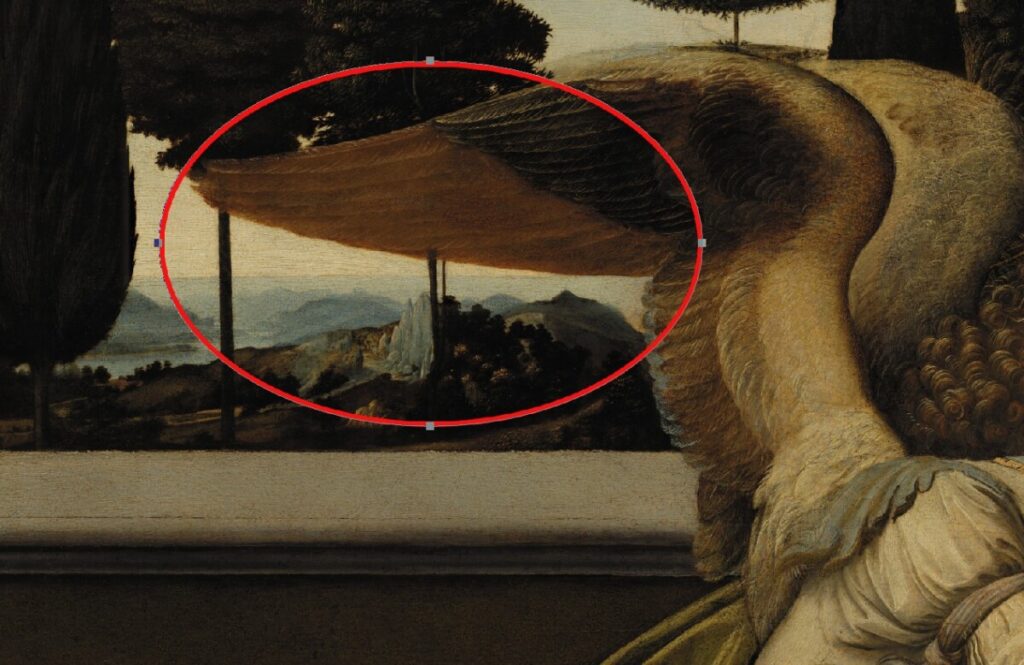
There is, however, a strange anomaly, because the original wings were shorter. Later someone painted an extension, not understanding that Leonardo wanted to represent here the angel who has just landed and is therefore folding his wings. This correction compromised all of Leonardo’s study of birds and his realistic representation of the wing.

The angel presents a lily, emblem of purity and chastity, to the Virgin Mary. The cypress (in the background) is associated with the image of the Virgin Mary, Christ, and the Church, probably because of its characteristic of growing tall toward heaven.
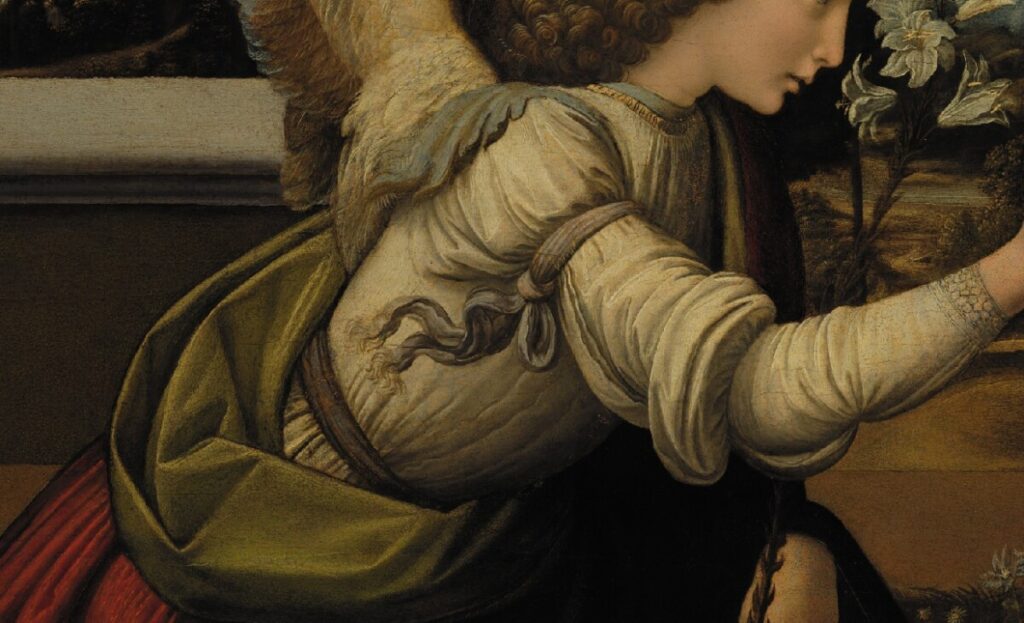
The configuration of the pose is classic Leonardo, considering the drapery with its broad, soft folds. The artist sometimes made clay models of the figures, wrapped them in soft cloths soaked in plaster, and then patiently reproduced the course of the drapery. The position of the hands is natural: the right hand, with the curvature of its fingers, announces the One and Triune God together with the divine and human nature of Jesus, while the left holds the lily, symbol of purity.
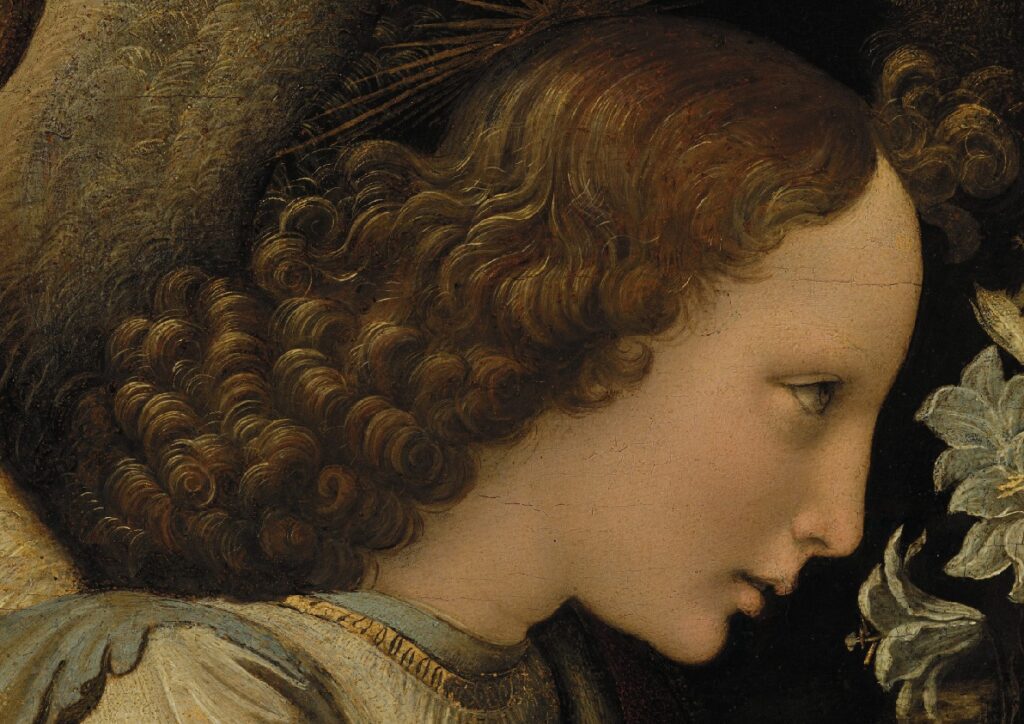
His gaze is fixed on Mary, in the act of announcing.
There is a puzzle concerning the angel’s head: the complexion is pale and flat, and it lacks Leonardo’s classic transparencies. One notices a great difference from the angel in the Baptism of Christ: here the hair does not fade softly but appears as a compact mass of curls, which suggests that it was an assistant who painted the head.
Mary

Leonardo’s Annunciation is certainly one of the best-known works. Much has been written about it, but little has been said about the Mariological question, above all because Mariological analyses of art still lack dissemination today.
This work came into being as one of his first works, when Da Vinci was still in Verrocchio’s workshop. Its original location and commission are unknown. It arrived at the Uffizi Gallery in 1867 from the sacristy of San Bartolomeo a Monteoliveto, outside the San Frediano gate. One can already see the careful attention to atmospheric changes in the landscape that the artist would develop in later works.
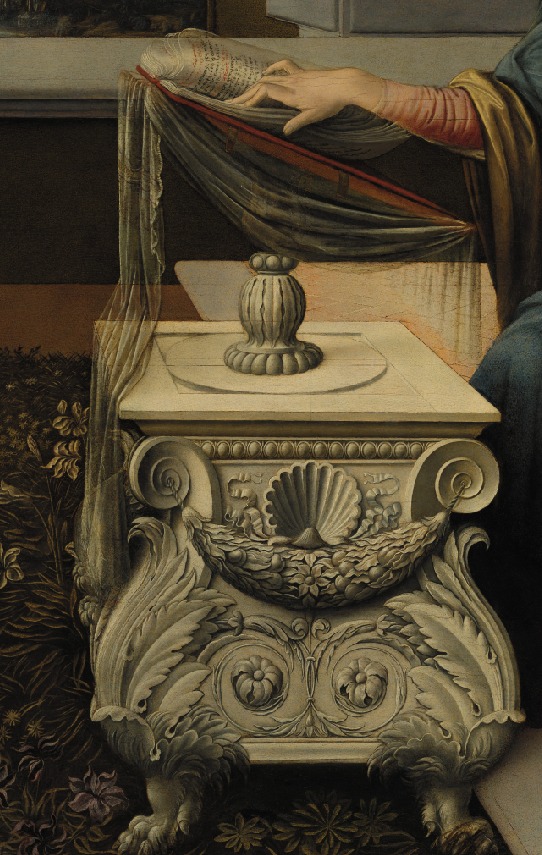
Mary is behind a carved marble altar on which the lectern rests. The altar shows how much Leonardo was influenced by Verrocchio’s teaching: it is decorated with classical motifs that are reflected in a monument by his master, the tomb of Giovanni and Piero de’ Medici in the Old Sacristy of San Lorenzo. Similar, too, are the lion’s-paw supports that develop at the sides into plant elements, spirals, and volutes. Between the upper scrolls, which echo the Ionic order, stretches a festoon of leaves, fruits, and flowers, surmounted by a shell between fluttering ribbons, a symbol of the new Venus, who is Mary, and of eternal beauty. Of great refinement is the semi-transparent veil beneath the book of the Sacred Scriptures that the Virgin was reading, a symbol of the Old Testament prophecies (in this case, in particular, a passage from Isaiah is represented), which are fulfilled through Mary’s act of acceptance.
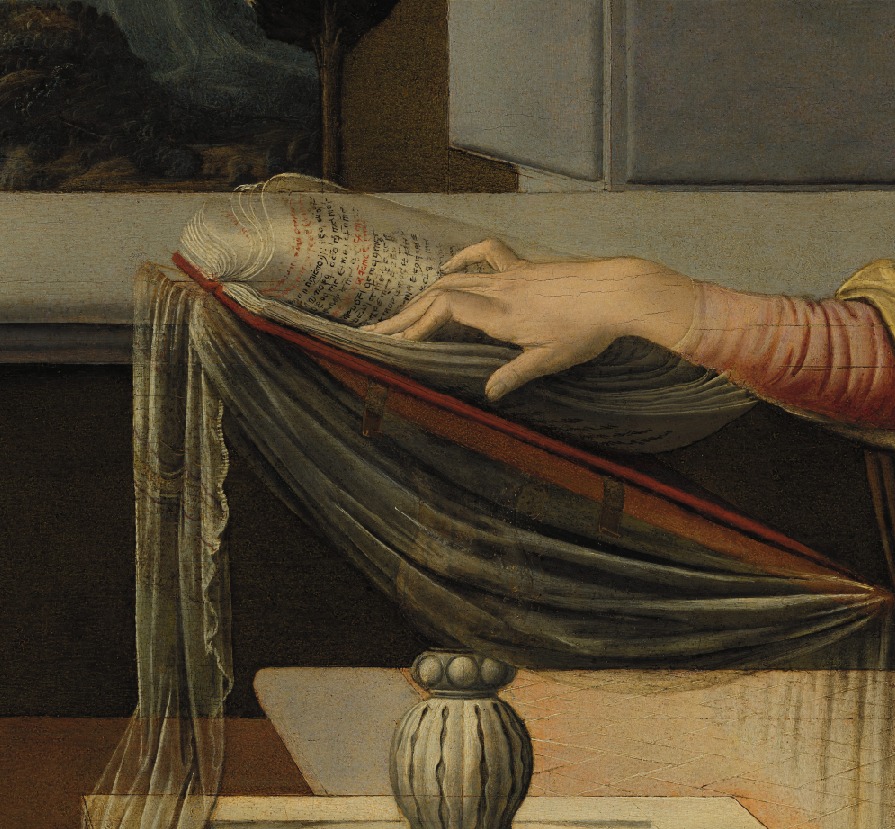
Mary’s right hand rests on the book as if to keep it from closing (perhaps because of the wind caused by the angel), while her left hand is raised as a sign of acceptance of her vocation. The blue mantle that covers her legs is very ample, falling onto the seat as well, which gives a strong sense of plasticity and emphasizes the hidden form of the legs.
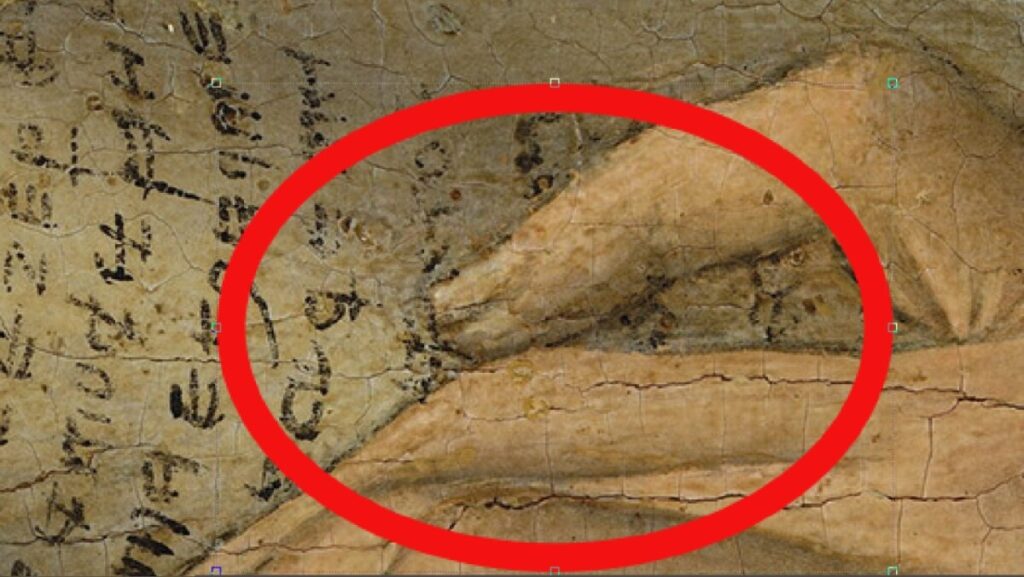
In some places, at very close range, one can find the fingerprints of the twenty-year-old Leonardo, who sometimes blended the paint with his fingertips to obtain effects of nuance and fusion. This technique can be found in the leaves of the festoons at the base of the lectern and in the fingers of the Virgin’s right hand.
Mariological Conclusion
Having contemplated how complex this Annunciation is, we can draw some conclusions regarding the author’s view of the figure of the Virgin Mary.
First, the Virgin is represented not in a bowed humility, with her hands on her breast and turned toward the ground, but in a vision typical of Christian humanism: freely, with her consent. This is a Mariological element that is gaining full citizenship in theology today, in affirming that man, capable of God, is called to give his yes to God freely and responsibly.
Second, the book and the Virgin, or rather, the Word and the Daughter of Israel, offer us a far more prominent overall view of the importance of Scripture in shaping our Mariological interpretation. This is so both through the position of the hand, which indicates continuity before and after the appearance of the angel, and through the memory of Revelation, which prophetically announces the Messiah who now dwells in the Virgin’s womb.
Third, the open space of the garden, no longer a hortus conclusus with high walls underscoring Mary’s perpetual virginity but the horizontal space of human choice that finds its place in God’s action in history, is a re-creation of the Garden of Paradise. In the new creation, the Eden of yesterday becomes today not the place of sin, shame, and repentance, but the center toward which all of history converges. The new Adam dwells in the womb of the Virgin, who is the New Eve, and God becomes present through the divine Messenger, who in the past had been used to expel the human progenitors and who now is found announcing to the new progenitors of the New Creation according to the Spirit.
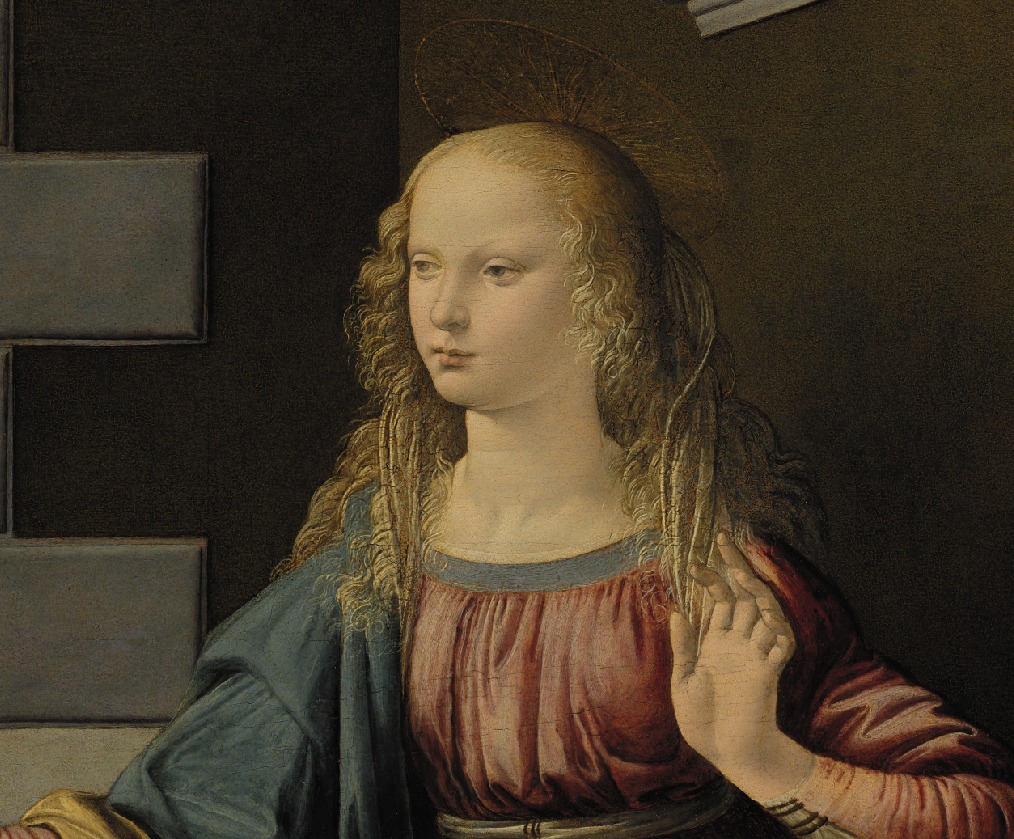
Fourth, we see the Virgin’s face and her hieratic, I would even say majestic, posture. We do not see fear or confusion, but the gaze, along the line of the horizon, of one who offers her consent. Mary does not look at the Angel; she looks into space and offers her consent, in the name of creation and together with creation, to the God who reveals Himself. Possibly, through the position of her hand, she seems to offer her consent to the horizon more than to the angel.
Postgraduate Program in Mariology
Would you like to deepen your formation in Mariology? Discover the Postgraduate Program in Mariology of Locus Mariologicus, an academic formation that unites theological rigor, spiritual life, and the living tradition of the Church.




Responses