Ego sum panis vitae: Mary and the Bread Come Down from Heaven
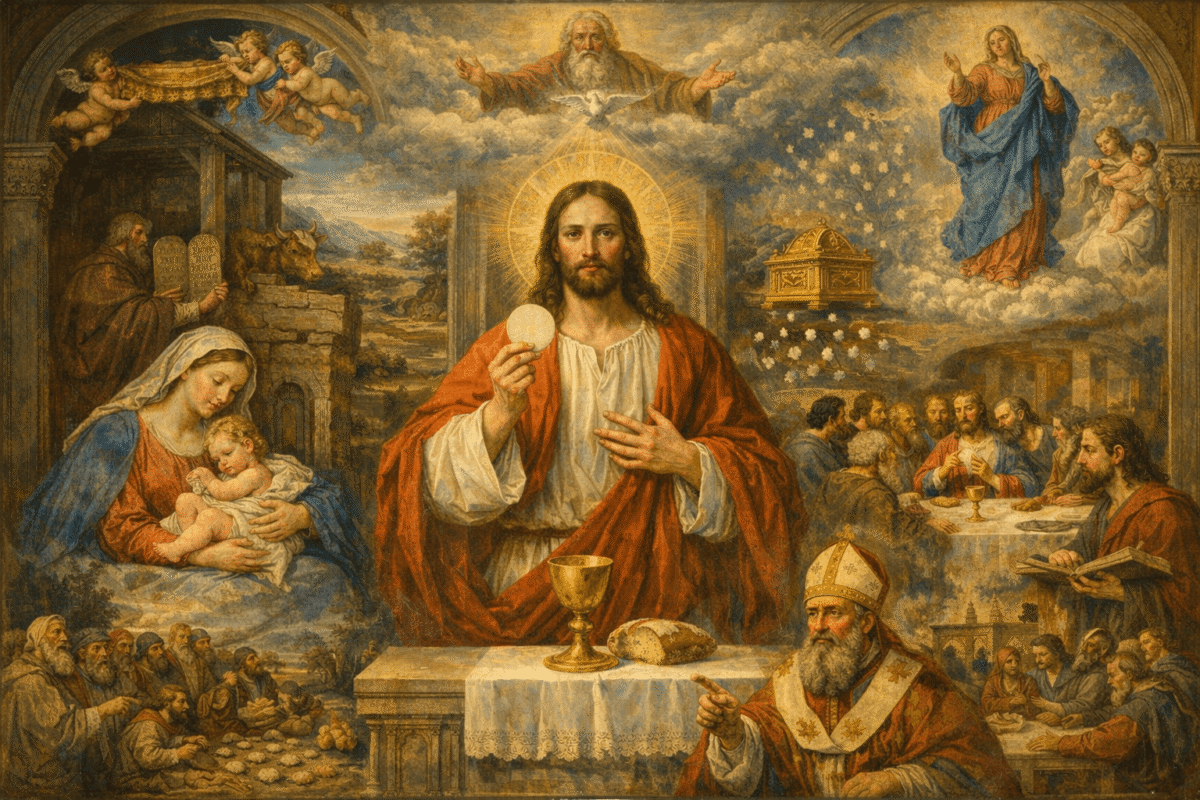
Ego sum panis vitae. Qui venit ad me non esuriet, et qui credit in me non sitiet umquam.
Jn 6:35
The progression of the Bread of Life discourse reaches its first summit in this pericope: “I am the Bread of Life,” the first of the great egō eimi [I am] declarations in the Gospel of John that are accompanied by a predicate. The formula is not merely a metaphor drawn from food; it is a revelation of divine identity (egō eimi echoes the divine Name of Ex 3:14) joined to an offer of total relationship: “whoever comes to me shall not hunger. Whoever believes in me shall not thirst.” Implicit at the heart of this revelation is the maternal mediation of Mary: the Bread that never leaves one hungry is the very body that she formed in her virginal womb and nourished with her mother’s milk.
I. “Bread” as an Incarnational and Eucharistic Category
For Christ to be the “Bread of Life,” He must be bread, that is, edible matter, nourishing substance, a physical reality that can be taken, broken, and distributed. Sacramental theology emphasizes that the Eucharist is wheaten bread. But Christology goes deeper: Eucharistic bread is possible only because the Word assumed human flesh. The flesh of the Son of God did not come down from heaven as a substance already formed, without human mediation; it was formed, over the course of nine months, in the womb of Mary. And it is this flesh, with its precise and historical maternal origin, that the Word offers as food in the Eucharist.
Cyril of Alexandria, in his commentaries on the Gospel of John, formulated this chain with a precision that has never been surpassed: the Father sends the Son (Jn 3:16). The Son assumes flesh from Mary (Lk 1:35). The flesh assumed from Mary becomes the Bread of the Eucharist. Mary’s divine motherhood, dogmatically defined at the Council of Ephesus (AD 431) with the title Theotokos, “Bearer of God,” is the ontological condition of possibility of the Bread of Life. One cannot meditate on the Eucharist without Mary. One cannot contemplate the Bread that comes down from Heaven without recognizing that He came down through a woman’s womb.
The beauty of this connection between the Incarnation and the Eucharist has been captured by Christian art down through the centuries. The iconography of the manger, with the Child Jesus lying in swaddling clothes, offered to our gaze, anticipates the Eucharistic iconography of the Bread broken and distributed. In both cases, there is a “bread” that is presented, broken, and given: in Bethlehem, through the gesture of Mary laying her Son in swaddling clothes; at the Last Supper, through the gesture of Jesus breaking the bread and distributing it. The medieval Fathers, especially Thomas Aquinas and Bonaventure, developed this iconological correspondence as one of the richest in sacramental theology.
The dialogue between Jesus and those speaking with Him in Jn 6:30-34 reveals how difficult it is to understand what the Bread of Life is. They ask for a sign like the manna, “our fathers ate the manna in the wilderness” (Jn 6:31), and Jesus answers that the manna was not the true bread: “It was not Moses who gave you the bread from heaven. It is my Father who gives you the true bread from heaven” (Jn 6:32). The logic of “even better”—not the manna, but the true Bread—is the logic of progressive revelation: the Old Covenant prepared for the New, the manna prepared for the Eucharist, the figures prepared for the reality. Mary, who is a “daughter of Israel” and heir to the promise of the manna, became the mother of the Reality that the manna prefigured.
II. “Whoever Comes to Me”: Mary as the Model of Coming to Christ
“Whoever comes to me shall never hunger.” The movement of “coming to Christ,” erchesthai pros me, describes the fundamental dynamic of Christian faith. It is not merely a movement through space or an external religious gesture: it is a total orientation of one’s being toward the Son of God made man. “Coming to Christ” means recognizing that He is the center, that everything that truly nourishes human existence is found in Him, and that no other source can satisfy the deepest hunger of the human heart, as Augustine put it in unsurpassable words: “You have made us for Yourself, and our heart is restless until it rests in You.”
In the Marian tradition, Mary is the supreme model of this “coming to Christ.” Her whole life was a movement of ever closer approach to the Son: from the fiat of the Annunciation, in which she welcomed the Son into her being, to the contemplative recollection of the Upper Room, by way of the Visitation, the Nativity, the flight into Egypt, the thirty years in Nazareth, Calvary, and the Resurrection. This movement never stopped. It was never interrupted by refusals or deliberate distance. Mary “came to Christ” with a constancy that no other human being has attained, and this constancy is the foundation of her spiritual motherhood: she can lead her children to the Son because she herself never stopped walking toward Him.
The spiritual tradition, from Bernard of Clairvaux to Louis-Marie Grignion de Montfort, has seen in Mary the privileged way to “go to Christ”: ad Iesum per Mariam. This proposal does not contradict Jn 6:35. It is rooted in it. Mary is the door through which the Son of God entered the world: whoever passes through Mary in the opposite direction finds the Son more easily. It is not a matter of an alternative to the direct way to Christ; it is a matter of recognizing that the human path of access to the Son passes, historically and mystically, through the Mother. The Incarnation, the Word who entered through Mary’s womb, continues to resonate in the spiritual life as an invitation to travel the same path that the Word traveled in coming into the world.
In the Treatise on True Devotion, Montfort gave a theological justification for this path: just as God came into the world through Mary, it is normal for men to return to God through Mary. The “normality” of this proposition is not a rigid law, for the Spirit blows where He wills, but it expresses a structural affinity between the Incarnation and the spiritual life: whoever follows the same path that God chose for coming into the world is walking in the same direction in which God moves. And God chose Mary.
III. The “Descent from Heaven” and the Paradox of the Divine Motherhood
Jn 6:33 specifies: “The Bread of God is that which comes down from Heaven and gives life to the world.” The “descent from Heaven” is a central theme of Johannine Christology (cf. Jn 3:13; 6:38, 41, 42, 50, 51, 58): the Son does not have His origin in the world, but in God. He is not born of the will of man, but of the divine initiative. This “descent” is the movement of grace that precedes, and makes possible, every upward human movement of “coming to Christ.”
Mariology contemplates with wonder the paradox of this “descent”: the Son who “comes down from Heaven” comes down through the womb of a creature. The Infinite passes through the finite. The Eternal enters time through the gateway of a human motherhood. This paradox, which the Greek Fathers called kenosis (Phil 2:7), does not diminish the Son: it reveals the greatness of a love that consents to become small in order to reach the small. And it also reveals the greatness of Mary: to be the gateway through which the Infinite came down into the finite is the highest distinction a creature can have.
The theology of the katabasis (descent) is inseparable from the theology of the divine motherhood. Mary is not simply the biological “channel” through which the Son passes without leaving a trace: she is the “place” where the descent takes place, where the eternal becomes temporal, the infinite becomes finite, the spiritual becomes flesh. Post-Ephesine Christian dogmatic theology insisted on this point against every Docetist tendency: the “descent” is real, the flesh is real, the motherhood is real. Jesus did not “seem” to be born of Mary. He was truly born of her, and His humanity is as real as our own. The Eucharist we celebrate is the bread of this real humanity, the real flesh of the Son of the real Virgin.
The mystery of Mary’s divine motherhood, “Theotokos,” was as hard for many to accept in antiquity as it is for many today in the modern age. Nestorius, in the fifth century, rejected the title because it seemed to him “too much”: how can a creature be “Mother [Bearer] of God”? The answer of Cyril and of the Council of Ephesus was simple but radical: because the Son of God is truly the same one who was born of Mary, not a demigod or an inspired man, but the eternal Son of the Father. And if this is so, then Mary is truly “Mother of God,” not of the Father, not of the Trinity, but of the Son who became flesh. This dogmatic definition is the most important in Mariology, and it is also, paradoxically, the most important in Christology.
IV. The Bread That Satisfies Forever: Eschatology and the Assumption
“Shall never hunger… shall never thirst.” Christ’s promise has an unmistakable eschatological dimension: it points to a satisfaction that transcends all fulfillment within history, to a plenitude that does not depend on the circumstances of temporal existence. Eternal life, prefigured in the Eucharist, is definitive communion with the Son, the eternal “eating” of the Bread that came down from Heaven, in a plenitude that will have neither end nor exhaustion.
Mary assumed into heaven, the Mary who already shares, body and soul, in the eschatological fullness, is the image of this promised satisfaction. She who never hungered for what perishes, who never thirsted for worldly glory, who found all her satisfaction in the Son, is now in the condition of one who has already fully received what others still await. Her Assumption is not a private privilege: it is the “firstfruits” (cf. 1 Cor 15:20) of the fullness that awaits the whole risen Church. Mary is the “first harvest” of the Bread of Life that came down from Heaven, the first human creature to reach the perfect satisfaction promised in Jn 6:35.
Contemplating Mary’s Assumption as the full realization of the promise of the Bread of Life has practical implications for the Eucharistic life of the Church. Each Eucharist is a real, not merely symbolic, anticipation of the eschatological satisfaction that Mary’s Assumption prefigures: “whoever eats my flesh and drinks my blood has eternal life, and I will raise him up on the last day” (Jn 6:54). The Eucharist is the link between Baptism, which brings us into the life of Christ, and the Assumption/Resurrection, which brings it to completion. Mary assumed into heaven is the most eloquent proof that the promise “shall never hunger again” is real, and that the Bread of Life is truly the food of eternal life.
In every Eucharist, we receive the same Body that Mary formed in her virginal womb. This awareness, which the liturgy expresses in the Communicantes and Marian devotion expresses in prayers before and after Communion, is not a pietistic detail: it is a theological truth of the first order. The “Bread of Life” has a name, a face, a mother. And the mother who gave Him the flesh in which He gives Himself as Bread continues to intercede so that her children may “come to Him” and “never hunger again.”
The Bread of Life who came down from Heaven took flesh from Mary. In every Eucharist, we receive the same Body that Mary formed in her virginal womb. May this awareness deepen our Eucharistic devotion and our love for Mary, Mother of the Bread of Life, in this Easter season.
Postgraduate Program in Mariology
Would you like to deepen your formation in Mariology? Discover the Postgraduate Program in Mariology at Locus Mariologicus – an academic formation that unites theological rigor, spiritual life, and the living tradition of the Church.
Would you like to study Mariology seriously?
This article grows out of the works in the Locus Mariologicus library. The Postgraduate Program in Mariology takes you to the same source, with academic guidance: Scripture, the Fathers of the Church, and the Magisterium, from the first dogma to contemporary questions.





Responses