Marian art and iconography: the image at the service of dogma
Marian art and iconography: the image at the service of dogma
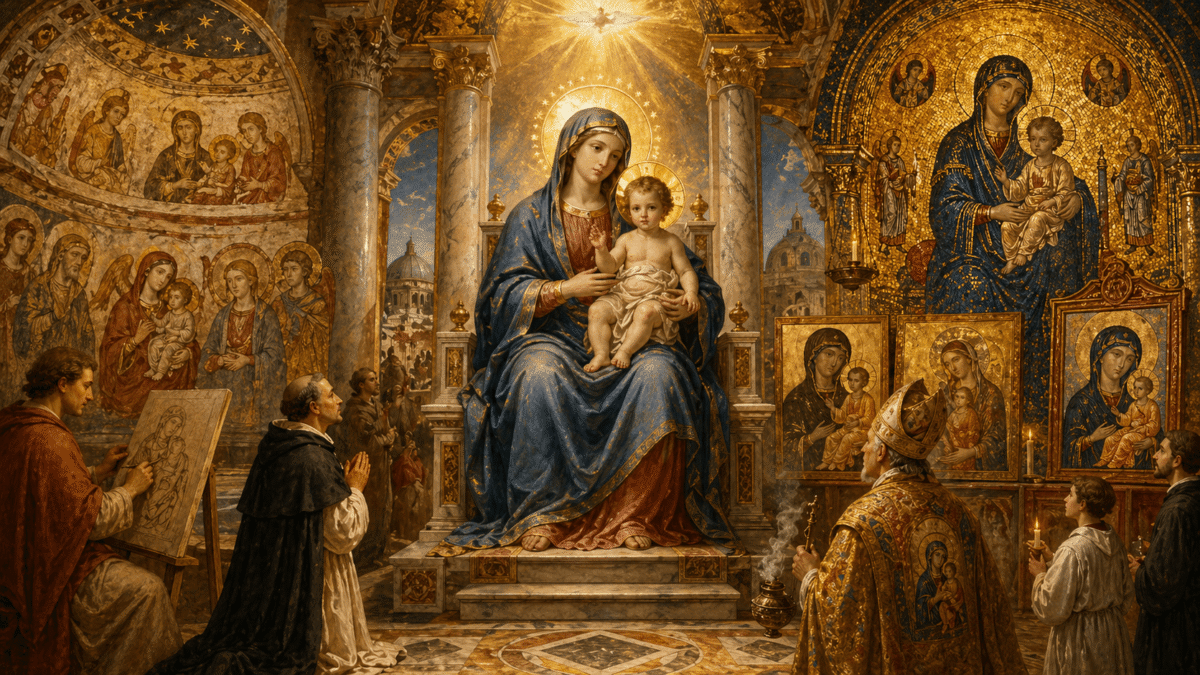
Marian iconography is not merely artistic production; it is theology expressed in images. From the first representations in the Roman catacombs (second century) to contemporary art, the image of Mary has served as a place of confession of faith, visual catechesis, and expression of popular devotion. For Mariology, to study Marian art is to study the way in which the Church, in every age, understood and celebrated the mystery of the Mother of God.
The catacombs: the first images of Mary
The oldest Marian images appear in the funerary art of the Roman catacombs. The catacomb of Priscilla preserves, probably from the second century, the oldest known representation of Mary with the child Jesus, accompanied by a prophet (Balaam or Isaiah) who points to the messianic star (Num 24:17). In this period, Marian iconography is entirely subordinate to the mystery of the Incarnation: Mary appears as the Virgin who conceived and gave birth to the Messiah, according to the oracle of Isaiah (Is 7:14).
After the Council of Ephesus (431): “triumphal art”
The dogmatic definition of the Theotokos at the Council of Ephesus (431) gave an extraordinary impulse to Marian art. Churches dedicated to Mary and iconographic programs centered on her figure multiplied. The mosaics of the triumphal arch of the Basilica of Saint Mary Major in Rome (432-440), commissioned by Pope Sixtus III, are the most sublime example of this theological art: Mary appears clothed as a Byzantine empress (basilissa), type of the Church, while she presents to the world the incarnate Word of God. Scenes inspired by the Protoevangelium of James (Annunciation, Adoration of the Magi) complete the iconographic program.
The great iconographic types
The Christian tradition developed several distinct iconographic types, each one expressing a specific theological dimension. The Hodigitria (“she who points out the Way”), attributed to Saint Luke, represents Mary facing forward, with the Child on her left arm, while with her right hand she points to the Son: Mary is the mediatrix who leads to Christ. The Eleusa (“the Merciful One”) shows the tenderness between mother and son, their faces touching. The Basilissa (Virgin Queen) presents Mary enthroned with the Child, surrounded by angels, as type of the Church in glory.
Iconoclasm and the defense of images
The iconoclast crisis (eighth-ninth century) was paradoxically a moment of theological deepening concerning the sacred image. The defenders of images (iconodules) argued that to forbid the image of Christ was equivalent to denying the Incarnation: if the Word became flesh, He can be represented. The Second Council of Nicaea (787) defined the legitimacy of the cult of images. In this context, the image of the Theotokos became a Christological bulwark: to venerate the Mother of God in an image was to affirm that God had really become incarnate in her womb.
From the Renaissance to contemporary art
The Italian Renaissance introduced a new sensibility: the humanity of Mary and the tenderness of the mother-son relationship became the center of the compositions. Raphael, Leonardo, Michelangelo, and Titian created Marian images that have remained a reference point of Western culture. The Counter-Reformation (sixteenth-seventeenth century) used Marian art as an apologetic instrument against Protestant criticisms, underscoring the greatness and the intercession of Mary. Contemporary art continues to question the Marian mystery in new languages, without losing its theological substance.
Deepen your studies: explore Mariology, Mother of God, Marian apocrypha, and the Postgraduate Program in Mariology.
Magisterium of the Church
Imagines Beatae Mariae Virginis quae in Ecclesia coluntur, exhibent ipsam Matrem, quae filios suos ad Filium ducit.
Second Vatican Council, Const. Sacrosanctum Concilium, n. 125 (4 decembris 1963)
📚 Literal translation: The images of the Blessed Virgin Mary that are venerated in the Church show the Mother herself, who leads her children to the Son.
Postgraduate Program in Mariology
Would you like to deepen your formation in Mariology? Discover the Postgraduate Program in Mariology of Locus Mariologicus – an academic formation that unites theological rigor, spiritual life, and the living tradition of the Church.
Discover the oldest Marian image in the Catacomb of Priscilla.
Would you like to study Mariology seriously?
This article grows out of the works in the Locus Mariologicus library. The Postgraduate Program in Mariology takes you to the same source, with academic guidance: Scripture, the Fathers of the Church, and the Magisterium, from the first dogma to contemporary questions.




Responses