Under Your Protection

The origins of Marian devotion before the Council of Ephesus (431) and the role of early veneration in Scripture
According to a widespread prejudice, the veneration of Mary supposedly began only with the Council of Ephesus in 431, when Mary was defined as “Mother of God” for all the faithful. Dogmas, however, are by no means innovations of creative theologians or popes; rather, they are the Magisterium’s confirmation of what the Church has always believed. Thus even the last two Marian dogmas are based on theological reflections and traditions from the first centuries.
The continuity of Marian devotion: Ratzinger, Daughter Zion, and the testimony of Luke (Lk 1:48 and Lk 11:27-28)
In reality, Marian devotion is as old as the Church. Even Joseph Ratzinger, in his book on Mary, Daughter Zion, recalls that “it is the Gospel that prophesies and calls for the veneration of Mary: ‘Behold, from now on all generations will call me blessed’ (Lk 1:48). This is a duty of the Church. The words Luke wrote about this presuppose that the praise of Mary already existed in the Church of his time and that he regarded it as a duty of the Church for all future generations.” At the same time, Luke presents Elizabeth to us as the first to sing the praises of Mary. In Ain Karim, filled with the Holy Spirit, as the evangelist explicitly notes, she exclaims: “Blessed are you among women,” and calls the young virgin, her kinswoman, “Mother of my Lord” (Lk 1:42-43). If we consider that for a devout Jewish woman there was only one Lord, namely God, then we see how the first Marian title, God-bearer or Mother of God, finds its true origin here.
In other passages too, Luke presents traces of an ancient Marian veneration, as when he quotes the words of a woman in the crowd who exclaims: “Blessed is the womb that bore you, and the breasts that nursed you!” (Lk 11:27). Jesus’ reaction is not harsh, but He sets against the biological, everyday aspect something different, which is what made Mary truly unique: her obedience, her unconditional readiness for the Fiat: “Rather, blessed are those who hear the word of God and keep it” (Lk 11:27-28).
Paul and Mary’s decisive role: the Dormition (AD 48) and the first apostolic testimonies to Marian veneration
Among the first witnesses to the veneration of Mary is also Paul, who may have been present at the Dormition of the Mother of God when, in AD 48, he took part in the ‘Council’ of the Apostles in Jerusalem. Shortly afterward, probably the following year, he composed the Letter to the Galatians, which theologians regard as the oldest Christian writing about Mary. Here, in his brief presentation of salvation history, Paul reserves a decisive role for Mary: “when the fullness of time had come, God sent his Son, born of woman, born under the Law” (Gal 4:4).
Mary in the Apocalypse of John: Rev 12 and the personification of the true Israel in the vision of Patmos (c. AD 95)
The last book of the New Testament, the Apocalypse of John, presents the apotheosis of Mary. Now she is not only the handmaid of Nazareth and the Mother of the Lord, but the personification of the true Israel, in which the People of God of the Old and the New Covenant (that is, Israel and the Church) are one and the same. As such, she becomes an apocalyptic sign, the sign in heaven: “Then a great sign appeared in heaven: a woman clothed with the sun, with the moon under her feet, and on her head a crown of twelve stars. She was with child and cried out in her pangs of birth, in torment to give birth” (Rev 12:1-2). Then she stands against the dragon that threatens to devour her child. Finally, “the dragon was furious with the woman and went off to make war on the rest of her offspring, those who keep the commandments of God and hold the testimony of Jesus” (Rev 12:17).
John, who wrote down his visions on the island of Patmos around the year 95, links directly to the book of the prophet Daniel, taking up its images. After all, Jerusalem had been destroyed by Titus twenty-five years earlier. It was precisely at that moment that the saints were delivered for a time, two times, and half a time into the hands of the king who succeeded the ten kings who arose out of that kingdom, as is said in Daniel. Yet at that time the judgment did not take place, nor was the power taken away from that king, who was not even completely destroyed and eliminated, as foretold in chapter VII of the prophetic book.
The parousia, that is, the return of Christ, so eagerly awaited by Christians, was delayed. Was Daniel wrong? Were “the kingdom, the power, and the greatness of the kingdoms under heaven” perhaps not being given “to the people of the saints of the Most High”? John was able to interpret the prophet’s images correctly. He still had in his ears the words of Jesus: “My kingdom is not of this world” (Jn 18:36). Even if the old Israel had been severely struck, even if Herod’s temple lay in ruins, the new Israel, the Church, despite all her tribulations, appeared radiant and victorious, like the woman of his vision.
The destruction of Jerusalem had further hastened the Church’s cutting of the umbilical cord and her opening to the whole world. The Gospel was being proclaimed from Spain to India, from Germany to Ethiopia, and therefore on all three continents of the world known at the time. There was no persecution, however fierce, nor any emperor, however furious and diabolical, that could halt this journey.
In the end, what the prophet had foretold was fulfilled for the new Israel, the Church: “his kingdom shall be everlasting, and all empires shall serve and obey him” (Dan 7:27). With the Apocalypse of John, the disciple whom Jesus loved and the son entrusted to Mary, Mariology definitively became ecclesiology, a reflection on the nature of the Church. From that moment on, the faithful, especially in times of persecution, placed themselves under the protection of the mantle of the Mother of God, which was also their own.
Testimonies to Marian devotion in Rome: the Catacombs of Prisca on the Via Salaria and early Christian art
Anyone who wants to get an idea of how deep the veneration of Mary was among the first Christians need do no more than go to Rome. There, north of the Eternal City, near the Via Salaria, lies one of the oldest catacombs. It bears the name of its founder, Prisca, who in a funerary inscription is presented as the wife of Manlius Acilius Verus and clarissima femina (illustrious woman), an honorific title that in ancient Rome was reserved solely for those who belonged to a senatorial family.

Marian devotion in the Catacombs of Prisca: Flavius Cimento, Domitian, and the persecution of Christians (first to second century)
According to the Roman historian Suetonius, during the reign of the Emperor Domitian her husband’s family was accused of attempting to introduce novelties, probably a reference to Christianity. Around the middle of the second century, Prisca donated a plot of her family’s land to the Roman Church, which built there a coemeterium, an underground burial place, which is precisely this catacomb. It remained in use until the sixth century; seven popes and many martyrs from the times of the persecutions found their final resting place there.

The Marian frescoes of the Catacombs of Prisca: the oldest pictorial representations of Mary with the Child
But what makes the Catacombs of Priscilla even more interesting are their frescoes, which are among the oldest evidence of Christian art. One of the most beautiful shows Mary holding the Child Jesus on her lap. It dates from the first years of the third century. In front of her stands Balaam, seer and prophet of the time of the Exodus, pointing with his right hand to a star. It is the star of the Messiah, the star he announced, the star of Bethlehem, the supernova of 5 BC. Mary is seated, wearing a long-sleeved stola and a coif that covers her head, leaning toward the baby with maternal tenderness. It is a very well-known image, copied by thousands of artists, which has become a symbol of early Christianity.
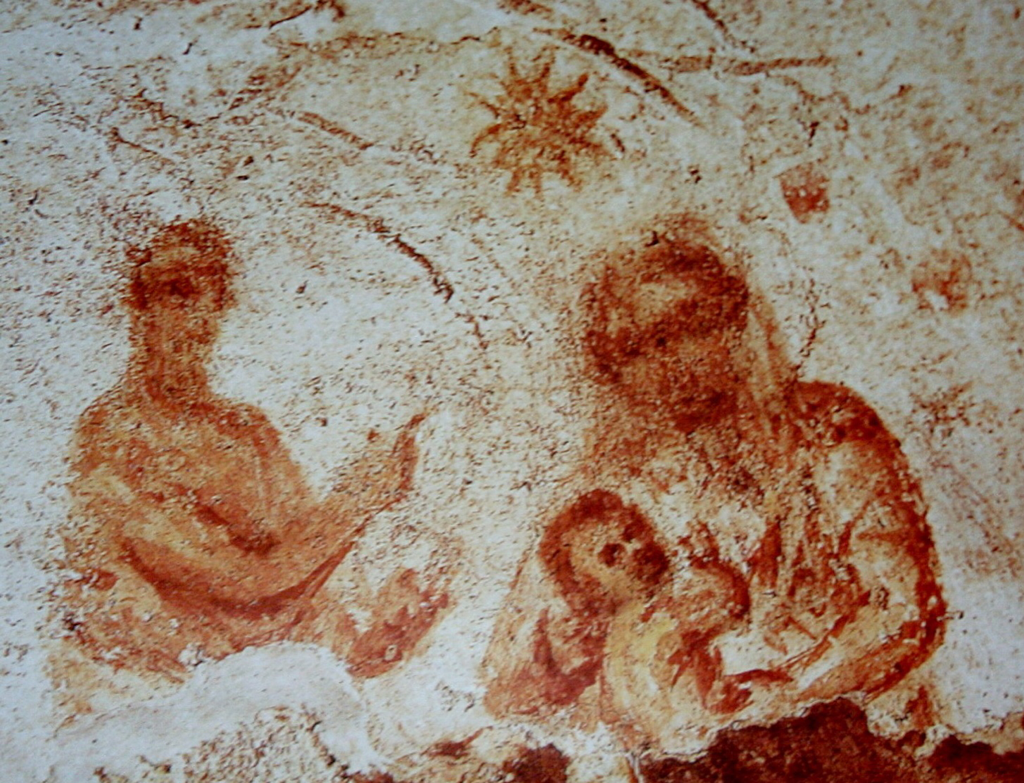
The Greek Chapel in the Catacombs of Priscilla: Greek inscriptions and Marian scenes among the oldest in Christian art
Continuing through a few rooms, one reaches what is perhaps the most beautiful place in the entire ancient cemetery, the Greek Chapel, which owes its name to two Greek inscriptions. Its rich decorations depict the most significant moments of salvation history, including the sacrifice of Abraham and the prophets Moses and Daniel, but also Christians gathered for the Eucharistic Supper. The main motif depicted at the center of the vault, however, is the scene most familiar to us. It again shows Mary with the child in her arms, this time during the adoration of the Magi, who are recognizable by their Phrygian caps. Although the colors are somewhat faded and many details have disappeared, the image is highly significant. The fresco, in fact, dates beyond any shadow of doubt from the second half of the second century, and is thus the oldest Marian representation in the world.
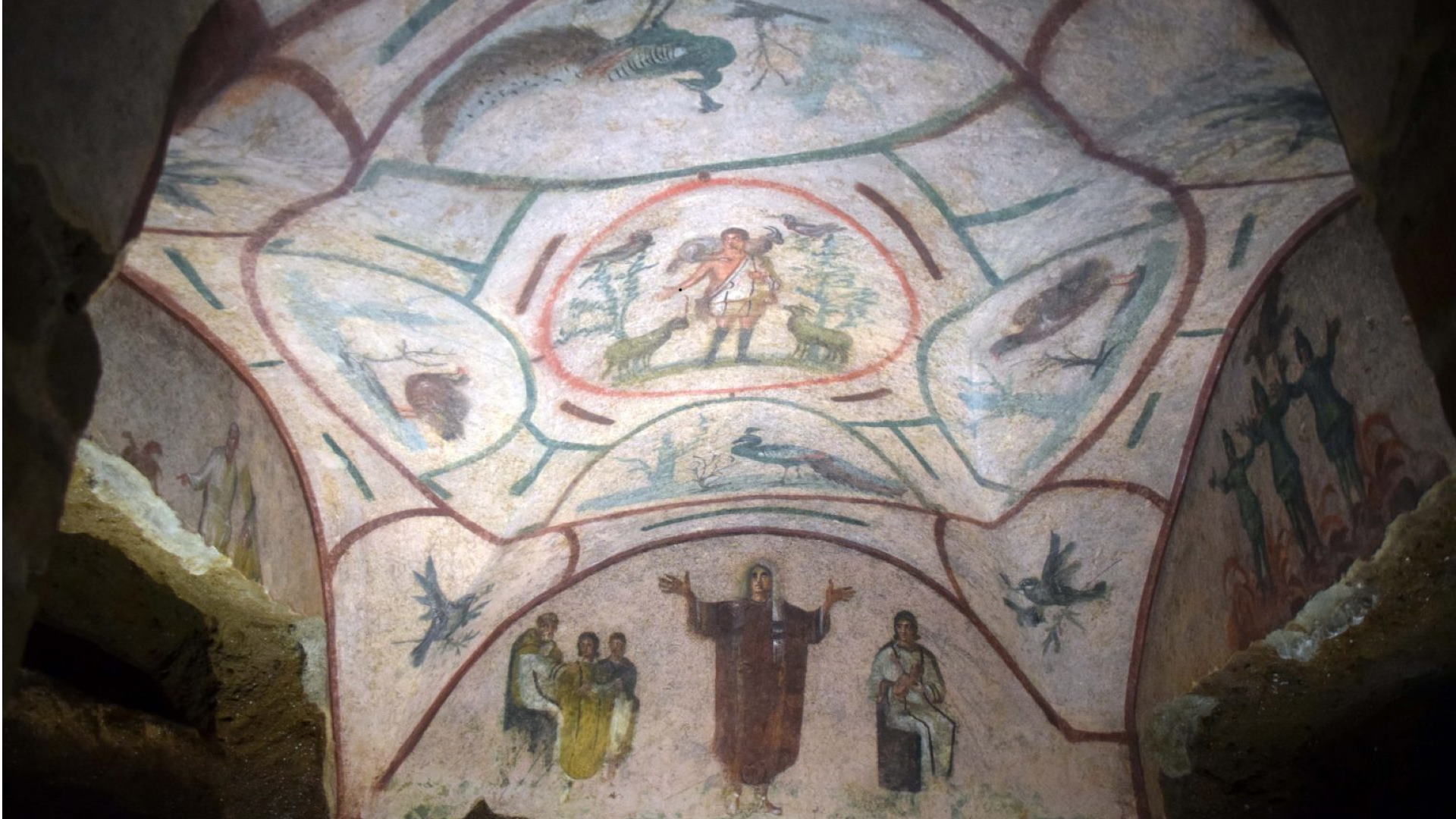
Mary in early Christian iconography: from the praying Virgin to Marian representations in the 2nd-3rd centuries
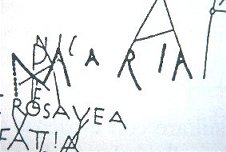
The fact that even today, after thousands of years, almost everyone instantly recognizes this motif says a great deal about the continuity of Christian art. But even more than this depiction of Mary as mother, what was common among the first Christians of the catacombs was the depiction of Mary in prayer, following the image, common at the time, of the orant with raised hands, as in the iconic Advocata. Even then, people trusted in the power of her intercession. It is not surprising, therefore, that even the graffiti wall beside the tomb of Peter, over which Constantine built the great Roman basilica before it gave way to the Renaissance basilica of Michelangelo, contains invocations to the Mother of God, carved into it by the Christians of the third century. Even then, they addressed her with the Greek invocation nika or the Latin vince, which mean conquer, and venerated her together with Christ.
The papyrus of the sub tuum praesidium: its discovery in Egypt (1917) and the oldest Marian prayer in the Greek language
Evidence of an entirely different kind for the Marian devotion of the first Christians was discovered in Egypt in 1917. It is a short prayer in Greek written on a papyrus that had been left in the tomb of a deceased person. Under the name Papyrus 470, it ended up in a renowned British collection, the John Rylands Library in Manchester, and was first published in 1938. Papyrologists dated it to the first half of the third century, which is sensational.

Sub tuum praesidium: the oldest Marian antiphon as a common prayer of the Greek Orthodox and Roman Catholic Churches
In fact, this prayer is still recited today as a Marian antiphon in both the Greek Orthodox Church and the Roman Catholic Church. Here it is known by the name Sub tuum praesidium, from its opening Latin words. In English, it is commonly recited in this version: “We fly to thy patronage, O holy Mother of God; despise not our petitions in our necessities, but deliver us always from all dangers, O glorious and blessed Virgin.” This is a translation of the original text of the papyrus: “Under your mercy we take refuge, Mother of God. Do not reject our supplication in the time of need, but save us from danger, you who are pure and blessed.”
The title Theotokos before Ephesus (431): from the third-century Coptic papyrus to the Synod of Antioch (324/325) and the Cappadocian Fathers
Until now, it was believed that the title “Mother of God,” found in the declaration of the Council of Ephesus, went back to the Cappadocian Fathers of the fourth century or to the Synod of Antioch of 324/5. For this reason, some zealous theologians tried to date the papyrus differently. It was said that it could only be from the second half of the fourth century, or perhaps from a later period. The papyrologists, however, objected: their dating is beyond doubt. Thus, the current opinion is that the prayer dates back to the persecution under Septimius Severus (after 202) or under Decius (250). But it could be even older!
This, the oldest of the prayers to Mary, is also the most beautiful. It bears witness to the trust that Christians of every age have always placed in the intercession of the Mother of God. This was the faith that sustained them in times of need and persecution, a faith in which they were always confirmed by so many answered prayers, for Mary never abandoned them. She has always been our Mother and will be for all eternity!
The prayer Sub tuum praesidium is considered the oldest known Marian prayer. Its value is recognized in Paul VI’s document on Marian devotion, Marialis Cultus.
Postgraduate Program in Mariology
Would you like to deepen your formation in Mariology? Discover the Postgraduate Program in Mariology at Locus Mariologicus — an academic formation that unites theological rigor, spiritual life, and the living tradition of the Church.




Responses