Marian Dogmas: The Four Dogmas of Faith about Mary
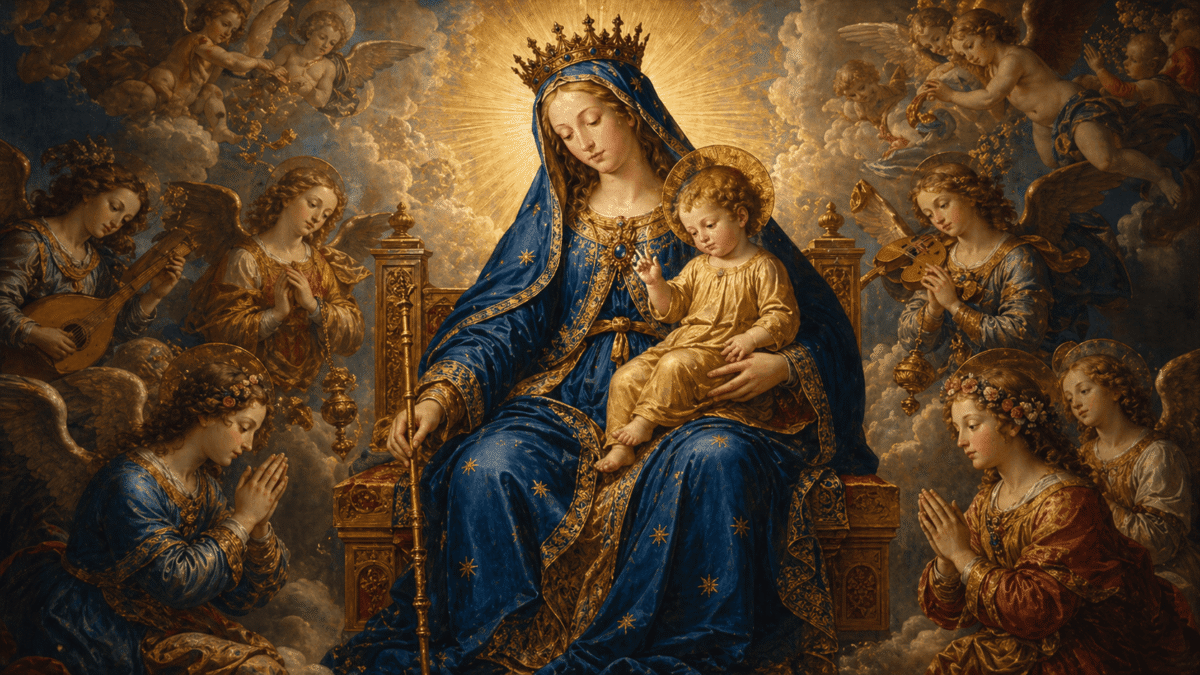
# Dogmas marianos: os quatro dogmas da fé sobre Maria
A Igreja Católica possui quatro dogmas marianos: a maternidade divina, a virgindade perpétua, a Imaculada Conceição e a Assunção. Estes dogmas são fundamentais para a teologia católica e a compreensão da figura de Maria.
## Resumo
– **Maternidade Divina**: O Concílio de Éfeso (431) declarou Maria como *Theotokos*, “Mãe de Deus”, enfatizando sua função como mãe não apenas da natureza humana de Jesus, mas de Sua Pessoa divina.
– **Virgindade Perpétua**: Definida no Sínodo de Latrão (649), afirma-se que Maria manteve sua virgindade antes, durante e após o nascimento de Jesus.
– **Imaculada Conceição**: A bula papal *Ineffabilis Deus* (1854) proclamou a Imaculada Conceição, afirmando que Maria foi concebida sem o pecado original em previsão dos méritos de Cristo.
– **Assunção**: A Constituição *Munificentissimus Deus* (1950) estabeleceu a Assunção de Maria como um dogma de fé, significando sua ascensão corporal ao céu após sua morte.
## Maternidade Divina (Éfeso, 431)
O Concílio de Éfeso abordou a questão da natureza divina e humana de Jesus Cristo e da função de Maria nisso. A definição de *Theotokos* significa que Maria é a Mãe de Deus, reconhecendo sua participação única na divindade de Cristo. Este dogma enfatiza a unidade de pessoa em Cristo, onde Maria é mãe tanto da Sua natureza humana quanto da Sua Pessoa divina. O Concílio de Calcedônia (451) reforçou esta visão ao afirmar que Cristo foi gerado do Pai antes dos séculos segundo a divindade e, nestes últimos tempos, nascido de Maria Virgem e Mãe de Deus segundo a humanidade.
## Virgindade Perpétua
O Sínodo de Latrão, sob o Papa Martinho I, declarou a virgindade perpétua de Maria, afirmando que ela permaneceu virgem antes, durante e após o nascimento de Jesus. Esta crença destaca a integridade e a pureza de Maria, bem como sua dedicação exclusiva ao serviço divino.
(Nota: O texto original contém links e formatação HTML que não foram reproduzidos nesta tradução.)
The Church professes Mary’s virginity *ante partum, in partu, and post partum* (Paul IV, DS 1880). The virginal conception of Jesus is explicitly affirmed in Mt 1:18-25 and Lk 1:26-38. The Council of Constantinople II (553) first recognized perpetual virginity in an ecumenical council (DS 422). Virginity is not merely a biological fact but a theological sign: “the novelty of the kingdom of God,” demonstrating that salvation is God’s sovereign initiative, not a human work.
## Immaculate Conception (Pius IX, 1854)
Defined by Pius IX on December 8, 1854, this dogma states that Mary “in the first instant of her conception was preserved immaculate from all stain of original sin, through a singular privilege of grace from God Almighty, in view of the merits of Jesus Christ” (DS 2803). The dogma does not exclude Mary from human nature; she belongs to Adam’s lineage and would have been affected by original sin if God had not preserved her through Christ’s redeeming merits. Preservation is, therefore, a form of anticipatory redemption, more perfect rather than less.
## Assumption (Pius XII, 1950)
Defined by Pius XII on November 1, 1950, this dogma states that Mary “after the completion of her earthly life, was assumed in body and soul into heavenly glory” (DS 3903). The definition takes no position on whether Mary died or not. The term “Assumption” does not imply a change of location but a change of state: the anticipatory glorification of Mary’s body is the state in which the just will be after the final resurrection. The Assumption is thus the “accomplished eschatology” of Mary, an image of the destiny of the whole Church.
## Characteristics of Marian Dogmas
Marian dogmas have two fundamental characteristics: first, they are embedded in the central mystery of Christianity; they are not peripheral truths but necessary corollaries of Christology and Soteriology. Second, they have a cultic-liturgical character; the *lex orandi* (law of prayer) preceded and nurtured the *lex credendi* (law of faith). The feasts of August 15 and December 8 were historically expressions of the Christian people’s faith before formal dogmatic definitions. Marian devotion was thus the laboratory where the dogmas matured.
**Deepen your studies:** explore Mariology, Mother of God, Marian Theology, and a Postgraduate Degree in Mariology.**
—
## Church Magisterium
> Four dogmas have been defined regarding the Blessed Virgin Mary: Divine Maternity (Ephesus, 431), Perpetual Virginity (Latrans, 649), Immaculate Conception (1854), and Assumption (1950). (Cf. H. Denzinger, P. Hünermann, *Enchiridion Symbolorum*, nos. 252, 503, 2803, 3903)
# Four Dogmas Defined Regarding the Blessed Virgin Mary:
## Translation:
Four dogmas have been solemnly defined regarding the Blessed Virgin Mary: Divine Maternity (Ephesus, 431), Perpetual Virginity (Latrán, 649), Immaculate Conception (1854), and Assumption (1950).
## Frequently Asked Questions about Marian Dogmas
### How many Marian dogmas are there in the Catholic Church?
There are four solemnly defined Marian dogmas: Divine Maternity (Theotókos), Perpetual Virginity, Immaculate Conception, and Assumption. Each belongs to the deposit of faith, and denying them is equivalent to formal heresy. Other Marian truths (mediation, co-redemption) have not yet been dogmatically defined.
### What is the difference between a dogma and a Marian doctrine?
A dogma is a revealed truth defined by the Church with infallible authority, binding on all believers. A doctrine is an authorized teaching from the Church, without reaching the supreme degree of definition. Every dogmatic truth is a doctrine, but not every doctrine has been elevated to the status of a dogma.
### In what documents were the Marian dogmas defined?
– Theotókos at the Council of Ephesus (431, DS 251)
– Perpetual Virginity at the Synod of Latrán (649) and Second Council of Constantinople (553)
– Immaculate Conception in the bull *Ineffabilis Deus* of Pius IX (1854)
– Assumption in the Apostolic Constitution *Munificentissimus Deus* of Pius XII (1950).
### Do Marian dogmas contradict Scripture?
No. The Church teaches that all Marian dogmas are contained implicitly or explicitly in Scripture and apostolic tradition. The dogmatic definition explicitly articulates doctrines already believed by the people of God, ensuring their correct interpretation against doctrinal errors throughout history.



Responses