Marian dogmas: the four dogmas of faith about Mary
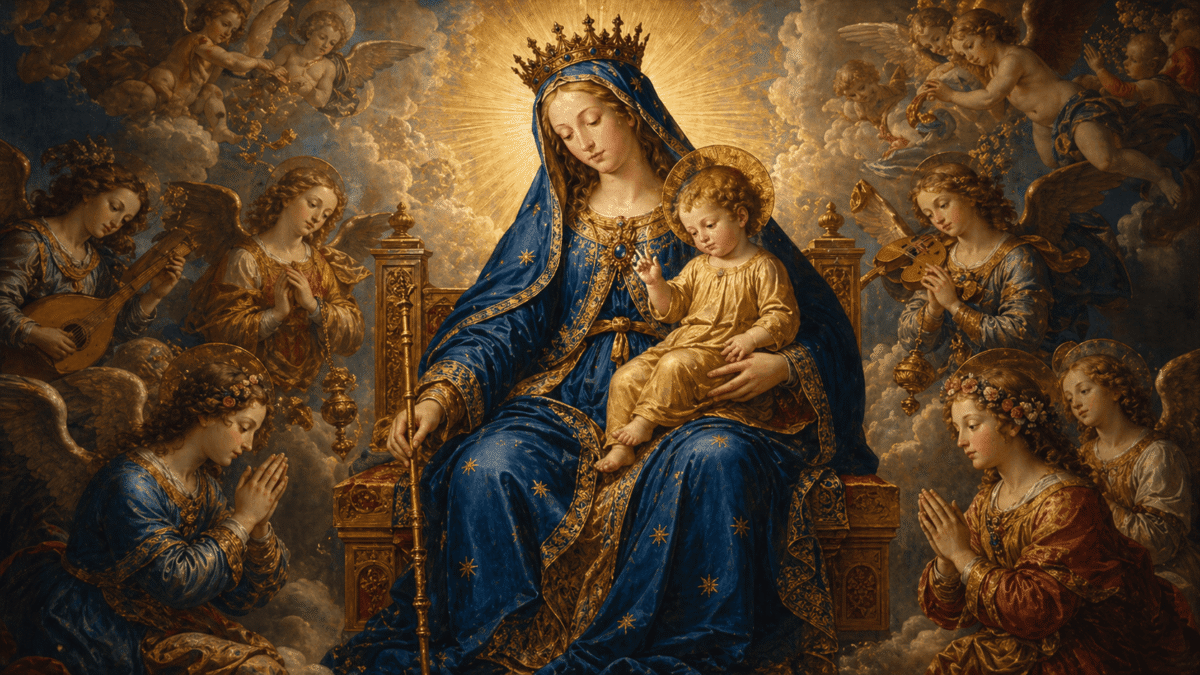
Marian dogmas, the four dogmas of faith about Mary
The Catholic Church holds four Marian dogmas: divine motherhood, perpetual virginity, the Immaculate Conception and the Assumption. The first two belong to primitive Christological faith and are inseparably bound to the mystery of the Incarnation. The last two were defined in the nineteenth and twentieth centuries, expressing the conviction of faith concerning the moral figure and the eschatological destiny of Mary. For a deeper study of each dogma: Mother of God, Virginity of Mary, Immaculate Conception, Assumption of Mary.
TL;DR, Summary. The Catholic Church defines four Marian dogmas: Divine Motherhood (Theotókos, Ephesus 431), Perpetual Virginity (Lateran 649), the Immaculate Conception (Pius IX, 1854) and the Assumption (Pius XII, 1950). The first two belong to the primitive Christological faith bound to the Incarnation; the last two define the moral figure and the eschatological destiny of Mary.
Key points
- The dogma of the Divine Motherhood (Theotókos) is Christological before it is Mariological: it affirms the unity of Person in Christ.
- The Synod of the Lateran (649), under Martin I, defined the perpetual virginity of Mary (before, during and after childbirth).
- The bull Ineffabilis Deus (1854) defined the Immaculate Conception in view of the merits of Christ.
- The Constitution Munificentissimus Deus (1950) defined the Assumption as a dogma of faith.
- The four dogmas follow the theological logic of fittingness to the dignity of the Mother of God.
Divine motherhood (Ephesus, 431)
The Council of Ephesus (431) defined Mary as Theotokos (“Mother of God,” DS 251), in opposition to Nestorius, who proposed only Christotokos. The definition affirms the unity of person in Christ: Mary is the mother not only of the human nature of Jesus, but of His Person, which is divine. Chalcedon (451) completed this definition by affirming that Christ was “begotten of the Father before the ages according to the divinity, and in these last times born of Mary, Virgin and Mother of God, according to the humanity” (DS 301). The divine motherhood is the foundation of all Mariology.
Perpetual virginity
The Church professes the virginity of Mary ante partum, in partu et post partum (Paul IV, DS 1880). The virginal conception of Jesus is expressly affirmed in Mt 1:18-25 and Lk 1:26-38. The Second Council of Constantinople (553) recognized perpetual virginity for the first time in an ecumenical council (DS 422). Virginity is not merely a biological fact, but a theological sign: “the newness of the kingdom of God,” which shows that salvation is the sovereign initiative of God, not a human work.
Immaculate Conception (Pius IX, 1854)
Defined by Pius IX on December 8, 1854, this dogma affirms that Mary “in the first instant of her conception was preserved immune from all stain of original sin, by a singular privilege of grace of almighty God, in view of the merits of Jesus Christ” (DS 2803). The dogma does not exclude Mary from the human condition: she belongs to the lineage of Adam and would have been affected by original sin had God not preserved her by the redeeming merits of Christ. Preservation is, therefore, a form of anticipated redemption, more perfect, not lesser.
Assumption (Pius XII, 1950)
Defined by Pius XII on November 1, 1950, this dogma affirms that Mary, “having completed the course of her earthly life, was assumed body and soul into heavenly glory” (DS 3903). The definition takes no position on whether Mary died or not. The term “assumption” does not express a change of place, but of “state”: the anticipated bodily glorification of Mary is the state in which the just will be after the final resurrection. The Assumption is thus the “realized eschatology” of Mary, an image of the destiny of the whole Church.
Characteristics of the Marian dogmas
The Marian dogmas have two fundamental characteristics. First: they are situated within the central mystery of Christianity; they are not peripheral truths, but necessary corollaries of Christology and soteriology. Second: they have a cultic-liturgical character; the lex orandi (law of prayer) preceded and nourished the lex credendi (law of faith). The feasts of August 15 and December 8 were, historically, witnesses to the faith of the Christian people before the formal dogmatic definitions. Marian devotion was thus the laboratory in which the dogmas matured.
Deepen your studies: explore Mariology, Mother of God, Marian Theology and the Postgraduate Program in Mariology.
Magisterium of the Church
Quattuor sunt dogmata de Beata Virgine Maria definita: Maternitas Divina (Ephesi, 431), Perpetua Virginitas (Laterani, 649), Immaculata Conceptio (1854), Assumptio (1950).
Cf. H. Denzinger, P. Hünermann, Enchiridion Symbolorum, nn. 252, 503, 2803, 3903
📚 Literal translation: Four are the dogmas defined concerning the Blessed Virgin Mary: the Divine Motherhood (Ephesus, 431), the Perpetual Virginity (Lateran, 649), the Immaculate Conception (1854) and the Assumption (1950).
Frequently asked questions about the Marian dogmas
How many Marian dogmas are there in the Catholic Church?
There are four solemnly defined Marian dogmas: Divine Motherhood (Theotókos), Perpetual Virginity, the Immaculate Conception and the Assumption. Each one belongs to the deposit of faith, and to deny it amounts to formal heresy. Other Marian truths (mediation, co-redemption) have not yet been defined dogmatically.
What is the difference between Marian dogma and Marian doctrine?
A dogma is a revealed truth defined by the Church with infallible authority, binding on all the faithful. A doctrine is an authoritative teaching of the Church, without the supreme degree of definition. Every dogmatic truth is doctrine, but not every doctrine has been raised to the condition of dogma.
In which documents were the Marian dogmas defined?
Theotókos at the Council of Ephesus (431, DS 251), Perpetual Virginity at the Synod of the Lateran (649) and the Second Council of Constantinople (553), the Immaculate Conception in the bull Ineffabilis Deus of Pius IX (1854), the Assumption in the Apostolic Constitution Munificentissimus Deus of Pius XII (1950).
Do the Marian dogmas contradict Scripture?
No. The Church teaches that all the Marian dogmas are contained implicitly or explicitly in Scripture and in the apostolic Tradition. Dogmatic definition makes explicit doctrines already believed by the people of God, guaranteeing their correct interpretation against doctrinal errors throughout history.
Postgraduate Program in Mariology
Would you like to deepen your formation in Mariology? Discover the Postgraduate Program in Mariology of Locus Mariologicus, an academic formation that unites theological rigor, spiritual life, and the living tradition of the Church.
Would you like to study Mariology seriously?
This article is born from the works in the library of Locus Mariologicus. The Postgraduate Program in Mariology takes you to the same source, with academic guidance: Scripture, the Fathers of the Church, and the Magisterium, from the first dogma to contemporary questions.

Responses