Our Lady of Graces, the Miraculous Medal
By Prof. Dr. Daniel C. Afonso · Updated
“Mary, conceived without sin, pray for us who flee to thee.” (Inscription on the Miraculous Medal)
I. Rejoice, daughter of Zion: The grace of God dwelling among the people
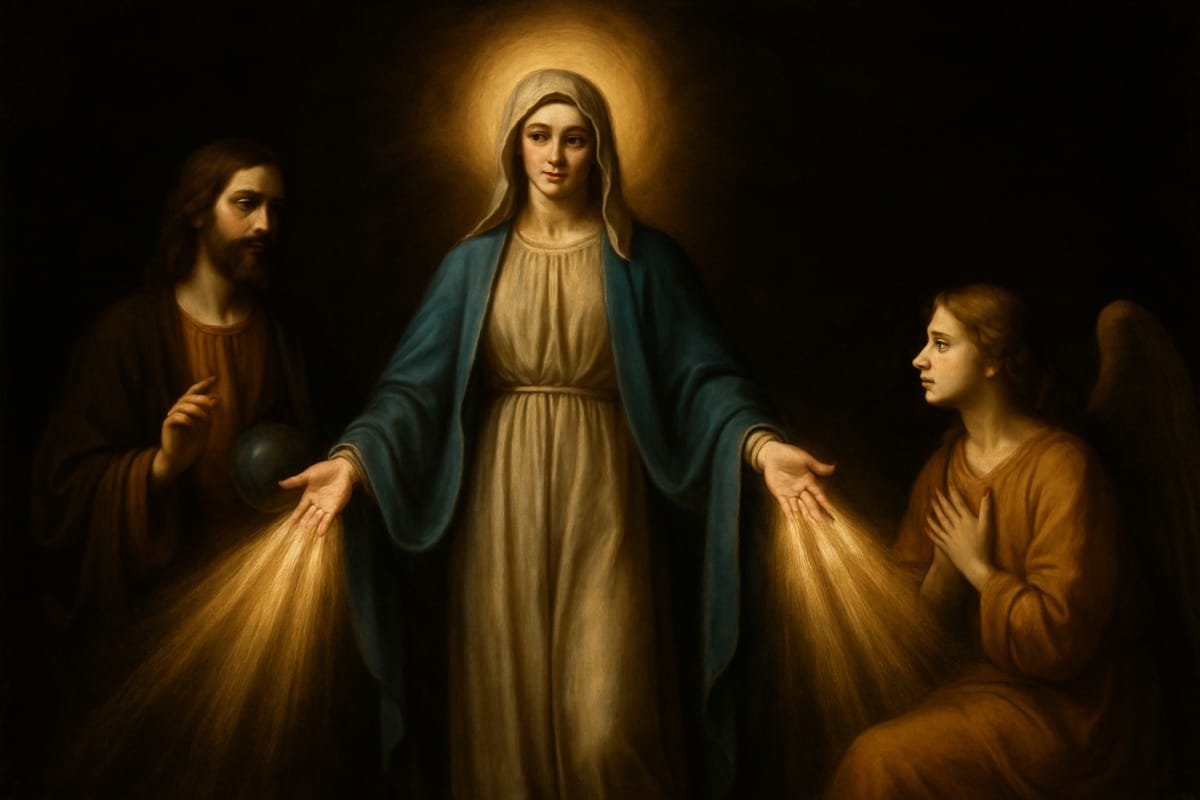
The text from Zechariah that inaugurates this celebration is one of the most dense proclamations of joy in the entire minor prophet corpus: “Rejoice and exult, daughter of Zion, for behold, your King comes to you; he is righteous and victorious, humble and riding on a donkey” (Zech 9:9). The foundation of this joy is not a human event or historical achievement, but God’s decision to dwell among his people. And the consequence of this divine dwelling is transformative, not merely liturgical or cultic. “Many nations shall join themselves to the Lord in that day and shall be his people” (Zech 2:15). The grace of God dwelling does not remain confined to a privileged group; it overflows, expands, reaching nations once outside. This logic of overflowing grace is precisely what iconography of the Miraculous Medal represents so eloquently: rays of light emanating from Mary’s hands illuminate all the earth, a visual image of the mission she received to distribute to all the grace she herself received in fullness.
II. Paris, 1830: The apparitions and birth of the Miraculous Medal
On the evening of November 27, 1830, young novitiate Catherine Labouré of the Daughters of Charity, at the motherhouse on Rue du Bac in Paris, experienced a second vision of Our Lady. Mary appeared bathed in light, with her hands covered in rings that cast radiant beams upon a sphere she held. Then the image turned, and Catherine saw the back of the apparition, with a cross, the letter M, and twelve stars. She heard a voice tell her to have a medal struck with this image, promising: “All who wear this medal will receive great graces.” The medal was minted in 1832, and its diffusion was so rapid and its fruits so visible that the people spontaneously christened it “Miraculous.” Within years, hundreds of millions of medals were distributed throughout the world. Brazil, which received the Daughters of Charity and Marian congregations since the 19th century, embraced this devotion with the intensity characteristic of Brazilian popular religiosity, and today the Miraculous Medal is one of the most common devotional objects in homes and on the necks of Catholics across the country.

III. Full of Grace: The Announcement as the Foundation of Mary’s Mission
The Gospel of the Announcement that accompanies this celebration reveals the biblical foundation for the title “Our Lady of Graces” and the mission represented by the Miraculous Medal. When Gabriel greets Mary with the Greek term kecharitomene, “full of grace” (Lk 1:28), he is designating not merely a moral quality but an ontological reality: God constituted Mary, from the first instant of her existence, as a full and perfect receptacle of divine grace. And whoever receives in fullness overflows. The Marian mediation theology of graces, which Saint Bernard of Clairvaux formulated with the image of an aqueduct and which Tradition developed over the centuries, finds here its scriptural foundation: Mary, full of grace at the Announcement, becomes a distributor of grace to all who turn to her. The hands of the Miraculous Medal, open and radiant, are the iconographic representation of Mary’s fiat: her total surrender that opened the floodgates of God’s grace upon humanity.
IV. Distribution of Graces and Mary’s Mediating Mission
The Mariological doctrine on Mary’s mediation in the distribution of graces is one of the most delicate and richest themes in contemporary theological reflection. John Paul II, in his Encyclical Redemptoris Mater, accurately emphasized that Mary’s mediation is “a participation in Christ’s unique mediation” and that it “does not obscure or diminish this unique mediation of Christ, but rather reveals its power” (RM, 38). Our Lady of Graces does not compete with Christ; she is the channel through which Christ’s grace flows most easily to those in need. The Miraculous Medal, with its front inscription invoking the Immaculate Conception and its reverse joining the Cross, the letter M, and the stars of the Apostles, is a complete Marian catechesis in metal: it proclaims that Mary is always in reference to her Son, that her mediation is always subordinate, and that her mission is always to lead to Christ dead and risen. The Second Vatican Council, affirming that “Mary’s motherhood in the order of grace continues without interruption” (Lumen Gentium, 62), confirmed what popular devotion to the Miraculous Medal had intuitively perceived since 1830: Mary has not abandoned her children. She continues with open hands, continuing to radiate the grace she received, and continuing to intercede with her Son for all who turn to her in their needs.
Postgraduate Program in Mariology
Would you like to deepen your formation in Mariology? Discover the Postgraduate Program in Mariology from Locus Mariologicus – an academic formation that combines theological rigor, spiritual life, and the living tradition of the Church.
Responses