Our Lady of Lasalle, Reconciler of Sinners
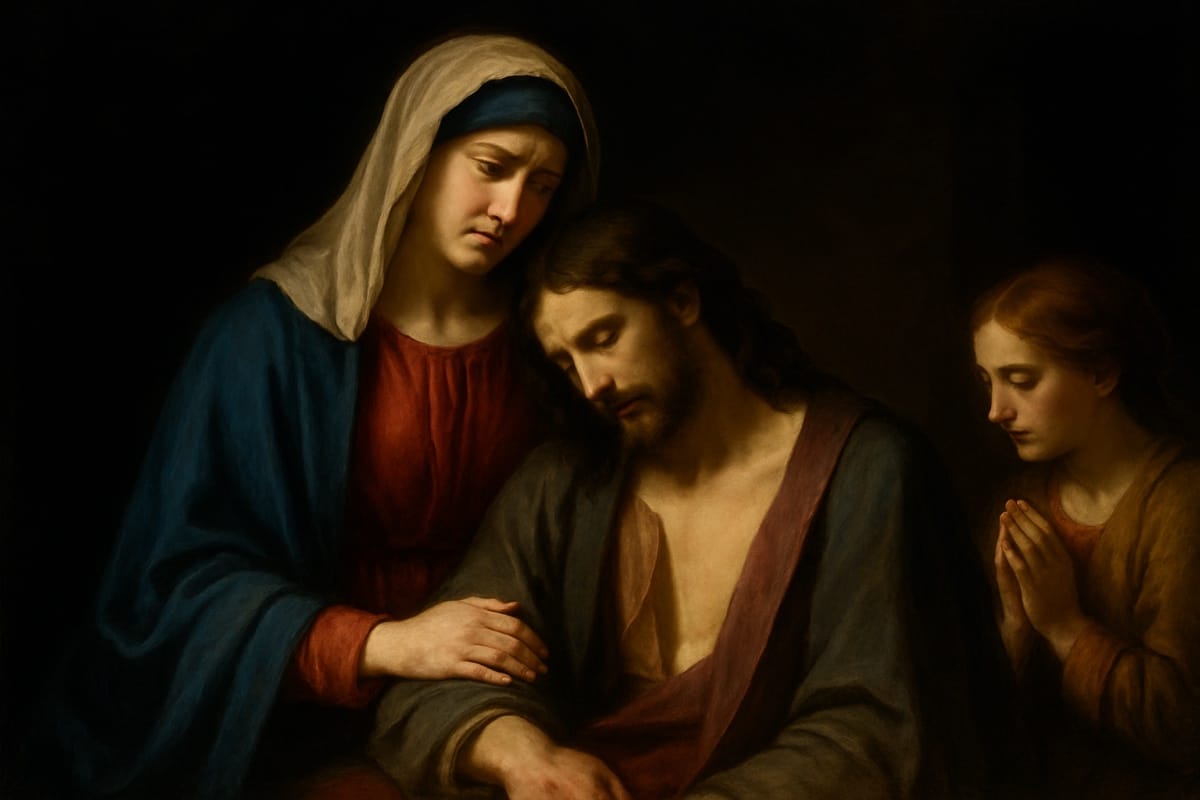
“Pour out your heart like water before the Lord” (Lamentations 2:19), “Derrama o teu coração como água diante da face do Senhor
I. The Tears of Zion: Lament as the Language of Loving Pain
The text from Lamentations that opens this meditation belongs to one of the most dense and misunderstood books of the Old Testament. The prophet, in the face of Jerusalem’s destruction in 587 BC, realizes there are moments in history when the only language possible before God is that of tears. “Rise up and cry out at night, at the beginning of the vigils; pour out your heart like water before the Lord” (Lamentations 2:19). The crying to which the prophet invites is not resignation nor despair. It is the recognition that love, when it sees its beloved in ruin, cries before explaining. This language of tears, never scorned by Scripture, permeates the entire history of Christian spirituality: Peter’s tears after denying Jesus, Mary Magdalene’s tears at the tomb, Jesus’ tears over Lazarus’ death and over Jerusalem’s impending destruction. And it is within this biblical and patristic tradition of tears as the language of love that the apparition of Our Lady of La Salette takes place, where Mary, for the first time in recognized apparitions by the Church, appeared to the visionaries weeping.
II. La Salette, September 19, 1846: The Mother Who Weeps for Her Children
In the afternoon of September 19, 1846, on Mount Sous-les-Baisses near the Alpine village of La Salette-Fallavaux, two young shepherds, Mélanie Calvat, aged fifteen, and Maximin Giraud, aged eleven, encountered a “beautiful Lady” sitting and weeping by a spring that had just dried up and now flowed again. She wore regional dress but was enveloped in a light not from the afternoon sun. She spoke at length to them in French and then in local patois, conveying a message that would become one of the densest and most dramatic in the history of Marian apparitions. The central theme was a mother’s lament over the offenses she received from a people turning away from God: profanation of Sunday, habitual blasphemy, disregard for prayer, indifference to the Eucharist. And a phrase echoed through the centuries with the force of a warning that still challenges us: “If my people do not want to submit, I am forced to let fall the arm of My Son.” On September 19, 1851, exactly five years after the apparition, Bishop Philibert de Bruillard officially recognized the authenticity of the event. La Salette became one of the most visited Marian shrines in the French Alps and the prototype of penitential and reparative apparitions that marked Catholic piety in the 19th century.
III. Come to Me, You Who Are Weary: The Invitation to Restoring Comfort
The Gospel of Matthew, which accompanies this celebration, presents one of Jesus’ most comforting statements: “Come to me, all you who are weary and burdened, and I will give you rest. Take my yoke upon you and learn from me, for I am gentle and humble in heart, and you will find rest for your souls. For my yoke is easy and my burden is light” (Mt 11:28-30). This word sheds necessary light on La Salette’s message: Mary’s lament is not a condemnation, it is a call. The weeping Lady is not a lady who repels, but a lady who invites. And the invitation she conveys, ultimately, is the same invitation Jesus proclaims in the Gospel: come, turn back, rest with him who loves you. Therefore, Mary’s tears at La Salette are not contradictory to mercy; they are its most acute expression. Mary weeps not to terrify her children, but because a true lover weeps for the unfaithfulness of his beloved before finding peace in reconciliation. La Salette is the sanctuary of this dialectic between maternal sorrow and the call to reconciliation that defines Mary’s spiritual motherhood over the Church.
IV. Marian Tears: Theology of Maternal Compassion
The theology of Marian tears, which La Salette placed at the center of mariological reflection in the 19th century, has deep roots in patristic and medieval thought. St. Bernard already meditated on Mary’s heart pierced by the sword prophesied by Simeon (cf. Lk 2:35), recognizing in this image the theological intuition that Mary’s motherhood over Christ and the Church is a motherhood marked by suffering because of love. The tears at La Salette are not an isolated phenomenon; they are the visible continuation, in a specific historical moment, of that inner sword that forever pierced the Mother’s heart. And the theology La Salette proposes is notable for its evangelical soberness. Mary does not weep for herself: she weeps for her children. She does not demand new sacrifices: she asks for the fulfillment of the old precepts of the covenant. She does not invent a parallel doctrine: she calls to faithfulness to the received doctrine. The Second Vatican Council, by recognizing Mary’s motherhood over the Church as “permanent and uninterrupted” from her fiat at the Annunciation to her glorification (cf. Lumen Gentium, 62), gives to La Salette’s tears their most complete theological meaning: they are the historical and visible manifestation of a spiritual motherhood that knows no pause, suffering for her children while some stray, and ceaselessly interceding for their reconciliation with the Father.
Postgraduate Program in Mariology
Would you like to deepen your formation in Mariology? Discover the Postgraduate Program in Mariology from Locus Mariologicus – an academic formation that combines theological rigor, spiritual life, and the living tradition of the Church.




Responses