Our Lady of Knock, the Silent Apparition
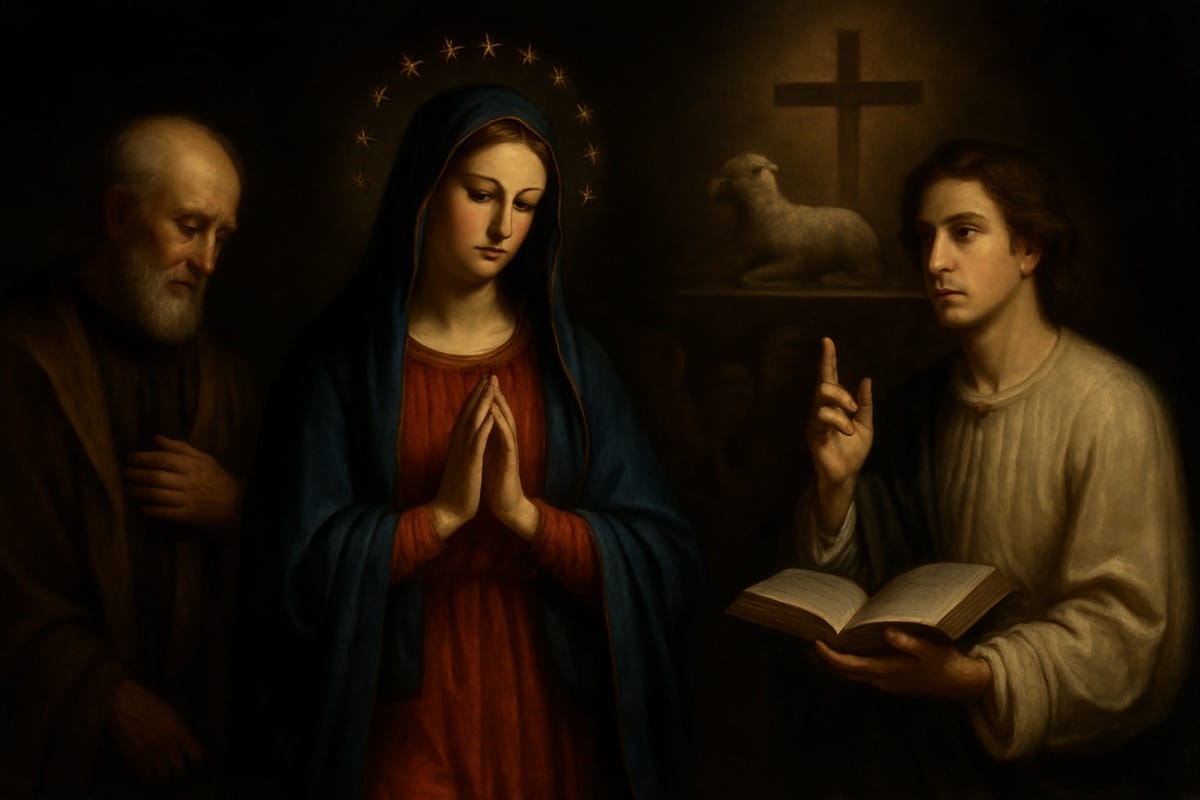
“Beati qui audiunt verbum Dei et custodiunt illud” (Lk 11:28), “Blessed are those who hear the word of God and keep it”
I. The Woman and the Lamb: The Johannine Vision That Prefigures Knock
The twelfth chapter of the Apocalypse presents the vision of a woman clothed with the sun, with the moon beneath her feet and a crown of twelve stars upon her head (cf. Rev 12:1). But what matters for understanding Knock is not only the figure of the woman: it is the whole of the scene that John describes, in which the woman appears in direct relation to the Lamb who is upon the throne and whose blood saves humanity. The heavenly liturgy of the Apocalypse is a silent liturgy of adoration and of presence: the woman and the Lamb are in communion, with no need of explanatory words. This is precisely the scene that was manifested at Knock on a rainy night in August 1879: Mary, Joseph, John the Evangelist, and the Lamb upon the altar, all in silence, all in adoration, all in liturgical communion. Knock is, in a certain sense, the Apocalypse staged on the wall of a small rural Irish church, without a human voice, but with all the eloquence of a heavenly liturgy made visible.
II. Knock, August 21, 1879: The Apparition That Did Not Say a Word
The night of the twenty-first of August 1879 was rainy and cold in the small village of Knock, in the Irish county of Mayo, when Mary McLoughlin, the parish priest’s housekeeper, was returning home around eight o’clock in the evening. As she passed by the south wall of the parish church, she saw three motionless figures enveloped in a light that did not come from any human source. She thought they were new statues that the parish priest had ordered, and she went on her way. Shortly afterward, Mary Beirne accompanied her and, passing by the church again, saw what Mary McLoughlin had dismissed as statues. She understood immediately that they were not statues: they were living persons, though enveloped in a supernatural light. She called other parishioners. Within a short time, fifteen witnesses, men, women, and children between five and seventy-four years of age, saw the same scene for about two hours: Mary crowned, with her hands raised in prayer, at the center. Saint Joseph at her right, in an attitude of reverence. Saint John the Evangelist at her left, with an open book and his right hand raised as though preaching. And behind them, an altar with a lamb upon it, flanked by adoring angels, and a cross raised up. The witnesses prayed throughout the whole duration of the apparition. Not a word was spoken by the heavenly figures. The rain went on falling around the seers, but not one drop touched the illuminated wall of the church. The apparition was recognized by the diocesan commission in 1879 and confirmed by a second commission in 1936. Pope John Paul II visited Knock on the centenary of the apparition, in 1979, conferring on the shrine the dignity of Ireland’s National Marian Shrine.
III. Blessed Are Those Who Hear and Keep: Silence as the Highest Form of Listening
The Gospel of Luke that accompanies this celebration presents one of the densest words of Jesus on true blessedness. A woman from the crowd proclaims: “Blessed is the womb that bore you and the breasts that nursed you” (Lk 11:27). And Jesus answers with a correction that deepens rather than denies: “More blessed are those who hear the Word of God and keep it” (Lk 11:28). This word of the Gospel finds in Knock a paradigmatic illustration. At Knock, no one spoke. Mary uttered no words, Joseph uttered no words, John the Evangelist, although he held the open book and gestured as a preacher, uttered no words. The witnesses, for their part, asked no questions, requested no favors, sought no messages. They remained in silent prayer before a heavenly liturgy that was unfolding in front of them. And it is precisely in this shared silence that the most perfect form of listening was accomplished. Knock teaches that to hear the Word of God is not only to listen to words: it is to enter into a silent communion with the divine presence that manifests itself. The Mariology of Knock is a Mariology of contemplation: Mary does not speak because she already is, in her very person, the silence in which the eternal Word dwelt.
IV. Knock and Liturgical Mariology: The Lamb at the Center
The visual composition of the apparition at Knock contains one of the richest and most coherently ecclesial theologies in the whole history of the Marian apparitions. At the center of the scene is not, properly speaking, Mary: it is the Lamb upon the altar. Mary, Joseph, and John the Evangelist are arranged around this central altar, all in an attitude of adoration. This composition is no artistic coincidence: it is a visible theological confession. Mary is not the center: the Lamb is the center. The Mariology of Knock is thus, above all, a eucharistic and liturgical Mariology. Mary’s proper place is precisely the one she occupies at Knock: beside the Lamb, in adoration, in communion, but never taking the place of the Son. The Second Vatican Council, by integrating Mariology into the document on the Church and by recalling that the only saving mediation is that of Christ (cf. Lumen Gentium, 60), is formulating doctrinally what Knock manifested iconically almost a century earlier: Mary exists in the Church for the sake of the Lamb, and her glory is precisely to point to Him. This theological sobriety of Knock, with no new messages, no secret revelations, no apocalyptic dramatics, makes it one of the apparitions of all time that are most liturgical, most ecclesial, and most perfectly integrated into the Catholic faith.
Postgraduate specialisation in Mariology
Would you like to deepen your formation in Mariology? The Locus Mariologicus postgraduate programme is a specialisation that brings together theological rigour, spiritual life and the living tradition of the Church. The next class begins in 2027.
Would you like to study Mariology seriously?
This article grows out of the works in the Locus Mariologicus library. The Postgraduate Program in Mariology takes you to the same source, with academic guidance: Scripture, the Fathers of the Church, and the Magisterium, from the first dogma to contemporary questions.

Responses