Jasna Góra, Black Madonna, and the Sanctuary of Częstochowa
# Jasna Góra, the Luminescent Mountain
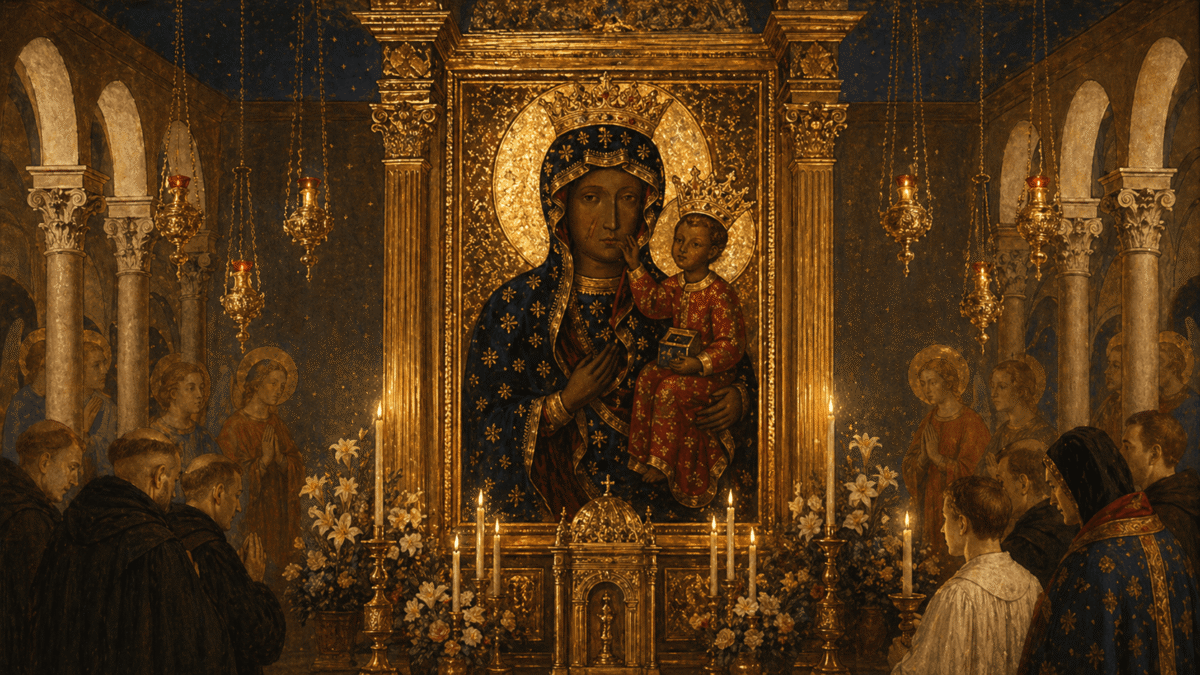
Jasna Góra (“Luminescent Mountain” in Polish) is Poland’s most important Marian sanctuary and one of the world’s largest pilgrimage centers for Christians, located in Częstochowa, Silesia. The Pauline Fathers’ Monastery has existed since 1382 and houses the icon that became the spiritual heart of the Polish nation: the **Black Madonna**, the Black Virgin Mary. The sanctuary welcomes between three and five million pilgrims annually, including the historic foot pilgrimage from Warsaw, a 250-km, nine-day journey.
## The Black Madonna Icon and Its Scars
The icon of the Black Madonna is a painting on oak wood in the **Hodegetria** style: Mary points to the Child as the path. The dark coloring results from the oxidation of pitch and centuries of candle smoke. The icon bears two visible scars on Mary’s face, remnants of a Hussite attack in 1430: when they tried to break the image, the aggressors stopped, and the icon was restored, but the scars were intentionally left as a reminder of the violation and the supernatural nature of the icon. This decision transformed the marks of violence into a symbol of hope: Mary, wounded, remains present.
## John Paul II and Totus Tuus
The relationship between Jasna Góra and Pope John Paul II is central to understanding contemporary Marian theology. Karol Wojtyła nurtured his devotion to the Madonna of Częstochowa from childhood, and as pope, he visited the sanctuary on every trip to Poland. Here, he proclaimed his life motto: **Totus Tuus** (“All Yours”), taken from Saint Louis de Montfort. The encyclical *Redemptoris Mater* (1987) is the mature theological expression of this devotion: a meditation on Mary as “Mother on the path of faith” that John Paul II lived in deep connection with Jasna Góra.
**Dive deeper:** Explore Marian apparitions, Our Lady of Fátima, Consecration to Our Lady, and the **Mariology Postgraduate Program**.




Responses