The “August Queen of Heaven” Prayer: Origin, Author, and Sources
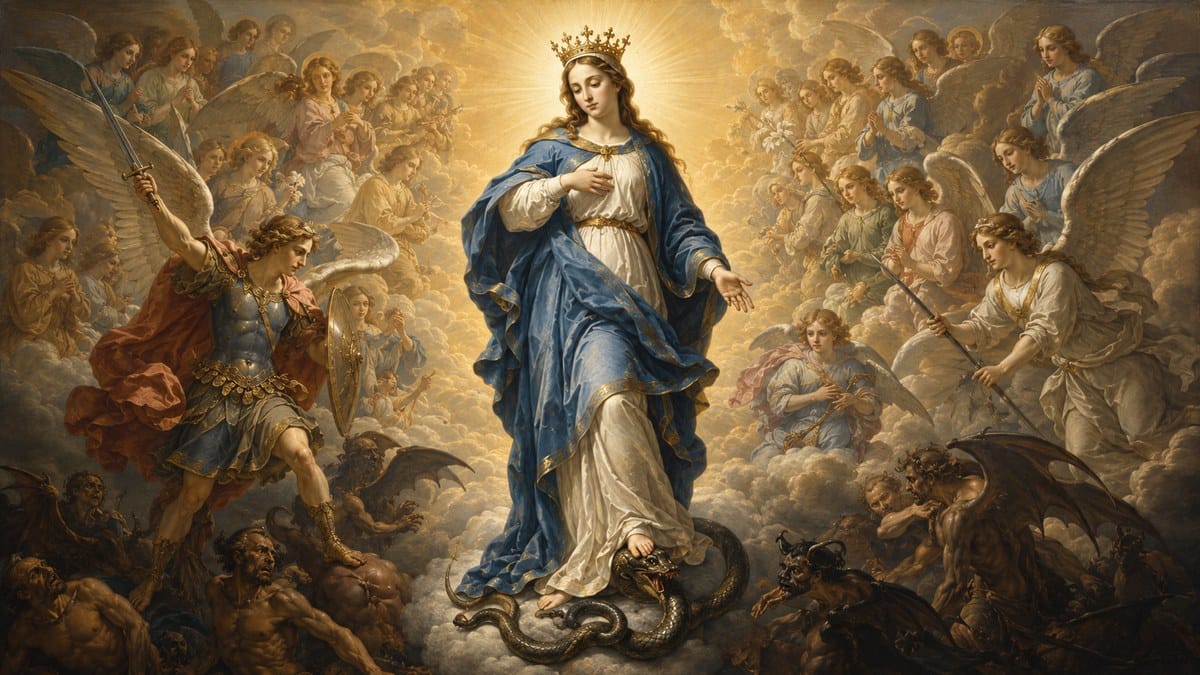
Few nineteenth-century Marian prayers attained the diffusion and the combative density of the “August Queen of Heaven.” Prayed in shrines, recommended by those who exercise the ministry of exorcism, printed by the hundreds of thousands, it invokes the Mother of God under an exact title, sovereign Lady of the Angels, and asks for the sending of the heavenly legions against the powers of darkness.
Behind its language there lie a precise date, an identifiable author, and sources worth knowing with precision. Whoever prays this prayer does not wield a magic formula. He takes up one of the clearest expressions of the Church’s faith in Mary’s angelic queenship.
I. The Text of the August Queen of Heaven Prayer
The widely circulated Portuguese version runs as follows:
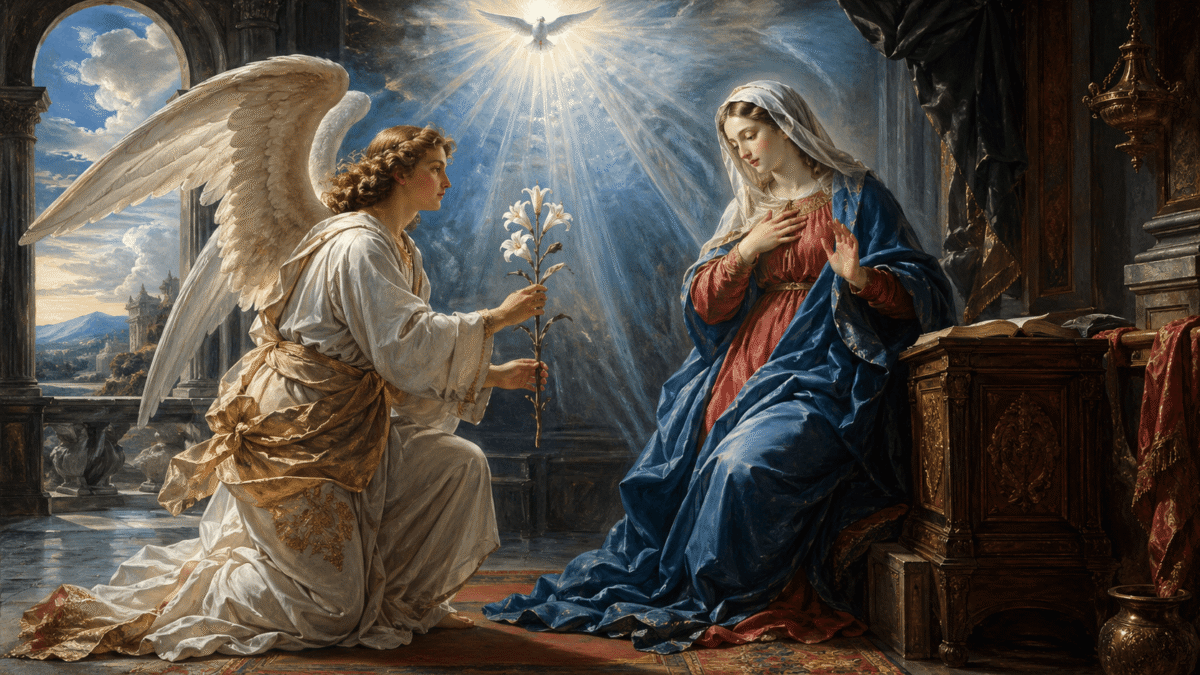
“August Queen of Heaven, sovereign Lady of the Angels, thou who from the beginning didst receive from God the power and the mission to crush the head of Satan, we humbly ask thee to send the heavenly legions, so that, under thy orders and by thy power, they may pursue the demons, combat them everywhere, repress their boldness, and cast them down into the abyss. Who is like God? O good and tender Mother, thou shalt ever be our love and our hope. O divine Mother, send the Holy Angels to defend me and to drive far from me the cruel enemy. Holy Angels and Archangels, defend us, guard us. Amen.”
The title that opens the supplication is not devotional ornament. “Queen of the Angels” renders the ancient liturgical invocation Regina Angelorum, present in the Litany of Loreto and prolonged in the antiphon Ave Regina Cælorum, Ave Domina Angelorum (Hail, Queen of Heaven, Hail, Lady of the Angels). The prayer concentrates in the form of a petition what the Church was already singing in the form of praise.
II. The Author, Blessed Louis-Édouard Cestac
The August Queen of Heaven has a well-documented historical author, the French priest Louis-Édouard Cestac. Born in Bayonne on January 6, 1801, he devoted his life to the human and spiritual rescue of women in situations of abandonment. In Anglet he founded the work of Notre-Dame-du-Refuge and, in 1842, with his sister Élise, the Congregation of the Servants of Mary. He died in Anglet on March 27, 1868.
His cause followed the ordinary path of the Church. He was declared venerable in 1908 by Pope Pius X, and beatified on May 31, 2015, in the cathedral of Bayonne, by Cardinal Angelo Amato in the name of Pope Francis. A frequent error on the internet should be corrected, since it moves the beatification back to the 1990s. The right date is 2015.
III. The Origin, the Vision of January 13, 1864
According to the tradition preserved in his biography, on January 13, 1864, Father Cestac was seized as though by a ray of light and saw the demons scattered over the earth. At that same hour he had a vision of the Most Blessed Virgin, who declared to him that the infernal powers were unleashed upon the world and that the hour had come to invoke her as Queen of the Angels, asking her to send the heavenly legions against them.
When the priest objected, asking why she would not send the angels without being asked, he received the order to print and spread the prayer. The August Queen of Heaven was born of that hour of combat, and Cestac had nearly five hundred thousand copies printed and distributed free of charge.
The sources link this vision to the announcement of La Salette. In the apparition of September 19, 1846, the message entrusted to Mélanie Calvat named 1864 as the year in which “Lucifer, with a great number of demons, will be loosed from hell.” Critical sobriety is called for here. The apparition was approved by the bishop of Grenoble in 1851, but the printed version of the “secret” (Lecce, 1879) is subject to reservations. The link between 1864 and the prayer belongs to the plane of spiritual reading.
IV. The Ecclesiastical Approvals and the Theological Sources
The prayer did not circulate on the margins of the Church. On that very January 13, 1864, Cestac wrote to Cardinal Clément Villecourt, asking him to present the text to the Pope. On February 17, 1864, Villecourt conveyed the reply of Pius IX, who found nothing to reject in prayers meant to thwart the designs of the devil. The bishops of Bayonne, Tarbes, Aire, Tours, and Cambrai also approved it.
Already in the twentieth century, the prayer was enriched with an indulgence by Saint Pius X, in 1908, and gathered into the Raccolta, the official collection of indulgenced prayers, under number 389.
More important than the chronology is to recognize where the content springs from. The prayer is a biblical and liturgical mosaic. The central image, crushing the head of Satan, comes from the Protoevangelium, in Gen 3:15, where the offspring of the woman strikes the head of the serpent. The scene of the legions carries forward Rev 12, with the woman, the dragon, and the war of the archangel Michael.
The exclamation “Who is like God?” renders the Latin Quis ut Deus?, which in turn renders the Hebrew Mî kā-ʾĒl (who is like God), the name of Saint Michael turned into a battle cry. The prayer belongs to the same family as the Leonine supplication to Saint Michael, of 1886. These are the sources that sustain the August Queen of Heaven, and that situate it within the horizon of Angelology and Demonology in the Catholic Magisterium.
Conclusion
Knowing the origin of the “August Queen of Heaven” does not weaken it; it strengthens it. To know that it was born in 1864, from the faith of a priest later raised to the altars, approved by Pius IX and indulgenced by Saint Pius X, is to understand that to pray is not to invoke the unknown.
To pray the August Queen of Heaven is to join one’s own voice to the constant voice of the Church, which recognizes in Mary the Queen of the Angels and in her the victory already announced over the serpent. To situate this supplication among the great Marian signs, see also the Marian apparitions in the papal Magisterium.
References
- BORDARRAMPÉ, P. Le vénérable Louis-Édouard Cestac. Paris: J. de Gigord, 1925.
- The Raccolta, or Manual of Indulgences. New York: Benziger, 1957, prayer no. 389.
- CONGREGATION OF THE SERVANTS OF MARY. Available at servantesdemarie.com.
- OUR LADY OF LA SALETTE. Apparition of September 19, 1846, approved by the bishop of Grenoble in 1851.
See our complete guide to Catholic Angelology.
Would you like to study angelology and demonology in depth?
This article comes from the Locus Mariologicus library. The postgraduate specialisation in Angelology and Demonology (360 hours, fully online) studies angels and demons in Scripture, the Fathers and the Magisterium, with a whole area on practical demonology, exorcism and deliverance prayer. The new class begins on 18 January 2027. Classes are taught in Portuguese.




Responses