Pater tuus qui videt in abscondito: Mary and Hidden Piety
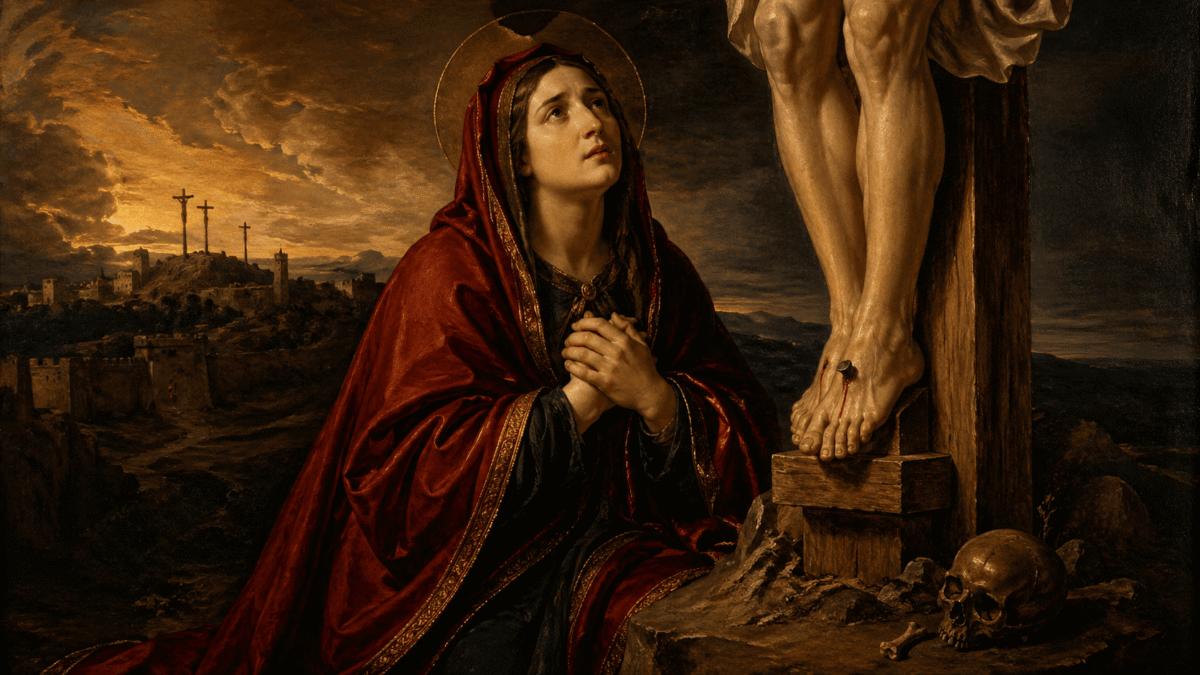
Tu autem cum oraveris, intra in cubiculum tuum, et clauso ostio tuo, ora Patrem tuum in abscondito. Et Pater tuus qui videt in abscondito reddet tibi.
Mt 6:6
The instruction of Jesus on the three fundamental practices of Jewish piety, almsgiving (Mt 6:1-4), prayer (Mt 6:5-15) and fasting (Mt 6:16-18), did not abolish any of these practices but radicalized them: it proposed that they be lived with such purity of intention that only the Father, who “sees in secret,” knows them. The criterion of authenticity is not social visibility (“to be seen by men”), but the relationship with God. The word “hypocrites” (hypokritai, stage actors who wear a mask) that Jesus applies to those who practice piety in order to be admired does not necessarily imply conscious hypocrisy: it can describe someone who has practiced a religiosity of façade to such an extent that he has lost awareness of the distance between the mask and the face.
The context is the Sermon on the Mount, which describes the “greater righteousness” of the Kingdom (Mt 5:20): a way of living that exceeds conventional morality not only in degree but in nature. The “greater righteousness” does not consist in practicing more almsgiving, more prayers and more fasting than the Pharisees; it consists in practicing these things in a radically different way: without an audience, without calculating any return, in a space of pure relationship with the Father. This pedagogy of interiority is the soul of Christian spirituality: not the multiplication of religious gestures, but the purification of the intention that animates them.
I. The “Inner Room” of Prayer: The Interior Space
The image of the “inner room” (tameion, the innermost room of the house, without windows) became, in the Christian spiritual tradition, the metaphor for the interior space of prayer. Origen, in On Prayer (third century), explained that the “inner room” of which Jesus speaks is not primarily a physical space but an interior disposition: the concentration of the mind and the heart on God, independently of place. This interiority of prayer is not incompatible with communal liturgy (which Jesus does not criticize): it is its root and its test of authenticity. Liturgical prayer is authentic when it springs from a heart that prays “in secret.” It becomes “hypocritical” when it is reduced to social performance without an interior root.
The Christian mystical tradition developed this image extensively. Bernard of Clairvaux, in the Sermons on the Song of Songs, described the “chambers of the King” as the degrees of contemplation. Teresa of Ávila, in The Interior Castle, structured the whole of the spiritual life around seven “dwelling places,” culminating in the “chamber” of union with God. John of the Cross, in The Ascent of Mount Carmel, described the progressive purification that leads to the “interior silence” where God speaks. This entire tradition recognizes in the image of Jesus the symbol of a phenomenology of spiritual interiority: life with God has an incommunicable dimension, which cannot be put on display, which exists only in the silence of the interior chamber.
The critique of ostentatious religious formalism has deeper Christological implications. Jesus does not criticize communal prayer in the synagogue or in the Temple. He criticizes those who use prayer as an instrument of social self-promotion. Prayer “in secret” is prayer that no longer serves any function of social capital: it is pure relationship with God, gratuitous, returning no capital of religious admiration. This “pure prayer,” with no motive other than the love of God, is the heart of the Christian contemplative life, and its most perfect model, in the tradition, is Mary.
II. Mary, Who Kept These Things in Her Heart
Luke describes Mary’s interior life with an expression that appears twice: “Mary kept all these things, pondering them in her heart” (syneterei en te kardia autes Lk 2:19. Cf. 2:51). This expression is precisely the language of the “inner room”: Mary did not put her interior life on display, did not publish her meditations, did not seek an audience for her spiritual experiences. Her prayer was what Jesus describes: the closed door, the Father who sees in secret, the heart that contemplates in silence the events of the mystery of Christ.
The iconography of the Annunciation, in which Mary is frequently depicted reading or praying at the moment when the angel appears, expresses this dimension theologically. Fra Angelico, Leonardo da Vinci and Rogier van der Weyden painted Mary in the “inner room” of her prayer when the angel found her. This iconography suggests that Mary’s readiness for the “fiat” was not spontaneous: it was prepared by a life of hidden prayer, of meditation on the Scriptures, of contemplation of God’s promise to Israel. The “fiat” was the ripe fruit of a heart that habitually dwelt in the “inner room” of the relationship with God.
Mary’s contemplative dimension was central to Carmelite spirituality. John of the Cross and Teresa of Ávila, both Doctors of the Church and patrons of contemplatives, regarded Mary as the figure who most perfectly lived the unity between contemplation and action that they described. The Visitation is the paradigm of this unity: Mary goes “with haste” to meet Elizabeth (action), carrying Christ with her (contemplation). Her activity is not cut off from the “inner room”; she acts because she contemplates. She brings God because she has Him within her.
III. Almsgiving and Fasting: A Discreet Asceticism
The principle of hidden piety applies also to almsgiving and to fasting. The instruction of Jesus about almsgiving, “do not let your left hand know what your right hand is doing” (Mt 6:3), is a hyperbole that expresses the ideal of a charity completely uninterested in human recognition. The “reward from men” that the hypocrites seek is the social capital of a reputation for generosity. But whoever gives in order to be seen has already received his reward, which exhausts the meaning of the gesture. Authentic charity gives without calculating the return, neither the human return of admiration nor (at the deepest level) the divine return of a calculated reward.
Mary’s Visitation is the exemplary model of this “hidden almsgiving”: a concrete charity, staying with Elizabeth for three months of her pregnancy, several days’ journey from Nazareth, which sought no publicity and was recorded in no social archive of the time. Only Luke came to know of it, probably from Mary herself or from Elizabeth. Mary’s service to Elizabeth has the style of the “inner room”: discreet, faithful, hidden from the eyes of men but visible to the eyes of the Father. It is the right hand of charity that the left hand of social prominence does not know.
Fasting “in secret,” anointing the head and washing the face so as not to appear to be fasting (Mt 6:17-18), completes the triptych of hidden piety. Authentic Christian asceticism does not seek to impress: the monk who displays his mortification has already lost the meaning of fasting, which is the interior education of desire, the widening of the space for God. Mary, whose ascetical practices the Gospel does not narrate, is described by the tradition as one whose interiority was so full that her asceticism was completely invisible, integrated into the ordinary life of Nazareth, without extraordinary spiritual marks. She was a woman among women, a heart in silence with God.
IV. The Father Who Sees in Secret
The promise that closes each of the three commandments, “your Father who sees in secret will reward you,” reveals the deep logic of Christian spirituality: there is no hidden act that escapes the gaze of the Father. This affirmation is at once consolation and challenge: consolation, because the gestures of love that no one sees have a witness that matters infinitely more than a human audience. Challenge, because this divine gaze also penetrates what is done “to be seen by men”; hypocrisy does not escape the Father who sees in secret.
The “reward” of which Jesus speaks is not a transactional payment: it is the reciprocity of love. Whoever loves without calculating the return will find the love of the Father who recognizes and responds. This “reward” is, in the last analysis, God Himself: eternal life, communion with the Father who “sees in secret.” Prayer, almsgiving and fasting in secret are therefore ways of “laying up treasures in heaven” (Mt 6:20), not by a sophisticated spiritual calculation, but by the logic of gratuitous love that gratuitously meets the love of God.
Mary, who “kept these things in her heart” (Lk 2:19), is the image of the Christian who lives in the certainty that the Father “sees in secret.” She did not need her contemporaries to recognize the greatness of what she carried; she knew that the Father knew, and that certainty was enough for the peace of her heart. This deep peace before the gaze of God, not needing human validation because one lives within the divine gaze, is the ripe fruit of the hidden piety that Jesus describes. It is the heart of the closed “inner room”: not the absence of relationship with the world, but the relationship with the world inhabited by a deeper relationship with God.
Postgraduate Program in Mariology
Would you like to deepen your formation in Mariology? Discover the Postgraduate Program in Mariology of Locus Mariologicus – an academic formation that unites theological rigor, spiritual life and the living tradition of the Church.
Would you like to study Mariology seriously?
This article grows out of the works in the Locus Mariologicus library. The Postgraduate Program in Mariology brings you to the same source, with academic guidance: Scripture, the Fathers of the Church and the Magisterium, from the first dogma to contemporary questions.





Responses