The pain of Mary
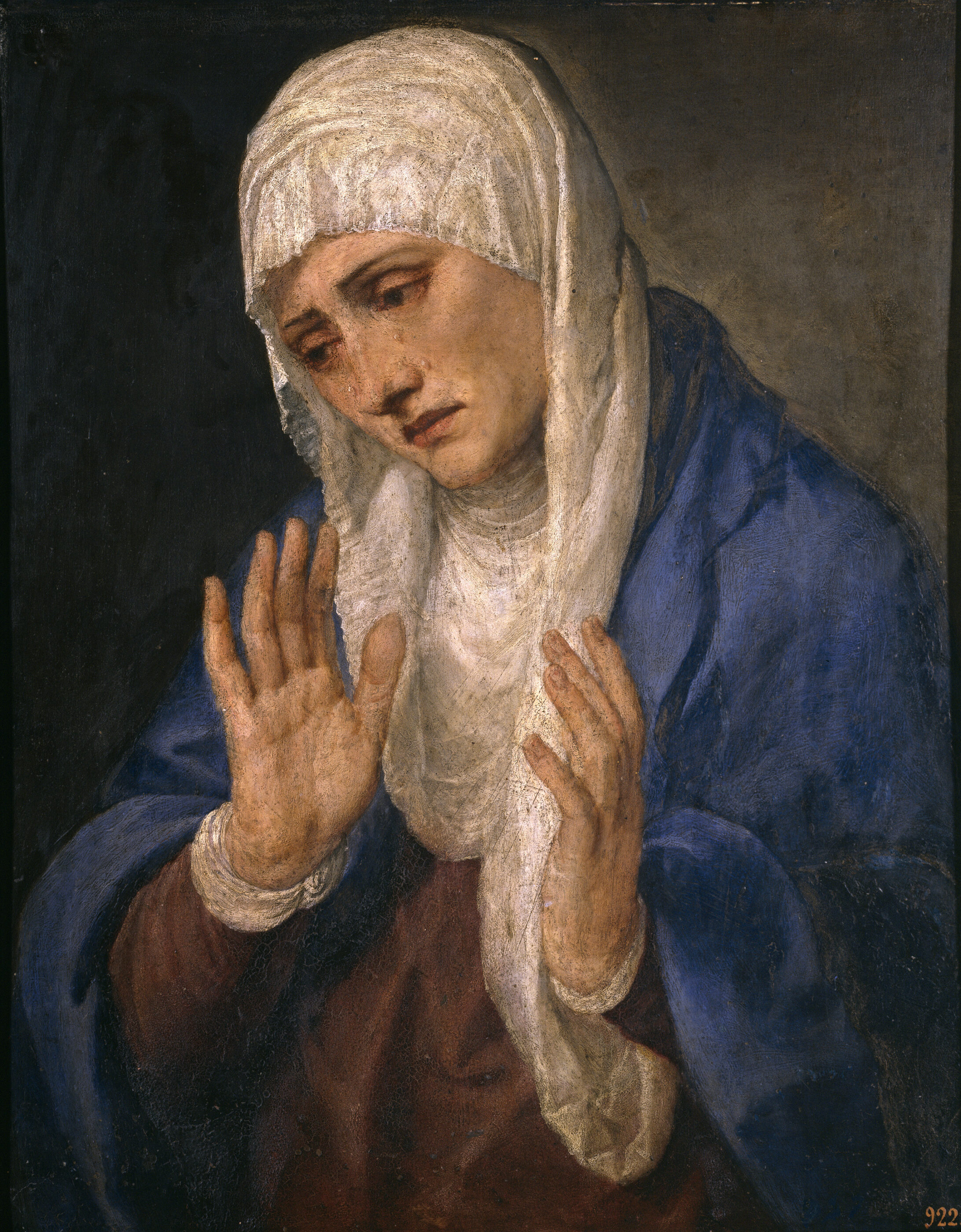
The sorrow of Mary at the foot of the cross

Mary, at the cross, is the “Strong Woman” of Scripture, who contemplates her son, flayed and crucified. “The mother of Jesus, his sister, Mary of Cleophas, and Mary Magdalene stood near the cross of Jesus. And seeing his mother and the disciple whom he loved standing there, Jesus said to his mother: ‘Woman, behold your son’! Then to the disciple he said: ‘Behold your Mother'”! (John 19:25-27). Mary becomes Mother of Men through her participation in the sacrifice on Calvary, and it is at the most dramatic moment of the Son’s life that her spiritual motherhood is revealed. Her presence at the cross represents the high point of her association with Christ’s salvific mission. Her sufferings, offered in union with the Redeemer Son, constituted the most important act of her spiritual motherhood. “Mary contemplated the wounds of the Son, while all fled. She stood firm. The Son hung on the cross, and the Mother offered herself to the persecutors,” (St. Augustine, De Institutione Virginum, Patrologia Latina 16, 318).
Christ has died and His mission is accomplished, but Mary’s mission begins now. In the regeneration of humanity, she is the new Eve, therefore, the Mother of the redeemed through intimate association with Christ. As such, her mission encompasses, as filters, all those associated with divine grace to Christ. This new mission of Mary is necessary for the completeness of redemption: it is the source of her function in relation to the Church and the worship rendered to Mary.
Hilary of Poitiers (d. 367) speaks of the Desolated One, to whom the Son wished to give, under the cross, the comfort of another filter in the person of the apostle John: “The Lord said to both: ‘Woman, behold thy Son’!”, and to John: ‘Behold thy Mother’!”, in order to ensure, in the person of the disciple, the love of a son for the comfort of the desolated mother” (Hilary of Poitiers, Commentary on the Gospel of Matthew, 27, 56). Saint Anselm of Aosta (1033-1109), in various works, presents us with a suffering Mary: “O merciful Mother, what tears did flow from thy most compassionate face while thou sawest thy Son God stretched out, without guilt, on the cross?” (Saint Anselm of Aosta, Oratio XV ad Christum).
From the 11th century, devotion to Our Lady of Sorrows develops, which will be invoked with titles such as Desolated One, Virgin of the Seven Sorrows, Piety, Soleád (Spant), Vesperbild (German). Prayers and practices develop, in particular the Via Matris, in which one seeks to unite Jesus’ sufferings with Mary’s, to have a clearer image of the Co-Redemptrix. With the Synod of Cologne in 1423 (Feast of Compassion), public worship of Our Lady of Sorrows is established, in opposition to the teresa of the tussitas, who destroyed images of Mary the sufferer. Benedict XIII, in 1727, fixed this memory on Friday of Holy Week. After the last liturgical reform, the celebration of Our Lady of Sorrows is found on September 15, immediately after the Exaltation of the Holy Cross, celebrated on September 14 of the same month. In various places, there is a particular celebration of Our Lady of Sorrows on the morning of Holy Saturday.
Today, more than ever, the figure of Our Lady of Sorrows is relevant. Many mothers have suffered the experience of slavery, abduction, violence; mothers who have seen their children under the cross of modern violence, victims of terrorism and hatred. The interior attitude of each faithful, on the Lenten path, must be of participation, like Mary, in Christ’s liberating work, to be with him on the way to Calvary that leads to Light.
Per crucem ad lucem
Cultivating a particular devotion to Our Lady of Sorrows becomes especially relevant in this time laden with egoism, wars, violence, and suffering. All the world’s pain passes through the Mater Dolorosa, who incessantly prays for us.
The Immaculate and Painful Heart of Mary
On October 13, 1917, the Lady presented herself to Lúcia, Francisco, and Jacinta, the three shepherd children of Fátima, as Our Lady of the Rosary. Yet, as early as June 13, 1917, she had told Lúcia that she would live longer than Francisco and Jacinta, because:
“Jesus wants to make use of you to make Me known and loved. He wants to establish in the world the devotion to My Immaculate and Painful Heart. To whoever accepts it, I promise salvation, and these souls will be loved by God as flowers placed by Me to adorn His throne.”
Lúcia was troubled, and Mary added:
“Do not be discouraged, I will never leave you. My Immaculate and Painful Heart will be your refuge and the path that will lead you to God.”
Lúcia remembered:
“Before the palm of Our Lady’s right hand, I saw a heart crowned with thorns, which seemed to be pierced into it. I understood that it was the Immaculate and Painful Heart of Mary, wounded by the sins of humanity, asking for reparation.”
The Immaculate Heart of Mary is spoken of without adding “Painful,” because the graphic representation clearly shows it is the Painful Heart: the heart, a symbol of love, bears not only the crown, indicating the intensity of Mary’s love for us, but also the thorns, clearly signifying the suffering of Mary’s Heart. Devotees of the Heart of Jesus, according to the revelation given to Saint Margaret Mary Alacoque, know that the thorns around the Heart of Jesus indicate that Jesus loves, but is not loved in return. Thus, He suffers and asks for a more intense love to repair the time when we did not love Him as we should, and also for those who do not love Him as they should.
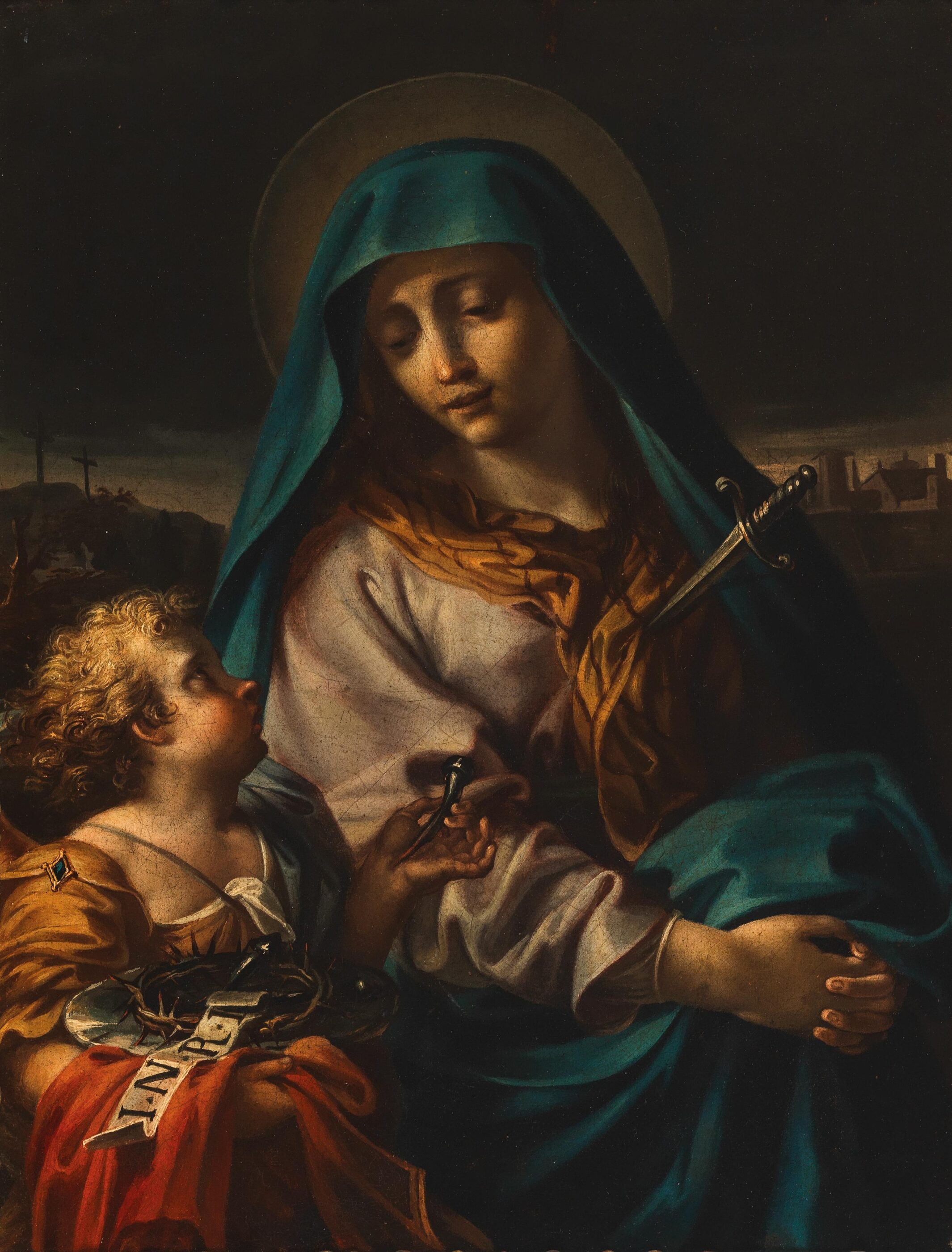
This way of presenting the Painful Heart of Mary is new, as until then, Mary of Sorrows was depicted with a heart pierced by one or seven swords, to recall the past sorrows of Mary (the seven sorrows, or the sword prophesied by Simeon in Lk 2:35), or, more simply, with a heart crowned with roses, which obviously implies the presence of thorns.
Saint Alphonse writes:
*”Pelbarto relates that Saint Elizabeth was revealed that Saint John the Evangelist, after Mary’s Assumption into Heaven, desired to see her again. He obtained this grace: his beloved Mother appeared to him, along with Jesus Christ. And he then understood that Mary asked for some special grace for her devotees of her sorrows, and that Jesus promised them, four principal graces: that whoever invokes the Virgin Mother for her sorrows, before death, will merit to perform true penance for all his sins. That He will protect these devotees in the tribulations they face, especially at the time of death. That He will imprint upon them the memory of His passion, and that in Heaven, He will reward them. That He will place these devotees in Mary’s hands, so that she may dispose of them as She pleases and obtain for them all the graces She desires.”*
“, (Saint Alphonse de Ligori, The Glories of Mary, Discourse IX, «On Mary’s Sorrows»). And Saint Alphonse concludes by recounting the conversion and salvation of a great sinner, who was saved precisely through his devotion to Mary’s sorrows (Saint Alphonse de Ligori, The Glories of Mary, Discourse IX, «On Mary’s Sorrows»).
St. Brigid, a great devotee of Christ’s Passion and Mary’s Compassion, is attributed with revealing the seven most particularly painful moments in the life of Our Lady:
- in the prophecy of Simeon, when she learned she would suffer for her Son Jesus (Lk 2:33-35)
- in the persecution of Herod and the flight to Egypt (Mt 2:1-23)
- in the loss of Jesus in the Temple of Jerusalem (Lk 2:41-51)
- in the encounter with the Son carrying the cross on the way to Calvary (Mt 27:31-33)
- in the crucifixion and death of Jesus (Jn 19:25-27)
- in the descent from the cross, when she received in her arms the beaten and dead body of her Son (Jn 19:31-38)
- in the burial of her Son, when she laid Him in the tomb while she remained in sad solitude (Jn 19:39-42)
St. Brigid, in her approved Church revelations, also states that Our Lady promised to grant seven graces to whoever recites seven Hail Marys each day around her Sorrows or Tears:
- I will bring peace to their families
- They will be enlightened about divine mysteries
- I will console them in their sorrows and accompany them in their labors
- I will grant them everything they ask, provided it does not contradict the adorable will of my divine Son and the sanctification of their souls
- I will defend them in spiritual battles against the infernal enemy and protect them in every moment of life
- I will assist them visibly at the moment of death
- I have obtained from my Son that those who propagate this devotion (to my Tears and Sorrows) be transferred from this earthly life to eternal happiness directly, for all their sins will be destroyed, and my Son and I will be their eternal consolation and joy
We can also add the promise made by Our Lady to Sister Lucia of Fátima on December 10, 1925: «Look, daughter, at my Heart crowned with thorns, which the ungrateful ones pierce at every moment with blasphemies and ingratitudes. At least, try to console Me, and say that I promise to assist, at the hour of death, with all the necessary graces for salvation, all those who, on the first Saturday of five consecutive months, confess, receive Holy Communion, pray the Rosary, and make reparation to Me for a quarter of an hour, meditating the fifteen mysteries, with the intention of offering Me reparation».
Why so many promises, in private revelations, to encourage the faithful to recite the sorrows of Mother of Jesus and ours? Jesus loves Mary because she is His Mother. He knows how much she suffered in union with Him for our salvation. We were saved from hell by Christ’s most dolorous Passion, the only Redeemer, to which Mary associated herself in an incomparable manner by her Compassion at the foot of the Cross. Everything Jesus suffered in His body and heart, Mary suffered in her heart with a maternal pain that no other creature has known. It is for this reason that the spiritual tradition has attributed to her the title of «
“Corredentora”: not as a second redeemer cause, but as the one who, among all creatures, united her suffering most fully to the sacrifice of the Son. This heart that loved thus deserves our profound veneration and filial gratitude.
Mary, the lamb, servant of the Lord
The Second Vatican Council teaches that Mary suffered deeply with her Only-begotten, associating with a maternal spirit to his sacrifice, lovingly consenting to the immolation of the Son she bore, steadfastly maintaining under the cross the faithful consent given at the Annunciation (Second Vatican Council, Dogmatic Constitution Lumen Gentium 61-62). On the Cross, Mary is the Servant of the Lord (Lk 1:38-48), a perfect icon of service (Is 53), the Lamb of God (Jn 1:29-36). A servant lamb, patient and strong in pain (Acts 8:32), “
sine macula et sine defectu», because innocent and perfect is her sacrifice (1 Pt 1, 19), which atones and removes sin from the world (Jn 1, 29-36). To the Son, the Father, in the power of the Holy Spirit, she gives a “generous and humble servant,” full consent, acceptance, dependence, and loving detachment. Mary, the “companion of Christ,” is not only a “yes” to God’s Word, but participation in the death and glory of the Son. Indeed, at the foot of the cross, her maternal cooperation in the mission of the Savior was accomplished, both through her actions and sufferings (Lumen gentium 61).
By this extraordinary and formidable “maternal cooperation,” Mary, the humble Servant of the Lord, assumes in a surprising way the traits of the Servant of God, the spotless Lamb chosen to bring to completion the wonders announced by the prophets. “At the cross,” Mary is the Lamb’s Servant who bore the Lamb for sacrifice. The adventure of the young woman of Nazareth, begun with the mystery of the Annunciation, unfolds mystically throughout the public life of the Son and reaches its climax at Calvary, at the foot of the cross: “The pain of the Mother of God is great as the sea. She is immersed in it, but it is a restrained pain: she holds the heart firmly in her hand so that it does not break. The true death appears frighteningly in the open mouth of the Savior. But his head turned toward the Mother, to console her, and the cross is all light: the crossbeam of the cross became the light of Christ” (E. Stein).
The Lamb, associated with the sacrifice of the Lamb, suffers, in his own compassion, the passion of the Son, giving that sacrifice her maternal love consent. At the cross, the holy Virgin cooperates in salvation. She is the offering Virgin, crucified in her heart because she is indissolubly linked to the crucified Son. On Calvary, the union of the Mother with the Son is consummated in a sea of pain and charity at the same time. Both the Lamb and the Lamb’s Servant offer a single holocaust: “There was then one will in Christ and Mary, and they offered together a single holocaust: she, in the blood of her heart. He, in the blood of his flesh” (A. de Carts).
Inevitably, the title of Lamb refers to no less suggestive and biblically rich a title as the New Eve, because of her special cooperation in salvation. Mary is associated with Christ in the work of salvation, as Eve was Adam’s companion in the work of death. The liturgy proclaims Mary: “The Virgin cooperator and minister of the new covenant of salvation that offers the Lamb without blemish” (Missas da Bem-aventurada Virgem Maria). Mary is thus the New Eve, the Virgin who recapitulates the test, living to the full her vocation as a Virgin Mother, in a world wounded and seduced by evil: the strong woman, open to the Word, living to the full her vocation as a fertile Virgin Mother, icon of God’s maternal love, which transcends all love.
On Calvary, the Lamb bestows on the Lamb’s Servant the Holy Spirit (Acts 19, 26) and the tomb of John, “the disciple whom he loved” (Jn 19, 26). The title of Lamb also reveals Mary’s intimate bond with the Church (
Lumen Gentium 63), such that each is conceived in and through the other. The Church, like Mary, is called to share in the destiny of the Bridegroom Lamb, crucified and risen. Mary, finally, on the Cross, is the silent lamb, a contemplative presence more eloquent than words, consumed by the flames of the Holy Spirit in a holocaust of the interior: she is the “burning bush,” a presence so incandescent that she is totally identified with the death of her Son.
The Tears of Humanity
What does the Virgin say to each of us in tears? She sings because we do not recognize the coming of the Son, because we have not yet welcomed Him as our Lord. Mary suffers for the sin of indifference, for the infinite forms of paganism that distance us from the love of the Son. We no longer have a contrite and troubled heart. In families, as in parishes, the “sense” of sin has weakened. While God suffers from our daily offenses, we indulge in a state of sleep and domesticate our conscience of sin. However, it is not made holy who is not marked by the wound of the sword that pierced the Heart of Jesus and Mary. Let us learn to sing for our sins, to have suffering in our souls when we are against God. The first commitment of a genuine conversion is to reopen the wound of the heart and the tears of the eyes, because we are far from love.
The Tears of Jesus and Mary
At the feet of the Virgin of Sorrows, it is spontaneous to reflect on the tears of Jesus. Why? Bowing down before the Virgin of Sorrows is to feel a heart impulse that plunges into the tears of Christ. He, still foolish, as in Jerusalem then, says: “They will throw you down, you and your children, into this very place. They will leave no stone on stone in you, because you did not recognize the time when you were visited.” Jesus quotes and reveals his passion for us. Grieved by the evil we committed, he uses mercy without threats or punishments. He sows tears, but not without joy. Giving his life, he reaps our love (cf. Ps 126).
Mary participates in the tears of the Sower. And if the Son suffers for the sins of humanity, she cannot fail to be solidary in body and spirit. The most incisive icon of this divine solidarity is the Crucified, before whom Mary lets herself be enveloped by an eternal “yes” to the Father’s will. And the voice from on high proclaims: “Behold your Mother.” In this affirmation, the tears of Jesus and Mary, the tears of Mary with those of humanity, harmonize. From that moment of cross and glory, the Virgin lives the same feelings as Christ. She is the Mother who became pain for us on the Cross.
Conclusion
Contemplating Mary’s pain is not stopping at an emotional episode in the history of salvation, but entering the point where redemption reveals its human depth and, at the same time, its supernatural reach. At the foot of the Cross, Mary’s motherhood attains its highest form: not only motherhood according to the flesh, but motherhood according to the Father’s design, manifested in the gift of the Son to the disciple and of the disciple to Mary (
John 19, 25-27 reveals that Mary’s participation in Christ’s sacrifice on the Cross becomes her perpetual mission: to generate, in the order of grace, those who are associated with Christ. The Cross marks the end of Christ’s earthly mission but also the beginning of Mary’s maternal mission to the Church.
Therefore, Christian tradition, from the Fathers to the development of devotional forms in the West, recognized in the Most Holy Virgin of Sorrows not a peripheral devotion, but a way to spiritually understand the Paschal Mystery. “Desolata” is not merely a poetic title; it expresses the real solitude of one who remains when all flee, the strength of the faithful Mother, and the compassion that participates in the Redeemer’s suffering without replacing Him. The pain offered in union with Christ is not merely a narrative of losses, but becomes an act, an interior oblation, and loving consent.
Mary’s silent presence at the Cross constitutes the apex of her association with the salvific mission and, thus, a living source of her bond with the Church. The spirituality of the Immaculate Heart, as it emerges from the ecclesial consciousness, reveals that Mary’s maternal love is not merely tenderness but wounded love: the “thorns” signify a love that suffers for lack of acceptance and seeks reparation not out of resentment but out of charity. Here, devotion is not an escape from reality but heart education: to learn to respond to love with love and to transform indifference into conversion.
In the image of Mary as Servant and Lamb, theology achieves a powerful synthesis: the Mother, united to the Lamb, participates in the oblation with the consent of love, becoming a figure of the Church as bride, called to share the destiny of the crucified and risen Spouse. The New Eve does not repeat an idealized past; she recapitulates, in trial and suffering, the fidelity that opens the way to life. And so, Mary’s pain, far from fixating on herself, opens up to fertility: it generates hope, sustains perseverance, and teaches that salvation does not eliminate the cross but transfigures it.
Finally, Mary’s tears, united with Jesus’ tears, remind the faithful of a truth our time tends to numb: the gravity of sin and the seriousness of conversion. The Sentor of Sorrows does not weep to paralyze us, but to wake conscience, reopen a contrite heart, and lead to light.
Per crucem ad lucemNot as a rhetorical motto, but as a concrete form of the Christian path. Devotion to Sorrowful MotherWhen lived within the Church and oriented towards the Paschal center, it becomes a school of mercy, of solidarity with those who suffer, and of faithfulness to the saving love. Thus, all the world’s pain, passed through the Mother’s prayer, can become a place of encounter with Christ, where the Cross opens to the dawn of the Resurrection.Read also: The disciple’s path passes through Calvary. Mary At the foot of the cross “Short title/phrase” Mary In Christ, He reconciles us with God.To deepen devotive contemplation Mary Painful, consult the encyclical Mother of the Redeemer Section 18: Mary “At the Cross”“Mariology, angelology, demonology, josephology”
What does Mary’s pain at the foot of the cross teach us?
The pain of Mary at the foot of the Cross (Jn 19:25) is one of the deepest realities in mariology. It is not a passive suffering: Mary, the “strong woman” of Scripture (Pr 31), stands (stabat), a posture of courage and offering, not of despair. Her pain is co-redemptive in the sense that it is conscious, free, and united to the offering of the Son. Simeon had prophesied: «A sword shall pierce through thy soul.(Luke 2:35). On the Cross, this prophecy is fulfilled: Mary’s pain is the maternal face of the love that saves.
What are the Seven Sorrows of Mary and what is their spiritual meaning?
The Seven Sorrows (or Seven Sorrows of Mary) are moments of suffering contemplated in the Marian tradition:1) The prophecy of Simeon (Luke 2:35); 2) The flight into Egypt (Matthew 2:13); 3) The lost boy Jesus in Jerusalem (Luke 2:45); 4) Mary’s encounter with Jesus on the way to Calvary; 5) The crucifixion and death of Jesus; 6) The descent from the Cross (Pietà); 7) The burial of Jesus. Celebrated on September 15th (Our Lady of Sorrows), these moments propose a spiritual journey that joins human suffering to Christ’s redemptive mystery through Mary.
How does Mary’s suffering help us to understand our own suffering?
Mary is the Mater Dolorosa that the Church invokes precisely because her suffering is profound and real: she was not spared from pain, did not receive spiritual anesthesia. By contemplating her pain, the faithful learn that suffering does not contradict faith, but rather can become the place of the deepest encounter with God. Saint John Paul II, in Salvifici Doloris (25-26), states that Mary “opened her suffering to Christ” and, by doing so, shows the Church how to transform all human suffering into participation in the redeeming mystery of the Son.
Deepen your knowledge of Mariology If you desire to study Mariology With academic rigor, account for our (or our account of) the Postgraduate Program in MariologyLearn more about Marian theology “And as” Approved Marian apparitions recognized by the Church“Mariology, angelology, demonology, josephology”
Postgraduate Program in Mariology
Would you like to deepen your formation in Mariology? Get to know the Postgraduate Program in Mariology from Locus Mariologicus, an academic formation that combines theological rigor, spiritual life, and the living tradition of the Church.
Would you like to study Mariology seriously?
This article arises from the works in the Locus Mariologicus library. The Postgraduate Program in Mariology takes you to the same sources, with academic guidance: Scripture, the Fathers of the Church, and the Magisterium, from the first dogma to contemporary issues.




Responses