To Jesus through Mary in Saint Peter Damian: sermons, hymns, and Saturday
By Prof. Dr. Daniel C. Afonso · Updated
Sicut per te Dei Filius dignatus est ad nostra descendere, ita et nos per te ad ejus valeamus consortium pervenire.“Just as the Son of God deigned to descend to us, so too may we, through you, attain his company.” (St. Peter Damian)Sermo 46)
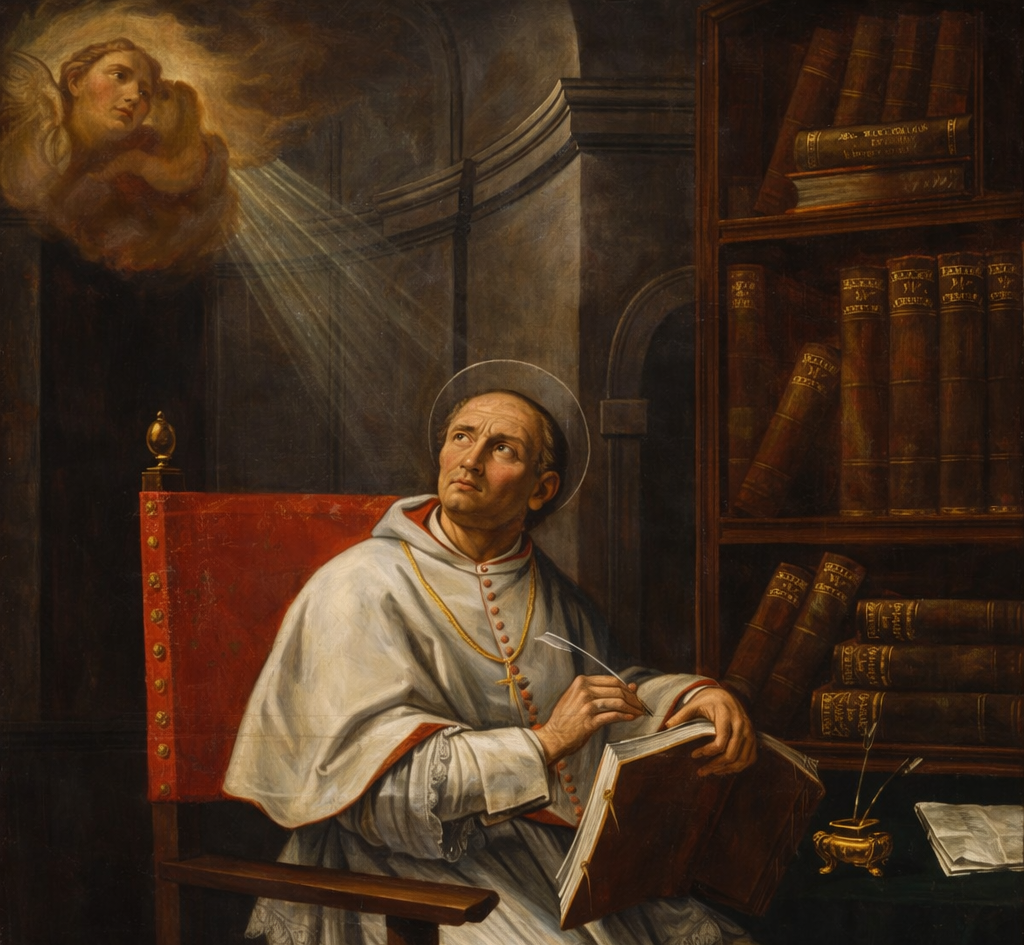
Saint Peter Damian (1007-1072), a monk and hermit from Fonte Avellana, a cardinal bishop of Ostia, and a Doctor of the Church, was one of the great reformers of the 11th century. He was also a devotee of Mary, and his sermons and hymns mark the Marian piety of medieval Western Christianity. Luigi Gambero, who studied the Mariology of medieval Latin theologians, states that he inspired the motto “to Jesus through Mary” (GAMBERO, 2000, p. 108). The texts show how far this idea extended and where subsequent tradition developed from it.
A question of authorship
Not all that the Patrologia Latina publishes under the name of Peter Damian is actually by him. The Marienlexikon notes that, of the seventy-five sermons in PL 144, nineteen are attributed to Nicholas of Clairvaux (COURTH, 1993, p. 182), the secretary to Saint Bernard, and the entry on Nicholas includes as his sermons the columns 736 B-740 D, which are the first sermon on the Nativity of Mary.Sermo44) (COURTH, 1992, pp. 623-624). Sermons 45 and 46, both on the Nativity of Mary, are authentic and have a critical edition (LONGÈRE, 2009, p. 583).
The House of Wisdom
Peter Damian reads the Nativity of Mary in the light of the Incarnation.Sicut ergo impossibile erat ut humani generis redemptio fieret, nisi Dei Filius de Virgine nasceretur, ita etiam necessarium fuerat ut Virgo, ex qua Verbum caro fieret, nasceretur“Just as it was impossible for the redemption of the human race to take place without the Son of God being born of the Virgin, so it was necessary that the Virgin should be born from whom the Word would become flesh.”Sermo(45, PL 144, 741 A).

And it applies to her the image from Proverbs: “It was necessary, indeed, that the house be built first, in which the Celestial King, descending, would be worthy to have lodging. That is, the one from which it is said through Solomon: Wisdom built for herself a house, she hewed seven columns” (Pr 9:1). The seven columns are the seven gifts of the Holy Spirit with which the Mother of the Lord was adorned (Sermo(45, PL 144, 741 B).
The Body of Christ, born of Mary
In one of his stronger statements, St. Peter Damian connects Mary to the Eucharist:Illud siquidem corpus Christi, quod beatissima Virgo genuit, quod in gremio fovit, quod in fasciis cinxit, quod materna cura nutrivit: illud, inquam, absque ulla dubietate, non aliud, nunc de sacro altari percipimus“That Body of Christ which the most blessed Virgin generated, which she held in her lap, which she wrapped in swaddling clothes, which she nourished with maternal care, that same one, without doubt, and not another, we now receive from the sacred altar.” And he adds the antithesis: “Eva ate a food by which we were condemned to the hunger of eternal fasting, Mary gave birth to a food that opened for us the way to the celestial banquet” (Sermo(45, PL 144, 743 B-C).
Eve and Mary
Through a woman, the curse of the earth was poured out; through a woman, the blessing of the earth is given back.SermoIn a hymn, in verses that repeat like an echo: “The Virgin gives life to man, whom a virgin had taken away,” and “Lifted above the stars, we pray for what Eve brought down” (Carmen 65, PL 145, 941 A).
“For You”
The same homily on the Nativity concludes with a prayer. Rogamus te, clementissima, ipsius pietatis et misericordiae mater, ut qui tuae laudis insignia frequentare gaudemus in terris, tuae intercessionis auxilium habere mereamur in coelis, quatenus sicut per te Dei Filius dignatus est ad nostra descendere, ita et nos per te ad ejus valeamus consortium pervenire“We pray to thee, most merciful Mother of piety and mercy, that we, who rejoice in celebrating on earth thy praises, may merit to have in heaven the aid of thy intercession, that even as by thee the Son of God deigned to descend to us, so by thee we also may attain to his company.”Sermo(46, PL 144, 761 B).
It is not yet the formula “to Jesus through Mary,” but it contains its core: the path by which the Son came to us is the path by which we go to him. The Marienlexikon notes that, since Mary is the path of Christ in time, the path to Christ also passes through her, and that this idea gained great importance in subsequent mariology (COURTH, 1993, p. 183).
Mary and the Church
In a sermon on Saint John, Peter Damian sets the two Mothers side by side:Utraque nimirum mater, mater Maria, mater Ecclesia. Sed Maria mater Christi, Ecclesia mater populi Christiani“Both are mothers, Mary as mother, the Church as mother. But Mary is the mother of Christ, the Church is the mother of the Christian people.”Hoc itaque modo et ex Maria prodiisse videtur Ecclesia“In this way, it seems that the Church was also born from Mary.”Sermo(63, PL 144, 861 A-B).
Mary’s Saturday
Peter Damian helped to spread the custom of dedicating Saturday to Mary and praying her office. He explains the reason: “Indeed, the Saturday, which is interpreted as rest, on which day it is said that God rested, is most appropriately dedicated to the most blessed Virgin, who built for herself a house of wisdom, and in it, by the mystery of humility assumed, rested as in a most sacred bed” (Opusculum 33, 4, PL 145, 565 D-566 A). And his Carmina 48-60 form a small daily office in honor of Mary, which begins “Sidus, Maria, splendidum, te laudat omne saeculum,” “Splendid star, Mary, all centuries praise you” (Carmen 48, PL 145, 935 B).
## References
Court, Franz. Nikolaus of Clairvaux. In: Bäumer, Remigius and Scheffczyk, Leo (eds.). Marienlexikon. St. Ottilien: EOS, 1992. Vol. 4, pp. 623-624.
Court, Franz. Petrus Damiani. In: Bäumer, Remigius and Scheffczyk, Leo (eds.). Marienlexikon. St. Ottilien: EOS, 1993. Vol. 5, pp. 182-183.
GAMBERO, Luigi. Mary in the Thought of Medieval Latin Theologians. Cinisello Balsamo: San Paolo, 2000.
LONGÈRE, Jean. Orationes ad Sanctam Mariam and the literary genre of Mariale. In: DAL COVOLO, Enrico and SERRA, Aristide (eds.). History of Mariology, vol. 1: From the Biblical Model to the Literary Model. Rome: Città Nuova, Marianum, 2009. pp. 567-589.
Peter Damian. Sermons. In: MIGNE, J.-P. (ed.). Patrologiae cursus completus. Series Latina. Vol. 144. Paris: Migne, 1853.
Pedro Damien. Opuscula. Carmina et preces. In: MIGNE, J.-P. (ed.). Patrologiae cursus completus. Series Latina. Vol. 145. Paris: Migne, 1853.
Postgraduate Program in Mariology
Would you like to deepen your formation in Mariology? Get to know the Postgraduate Program in Mariology from Locus Mariologicus – an academic formation that combines theological rigor, spiritual life, and the living tradition of the Church.
Would you like to study Mariology seriously?
This article arises from the works in the Locus Mariologicus library. The Postgraduate Program in Mariology takes you to the same sources, with academic guidance: Scripture, the Fathers of the Church, and the Magisterium, from the first dogma to contemporary issues.
Responses