The true message of Guadalupe in Nican Mopohua
By Prof. Dr. Daniel C. Afonso · Updated
Am I not here, who am your mother?
«Am I not here, who am your mother?» (Nican Mopohua 119)
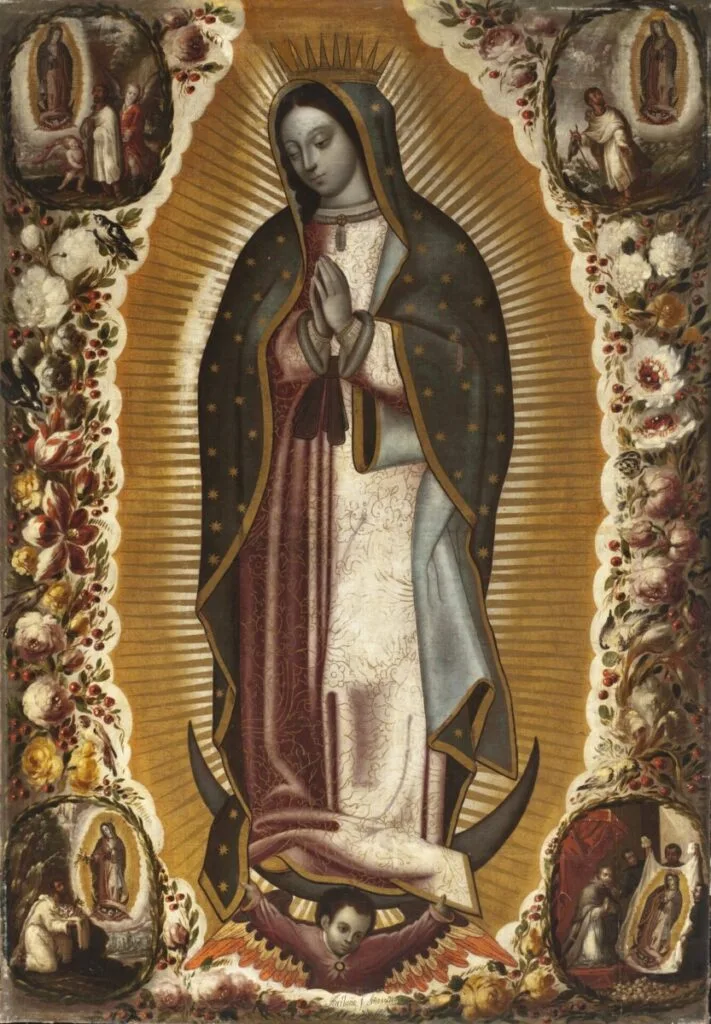
The message of Guadalupe is not found in hidden codes within the image, but in a text: the Nican Mopohua, the narrative in the Nahuatl language of the December 1531 apparitions to the indigenous Juan Diego on the Tepeyac hill, north of Mexico City. The name derives from the first words of the text, «here it is told». Written in the mid-16th century, it was transcribed in the Latin alphabet by Antonio Valeriano (1520-1605), an indigenous convert, and published by Luis Lasso de la Vega in 1649 (LAURENTIN and SBALCHIERO, 2007, p. 405). The text is cited in the Castilian translation by Mario Rojas (Los Angeles, 1994), divided by him into 218 verses, and reproduced in full by Osorio Villaseñor (2017, p. 58-64).
The Context
Eduardo Chávez Sánchez describes in the entry “Guadalupe” in the dictionary Mariology (2009, pp. 597-598) Mexico in 1531: ten years after the conquest of Tenochtitlan, the indigenous population devastated by epidemics, the first Franciscan missionaries with few fruits, and a hard conflict between Bishop Juan de Zumárraga and the Spanish authorities of the First Audience. In 1529, Zumárraga wrote to the king saying that, if God did not intervene, that land was on the verge of complete ruin (Chávez Sánchez, 2009, p. 598).
Four days in December
The narrative begins on a Saturday, December 9, 1531, very early in the morning (v. 3-6, Chávez Sánchez, 2009, p. 598). Juan Diego, a resident of Cuauhtitlan (v. 4), was on his way to Mass when he heard the song of birds in Tepeyac and a voice calling his name. A young lady presented herself: “the ever-perfect Virgin Saint Mary, Mother of the true God by whom all live” (v. 26). She requested that a house be built on that site, where she would manifest her love and hear the sorrows and cries of all who invoke her (v. 26-33).

Juan Diego went to the bishop, who listened to him without believing. He returned to Tepeyac and asked the Lady to send someone more important, for he was merely a peasant: I am a rope, I am a basket, I am a fan, I am a wing, «I am a load-bearing cord, I am a pad, I am a tail, I am a wing» (v. 55). The Lady insisted that he go. On Sunday, the bishop asked for a sign (v. 68-87).
On Monday, Juan Diego did not return, for his uncle, Juan Bernardino, was seriously ill. On Tuesday, December 12 (verse 99, Chávez Sánchez, 2009, page 599), he went to seek a priest for his uncle and tried to pass by Tepeyac on another route, to avoid encountering the Lady. She met him and spoke to him the words that form the heart of the message:
Am I not here, who am your Mother? Are you not under my shadow and protection? Am I not the source of your joy? Are you not in the lap of my mantle, at the cross of my arms? Do you need anything else?, «Am I not here, who am your Mother? Are you not under my shadow and in my care? Am I not the source of your happiness? Are you not in the embrace of my cloak, at the crossing of my arms? Do you need anything else?» (v. 119).
He assured him that his uncle was already healed and instructed him to gather flowers from the top of the hill (v. 120-126). Juan Diego found there Castilian roses, in the midst of winter (v. 128-133, 170), gathered them in his tilma, and brought them to the bishop. When he opened the cloak before him, the flowers fell, and suddenly the image of the Virgin appeared (v. 181-190). The bishop placed the image in his oratory, and the next day he went with Juan Diego to the place where the church was to be built (v. 191-194). The uncle recounted that the Lady had also appeared to him and requested that the image be called Santa Maria de Guadalupe (v. 195-208).
What the message says
The narrative offers no revelations about the future nor calls for penance. Mary presents herself as a mother, asks for a house to manifest her love, and chooses as her messenger a poor indigenous man, whom she treats with tenderness and who insists on sending a message to the bishop. The request goes through the Church: it is the bishop who must build the house. Laurentin and Sbalchiero, in the Dictionary of “Apparitions”, note that the original manuscript of the Nican Mopohua is lost and record the expansion of the cult that originated at Tepeyac: a first sanctuary completed in 1533, indirect approval of the apparitions by Bishop Alonso de Montúfar in 1555, and the authorization of a specific liturgical office by Pope Benedict XIV in 1754 (LAURENTIN and SBALCHIERO, 2007, pp. 405-406).
John Paul II saw Guadalupe as a model of inculturated evangelization. In the Exhortation Ecclesia in America, he wrote: “The mestizo face of Our Lady of Guadalupe was already, from the beginning on the Continent, a symbol of the inculturation of evangelization, of which it has been the star and guide,” (John Paul II, 1999, n. 70, p. 806). Juan Diego was canonized by the same pope, in the Basilica of Guadalupe, on July 31, 2002 (Chávez Sánchez, 2009, p. 602).
Pope Benedict XIV to John Paul II’s documents on Guadalupe are available at Marian Apparitions in the Magisterium.
## References
Chávez Sánchez, Eduardo. “Guadalupe.” In: De Flores, Stefano, Ferrari Schiefer, Valeria, and Perella, Salvatore M. (eds.). Mariology. Cinisello Balsamo: San Paolo, 2009. (I Dizionari San Paolo). pp. 596-602.
John Paul II. Post-Synodal Apostolic Exhortation Ecclesia in America, January 22, 1999. Acta Apostolicae Sedis, Vatican City, vol. 91, pp. 737-815, 1999.
Laurentín, René and Sbalchiero, Patrick. Guadalupe (Mexico, Diocese of Mexico). In: Laurentín, René and Sbalchiero, Patrick (eds.). Dictionary of the “Appearances” of the Virgin Mary. Paris: Fayard, 2007. pp. 402-408.
Osorio Villaseñor, J. Roel. Mary in the Evangelii gaudium of Pope Francis: A synthesis of a theological journey. 2017. Thesis (Licentiate in Theology with a specialization in Mariology) – Pontifical Theological Faculty «Marianum», Rome, 2017.
Postgraduate Program in Mariology
Would you like to deepen your formation in Mariology? Get to know the Postgraduate Program in Mariology from Locus Mariologicus – an academic formation that combines theological rigor, spiritual life, and the living tradition of the Church.
See the complete list of recognized Marian apparitions by the Church.
Are you serious about studying mariology? This article arises from the works in the Locus Mariologicus library. The Postgraduate Program in Mariology takes you to the same source, with academic guidance: Scripture, the Fathers of the Church, and the Magisterium, from the first dogma to contemporary issues.
Learn more about the Postgraduate Program in Mariology here.
Responses