Catholic Angelology: the Angels, the Hierarchies, and the Doctrine of the Church
Angelology is the theological treatise on the angels – purely spiritual creatures, created by God, endowed with intelligence and will, who contemplate Him and are sent as messengers of His plan of salvation. When the Creed confesses that God created “the universe visible and invisible,” it affirms that the real is not exhausted by matter: the angels belong precisely to that invisible creation. Here we present, in a Catholic key and with sobriety, what the angels are, how they are ordered, their place in the Bible, and what the Magisterium of the Church teaches.
What is Angelology?
The word comes from the Greek ángelos (“messenger”). Angelology studies the nature, the hierarchy, and the mission of the angels – and, by contrast, the fall of the rebel angels (demonology). A distinction of method matters here: the experimental sciences do not deny the angels; they simply cannot take them as their object, because they escape what is measurable. To confuse that limit with a denial of the real is already a philosophical option, not a scientific conclusion. Theology works on another plane: it does not measure, it interprets; it does not control, it discerns – in the light of Revelation and of reason.
What are the Angels?
Against ancient confusions, the patristic tradition fixed three affirmations: the angels are creatures (not gods nor eternal forces), they are spiritual (pure spirit, without a body), and they are providential (they serve God’s design). They possess intelligence and will and are by nature immortal. Saint Thomas Aquinas specified that, having no matter, each angel constitutes in itself a species – Gabriel and Michael do not differ as two men do, but as two distinct natures. Their knowledge is not discursive like ours: it is intuitive, received from God in the very act of creation.
The Angelic Hierarchies: the Nine Choirs
Following Pseudo-Dionysius the Areopagite (The Celestial Hierarchy), the tradition distinguishes nine choirs, in three hierarchies:
- Seraphim, Cherubim, and Thrones – beside the throne of God;
- Dominions, Virtues, and Powers – in the governance of creation;
- Principalities, Archangels, and Angels – sent to men.
Saint Thomas reinterpreted this order in a cognitive key: the more universal the knowledge the angel receives from God, the higher its order. Of the nine, five carry out missions in the world – Powers, Principalities, Virtues, Archangels, and Angels. For a deeper study, see the class The Angelology of Saint Thomas Aquinas.
The Angels in the Bible
In Scripture, the angels are never an object of curiosity: they always appear in the service of the history of salvation. In the Old Testament, the cherubim guard Eden (Gen 3:24) and the Angel of the Lord accompanies the people. In the New Testament, Gabriel announces the Savior (Lk 1), the angels sing at Christmas (Lk 2:13-14), serve Christ in the desert (Mt 4:11), and proclaim the Resurrection (Mt 28:5-7). The exorcisms of Jesus themselves are linked to the coming of the Kingdom: “If I cast out demons by the Spirit of God, then the Kingdom of God has come upon you” (Mt 12:28). The name of the angel is, in the final analysis, mission: he points to God and withdraws.
The Archangels: Michael, Gabriel, and Raphael
Scripture names three archangels, celebrated on September 29:
- Saint Michael (“Who is like God?”) – prince of the heavenly host (Dan 10; Rev 12:7);
- Saint Gabriel (“Strength of God”) – messenger of the Incarnation (Lk 1);
- Saint Raphael (“God heals”) – companion of Tobias (Tob 12).
The Guardian Angels
The Catholic faith teaches that each person is accompanied by a guardian angel, who protects him and leads him to God: “From infancy to death, human life is surrounded by their protection and their intercession” (CCC 336). The Church celebrates the Holy Guardian Angels on October 2.
What the Magisterium of the Church teaches
The Magisterium intervened above all to defend two truths: that the spiritual world belongs to creation and that evil is not an absolute principle. The Fourth Lateran Council (1215) defined that God created “out of nothing” the spiritual and the corporeal creature – the angels and the world – and that “the devil and the other demons were created good by God, but became evil by their own doing” (Denzinger 800). The Catechism treats of the angels in nn. 328-336 and of the fall in nn. 391-395. In the twentieth century this faith was reaffirmed by Paul VI (1972), the Congregation for the Doctrine of the Faith (Christian Faith and Demonology, 1975), and the catecheses of Saint John Paul II (1986).
The Fall of the Angels: Demonology
Not all the angels remained faithful. Some, by a free and irrevocable choice, refused God: this is the fall, from which the Devil and the demons proceed. Their sin was one of pride – a purely spiritual sin, of the will that refuses subordination to the Creator (cf. CCC 391-395). Here the faith maintains a sober realism: Satan is not an “anti-God” nor an equivalent cosmic force; he is a fallen creature. Evil is real, but not sovereign; active, but defeated. The key to everything is Easter: the cross and the resurrection of Christ are the decisive victory. For this reason the Christian lives in vigilance, not in fear.
Mary, Queen of the Angels
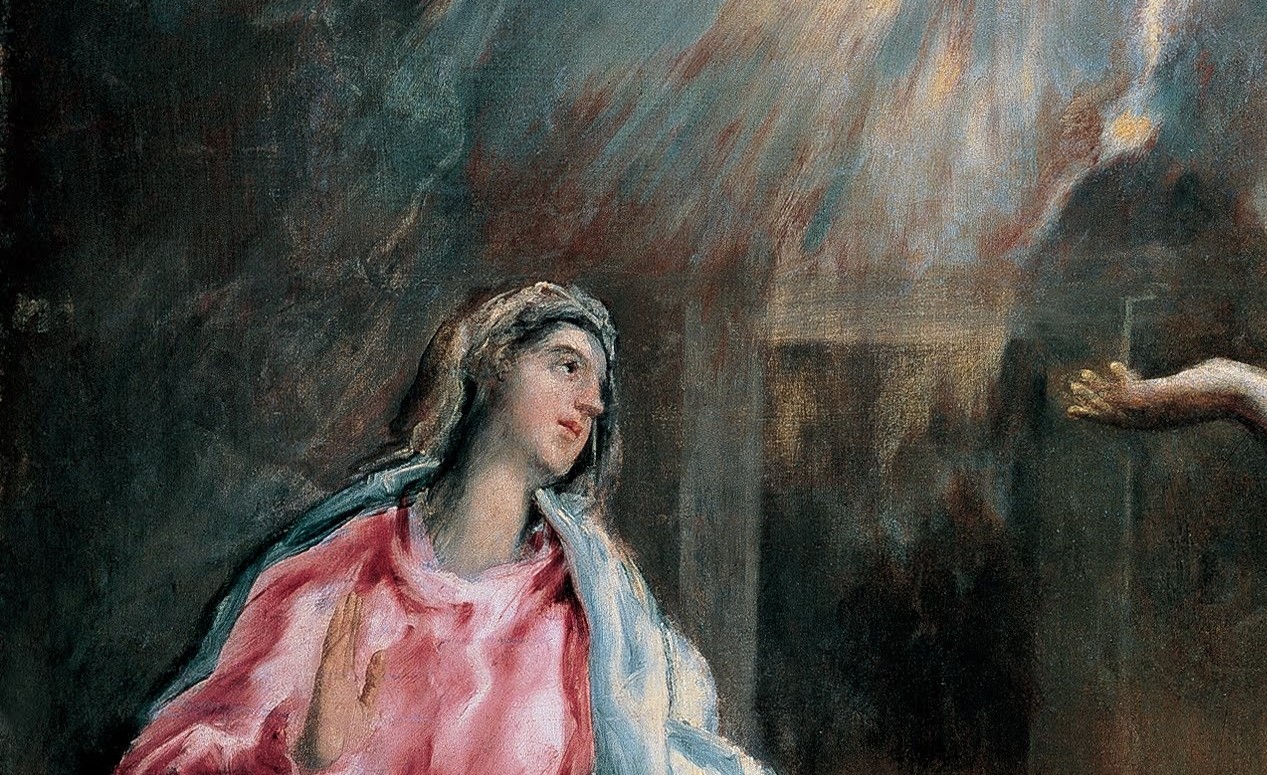
Here angelology meets Mariology. In the Litany of Loreto, Our Lady is invoked as Queen of the Angels (Regina Angelorum). Because she is the Mother of God and full of grace, Mary surpasses in dignity all the heavenly choirs – and yet she was served by them: Gabriel announces the Savior to her, and the angelic legions adore the Son whom she gives to the world. To read angelology in the light of the Mother of the Lord is the perspective proper to the Locus Mariologicus Institute.
Sources for Deeper Study
- The Angelology of Saint Thomas Aquinas
- The Angels in the Bible (Old and New Testament)
- Denzinger – dogmatic definitions on the angels
- Patristic angelology (Fathers of the Church, 2nd-8th centuries)
- Saint Michael the Archangel · Saint Gabriel the Archangel
Frequently Asked Questions
What is angelology?
It is the theological treatise that studies the angels: their nature as pure spirits, their hierarchies, and their mission in the history of salvation, according to Scripture and the Magisterium of the Church.
How many choirs of angels are there?
Nine choirs, in three hierarchies: Seraphim, Cherubim, and Thrones; Dominions, Virtues, and Powers; Principalities, Archangels, and Angels.
Which are the three archangels?
Saint Michael, Saint Gabriel, and Saint Raphael, celebrated by the Church on September 29.
Text of the Locus Mariologicus Institute, founded in Rome. Scientific direction by Prof. Dr. Daniel Cerqueira Afonso (PhD, Marianum).
See also
Would you like to study angelology and demonology in depth?
This article comes from the Locus Mariologicus library. The postgraduate specialisation in Angelology and Demonology (360 hours, fully online) studies angels and demons in Scripture, the Fathers and the Magisterium, with a whole area on practical demonology, exorcism and deliverance prayer. The new class begins on 18 January 2027. Classes are taught in Portuguese.


Responses