The Presentation of Mary in the Temple (November 21)
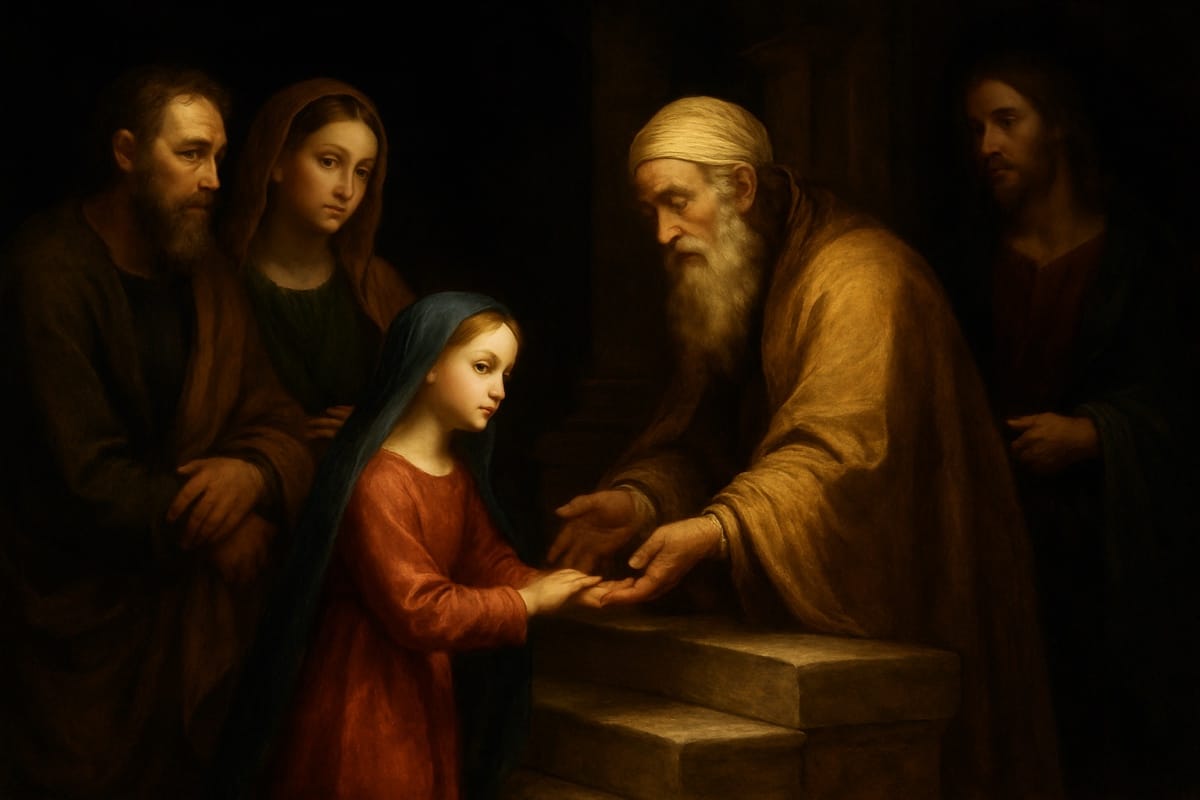
The Presentation of Mary in the Temple is celebrated on November 21 and recalls the tradition according to which Mary, while still a little girl, was consecrated to God by her parents, Joachim and Anne, in the Temple of Jerusalem. Like the Nativity of Mary, this feast has its origin in the Protoevangelium of James and expresses a profound truth: Mary belonged entirely to God from the beginning of her life.
The origin of the feast
The feast arose in the Christian East – where it is called the “Entrance of the Mother of God into the Temple” (Eisodos) – and is documented from the sixth century, linked to the dedication of a church to Saint Mary in Jerusalem. In the West it spread beginning in the fourteenth century. Today it is a liturgical memorial throughout the Church.
The meaning: Mary, the living Temple
The meaning of the feast is not historical but theological. Mary, presented and consecrated to God from childhood, is the creature who belongs entirely to the Lord. And there is a luminous paradox: she who is brought into the Temple becomes herself the true Temple – the holy place where God will come to dwell at the Annunciation. The feast also celebrates the total consecration of life to God, the model of all Christian and religious life.
Frequently Asked Questions
When is the Presentation of Mary?
On November 21.
Is it a historical fact?
The episode comes from the Protoevangelium of James, not from the canonical Gospels. Its value is theological and spiritual: Mary’s total belonging to God.
See also
Would you like to study Mariology seriously?
This article grows out of the works in the Locus Mariologicus library. The Postgraduate Program in Mariology takes you to the same source, with academic guidance: Scripture, the Fathers of the Church, and the Magisterium, from the first dogma to contemporary questions.




Responses