Ascended to the Father: Mary and the glory of the Son’s return
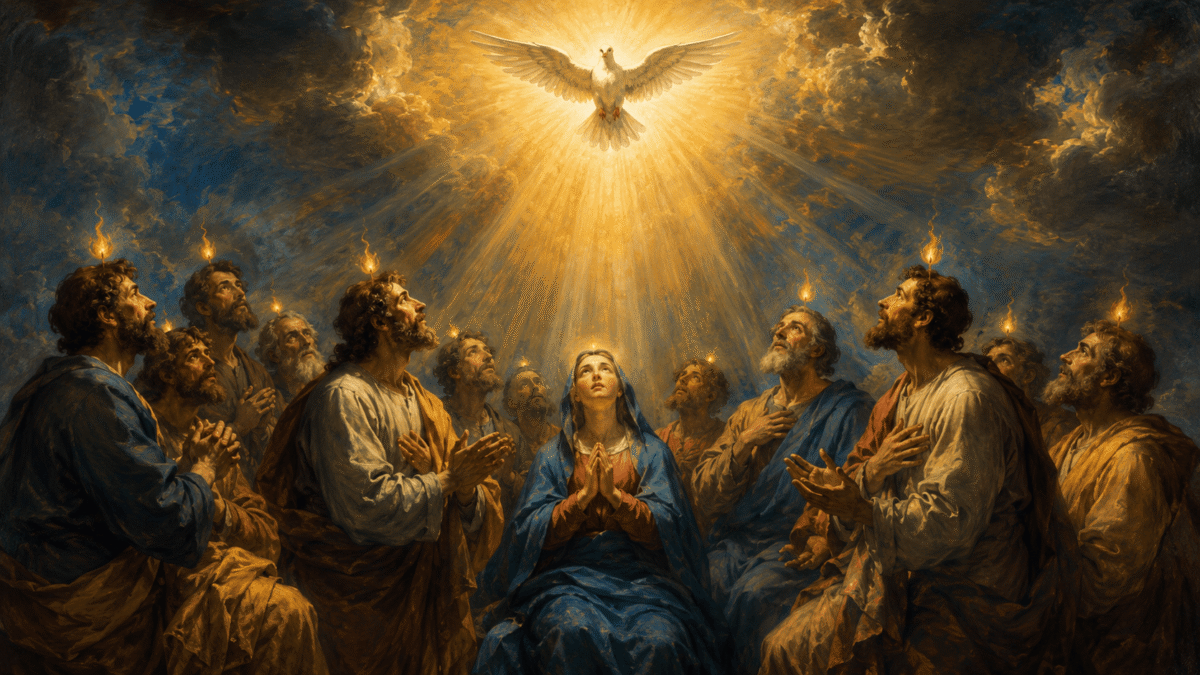
Ascendo ad Patrem meum et Patrem vestrum, et Deum meum et Deum vestrum.
Jo 20,17
“‘I go to my Father and your Father, to my God and your God.’ The words that the Risen One speaks to Mary Magdalene in the garden (Jn 20:17) summarize the entire Johannine theology of Ascension: the Son’s return to the Father is not a separation but a transformation of the relationship, and the disciples will now be introduced to the same filial relationship that the Son has with the Father. Mariology finds in this scene, and in the Ascension feast it inaugurates, one of its richest points of reflection: if the Son ‘ascends to the Father,’ Mary, who has received the Son more deeply, participates in this ‘ascending’ in a unique way.”
I. The Ascension in the Fourth Gospel: Return and Transformation
The Fourth Gospel does not narrate the Ascension explicitly as a historical event; this narrative belongs to Luke (Lk 24:50-53. Acts 1:9-11). However, the Ascension is omnipresent in John as a theological horizon: the entire farewell discourse (Jn 13-17) is structured around Jesus’ “going” to the Father. Jn 20:17 is the moment when the Risen One announces the imminence of this return: “I am going to my Father.”
The distinction that John 20:17 establishes, «my Father and your Father», is theologically precise. Not «our Father», because Jesus’ filiation is unique and eternal, while the filiation of the disciples is adoptive and derived. But «your Father», because Jesus’ Ascension introduces the disciples into a new relationship with God: they can now call «Father» the God of Jesus with the authority that the Son communicates to them. Thus, the Ascension is the definitive opening of divine filiation to humanity.
St. Athanasius formulated this principle in his soteriological axiom: “
Deus fez-se homem para que o homem se tornasse DeusThe Ascension is the fulfillment of this axiom: the Son who descended to raise humanity now ascends, taking humanity with Him. The humanity of Christ, real and concrete, the flesh He received from Mary, is now seated «at the right hand of the Father» (Eph 1:20). This means that human flesh has been introduced into the heart of trinitarian life: not merely «forgiven» but glorified, exalted, deified.
The mariological implications are immense: the flesh that the Son carried to the right hand of the Father is the flesh He received from Mary. The Ascension of Jesus is, in this sense, the anticipatory glorification of Mary’s flesh. What the Son now does with His humanity, including the flesh that is Mary’s, is the guarantee that Mary, and all redeemed humanity, will follow the same path. The Assumption of Mary is the fulfillment of this logic: the Son who ascended with Mary’s flesh welcomed Mary into His glorification.
II. Mary and the Ascension: Presence in the Farewell
Luke places the Apostles alongside Jesus at the moment of the Ascension (Lk 24:50. Acts 1:9-12). Mary, though not explicitly mentioned in the Ascension in Acts 1, is implicitly present: she is part of the group who “returned to Jerusalem with great joy” (Lk 24:52) and who will later gather in the Cenacle (Acts 1:14). The Ascension is, for Mary as for the Apostles, a moment of “farewell”, but a farewell that turns sorrow into joy.
The “great joy” with which the disciples return to Jerusalem after the Ascension (Lk 24:52) paradoxally contrasts with the expected sadness: Jesus “left,” and they are joyful? This joy can only be understood from the logic of Jn 16:7 (“it is to your advantage that I go”) and Jn 14:28 (“if you loved me, you would rejoice that I am going to the Father, for the Father is greater than I am”). The love of Jesus for the Father is the reason for the disciples’ joy at the Ascension: they love what Jesus loves. And Jesus goes to him who he loves most.
Mary, who loved the Son more deeply than any other human being, experienced this “joy in parting” particularly intensely. She who suffered at the Cross now contemplates the glorified Son who “ascends to the Father.” The same mother who received the Son in her arms in Bethlehem now contemplates him ascending to the glory that is eternally his. This contemplation of the Son’s glory, by the Mother who knows him intimately, is one of the most emotionally rich moments that tradition can imagine, although the Gospels do not narrate it explicitly.
The Eastern iconographic tradition has developed the scene of the Ascension with Mary at the center of the group of Apostles, with her arms raised in prayer or her hands open in adoration. This central positioning of Mary, emphasized in Byzantine icons, expresses the intuition that she is the central figure of the Church contemplating the glorified Son. She who was the point of entry for the Son into the world is now the reference point for the Church that contemplates him ascending to the Father.
III. «Do not touch me»: Ascension and a new form of presence
The Ascension of the Lord marks a pivotal moment in the Christian faith, signaling the completion of Christ’s earthly ministry and the beginning of His heavenly reign. This event, celebrated on the forty-ninth day after Easter, is not merely a departure but a transformation, as Christ ascends into the presence of the Father, preparing a place for His disciples (Jn 14:2-3). In this new reality, the Risen Lord continues to be present in a different way, through the power of the Holy Spirit.
For Catholics, the Ascension is not just a historical event but has profound implications for our spiritual lives. It signifies the ultimate victory over sin and death, and the promise of our own resurrection and ascension into heaven. It reminds us of the reality of Christ’s continuous intercession for us, as He sits at the right hand of the Father (Heb 7:25).
Through the Ascension, Christ establishes a new form of presence, not limited to time and space. He is present in a real but spiritual way through the sacraments, especially the Eucharist, where we receive His Body and Blood, the very substance of His Ascension (1 Cor 10:16-17). In the Eucharist, we participate in the divine nature (2 Pt 1:4), becoming one with Christ in a mysterious yet profound way.
This new form of presence is also manifested in the ongoing work of the Holy Spirit, who guides the Church and its members into all truth (Jn 16:13). The Spirit is the presence of Christ, who dwells within us, empowering us to live as His witnesses in the world (Acts 1:8).
Thus, the Ascension is not a departure but a continuation, a transition from one mode of presence to another. It invites us to trust in Christ’s continuous intercession, to participate in His divine nature, and to live as His disciples in the world, bearing witness to the good news of salvation.
John 20:17: “Do not touch me” (me mou haptou), Jesus says to Mary Magdalene, indicating that the relationship with the Risen One cannot be that of the historical Jesus who allowed physical touch. The new relationship with the Risen One, fully revealed in the gift of the Spirit, is of a different nature: no less real, but deeper, more interior, more universal. The Ascension prepares for this new form of relationship.
This “new form of presence” that the Ascension inaugurates has a direct Marian dimension. Mary, who “touched” the Son in a more intimate way than any other human being, who carried Him in her womb, who nursed Him, who embraced Him, experiences after the Ascension a relationship with the glorified Son that goes beyond physical contact. This “glorified” relationship is deeper, not less real: she who is with the Son in glory shares with Him a communion that flesh still does not allow to her spiritual children.
The mariology of intercession, the conviction that Mary intercedes for her spiritual children with the glorified Son, is precisely based on this new form of relationship that the Ascension inaugurates. Mary does not “intercede from afar” as someone who is separated from him she intercedes for; she intercedes “from within” the communion with the glorified Son, with the authority and intimacy of one who shares his glory. The intercession of Mary is not that of a subject who asks the king, but that of a Mother who has the intimacy of one who generated the Eternal Son.
The tradition of invoking Mary as «Our Advocate» is rooted in this logic. An advocate who intercedes before a judge does not do so from afar, outside the court, but is present, knows the circumstances, and has authority to speak. Mary, «present» in glory alongside the Son, intercedes with the authority of one who knows Him more intimately than any other human being and who loves Him with the love of a Mother who never gives up on her children.
IV. «Be witnesses»: Mary and the mission of the Church after the Ascension
The mission entrusted to Mary at the Annunciation, to be the Mother of the Savior, is intimately connected to the mission of the Church after the Ascension. As the Virgin Mary gave birth to Jesus, so too does the Church, through the sacraments, bring forth the life of Christ in the world. Mary, as the first fruit of the redemption, prefigures and accompanies the entire people of God on its way to the fullness of times.
In the Acts of the Apostles, we see the early Church, guided by the Holy Spirit, fulfilling the mission entrusted to Mary. The apostles, filled with the Spirit, testify to the life, death, and resurrection of Jesus Christ (Acts 2:1-4). This testimony is not merely intellectual assent but a dynamic witness that leads to conversion and the reception of the sacraments. It is a mission that continues today through the Magisterium and the Doctors of the Church, who, like the apostles, are called to be faithful witnesses of the truth revealed in Christ.
Mary, as the Mother of the Church (Realeza de Maria), is the model of this mission. Her perpetual virginity (virgindade perpetua) and her role as Corredentrix (Coredemptrix) mean that she is intimately involved in the work of salvation. As the Mediatrix of All Graces (Medianeira de todas as gracas), she intercedes for the Church, guiding it on its way to God. Her role is not to replace the Church or the sacraments, but to complement and deepen them, ensuring that the life of Christ is truly present and active in the world through the people of God.
Just as Mary was chosen to be the mother of the Savior, so too is the Church called to be a witness to the world. This witness is not merely passive but active, involving the whole person—intellect, will, and emotions—in a dynamic relationship with God. It is a mission that requires courage and fidelity, as the early Church faced persecution and trials. Today, the Church continues this mission, guided by the Spirit, as it proclaims the Gospel and seeks to bring the good news to all people.
“Acts 1:8: ‘You will receive power when the Holy Spirit comes upon you, and you will be my witnesses in Jerusalem, throughout all Judea and Samaria, and to the ends of the earth.’ The Ascension is not the end of the mission, but its beginning in a new phase. The disciples who saw Jesus ascend are given the mandate to be ‘witnesses,’ not passive spectators of the Lord’s glory, but active messengers to the world.”
Mary, present at the Cenacle after the Ascension (Acts 1:14), is at the center of this new missionary phase. She who was the most qualified “witness” to the life of Jesus, who lived with him from before his birth to his Ascension, is now at the heart of the community awaiting the Spirit to begin the universal mission. Her presence is not passive: “she persevered in prayer unanimously,” she who prayed for decades with the Son now prays with the emerging Church awaiting the Spirit who will make universal testimony possible.
The universal mission of the Church, to go “to the ends of the earth,” has in Mary its most eloquent figure. She who generated the Son sent “into the world” (Jn 3:16) is the figure of the Church that brings the Son to the whole world. Christian missions on all five continents, with their unmistakable Marian profile (cathedrals dedicated to Mary, processions, Marian feasts that structure the liturgical year of missionary communities), express this intuition: the universal mission of the Church has a Marian heart.
The Ascension of Jesus opens a new time, the time of the Church, animated by the Spirit and modeled by Mary. This time has a clear eschatological orientation: “This Jesus, who was taken from you into heaven, will come back in the same way as you saw him go up into heaven” (Acts 1:11). The Church, which awaits the return of the Lord, who proclaims “Maranatha, come, Lord Jesus” (Revelation 22:20), does so with Mary, who was the first to await the Son, who was the first to contemplate him glorified, and who now awaits the return of him who left, promising to come back.
Mary, who contemplated the Son ascending to the Father and who prays with the nascent Church in the Cenacle, is the heart of the universal mission that the Ascension inaugurates and the Spirit will equip on Pentecost.
References
- Vatican Council II, Lumen Gentium, n. 59 (1964).John Paul II, Redemptoris Mater, n. 26 (1987).St. Athanasius, On the Incarnation, 54.R. Brown, The Gospel According to John, vol. II (1970).X. Léon-Dufour, A Lecture on the Gospel According to John, vol. IV (1996).
Postgraduate Program in Mariology
Would you like to deepen your formation in Mariology? Get to know the Postgraduate Program in Mariology from Locus Mariologicus – an academic formation that combines theological rigor, spiritual life, and the living tradition of the Church.
Would you like to study Mariology seriously?
This article arises from the works in the Locus Mariologicus library. The Postgraduate Program in Mariology takes you to the same sources, with academic guidance: Scripture, the Fathers of the Church, and the Magisterium, from the first dogma to contemporary issues.




Responses