The Assumption of Mary: The Dogma of 1950
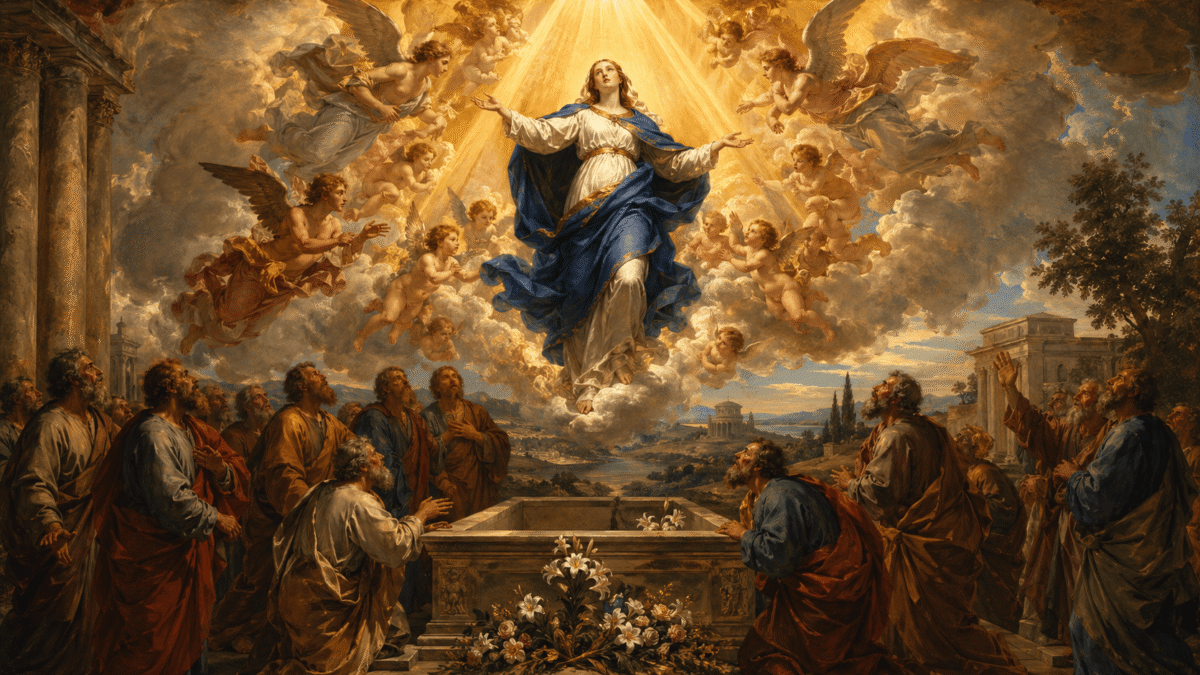
The Assumption of Mary, the dogma of 1950
The Assumption of Mary is the fourth and last Marian dogma defined by the Catholic Church. On November 1, 1950, Pope Pius XII solemnly proclaimed in the Apostolic Constitution Munificentissimus Deus: Mary “was raised body and soul to heavenly glory.”
Foundations of the definition
The Assumption is not explicitly mentioned in the Bible. Its foundation is its consonance with other revealed data: the Immaculate Conception (Mary did not contract original sin, and therefore was not to undergo the corruption that is the consequence of sin), the divine motherhood, and Mary’s association with the redemptive work of Christ.
Body and soul
The dogmatic definition speaks expressly of “body and soul.” This distinguishes the Assumption of Mary from a mere “dormition” (a peaceful death) or from a merely spiritual elevation. Mary shares fully, already now, in the Resurrection, the eschatological destiny that awaits all humanity redeemed by Christ.
Feast and devotion
The feast of the Assumption is celebrated on August 15 and is one of the days on which the greatest Marian crowds gather throughout the world. In Portugal, in Spain, in Italy, and in Latin America, August 15 is a national holiday in many countries, bearing witness to the cultural depth of this belief. For further details, see the article devoted to it: The Assumption of Mary, Dogma and Spirituality.
Deepen your studies: explore Mariology, Marian dogmas, Marian Theology, and the Postgraduate Program in Mariology.
Magisterium of the Church
pronuntiamus, declaramus et definimus divinitus revelatum dogma esse: Immaculatam Deiparam semper Virginem Mariam, expleto terrestris vitae cursu, fuisse corpore et anima ad caelestem gloriam assumptam.
Pius XII, Apostolic Const. Munificentissimus Deus, no. 44 (November 1, 1950)
📚 Literal translation: we pronounce, declare, and define it to be a divinely revealed dogma: that the Immaculate Mother of God, the ever-Virgin Mary, having completed the course of her earthly life, was assumed body and soul to heavenly glory.
Postgraduate Program in Mariology
Would you like to deepen your formation in Mariology? Discover the Postgraduate Program in Mariology of Locus Mariologicus — an academic formation that unites theological rigor, spiritual life, and the living tradition of the Church.
Would you like to study Mariology seriously?
This article grows out of the works in the Locus Mariologicus library. The Postgraduate Program in Mariology takes you to the same source, with academic guidance: Scripture, the Fathers of the Church, and the Magisterium, from the first dogma to contemporary questions.





Responses