Was the marriage of Joseph and Mary valid?
By Prof. Dr. Daniel C. Afonso · Updated
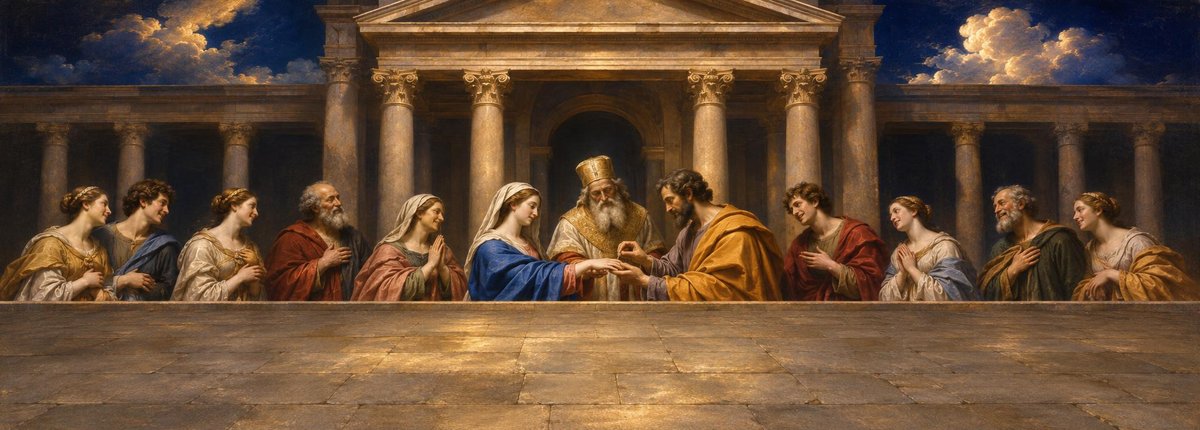
Yes. The Church teaches that Joseph and Mary were true spouses, even though their marriage was virgin. John Paul II states in Redemptoris Custos (7): “As is deduced from the Gospels, the marriage to Mary forms the legal basis for Joseph’s paternity.”
In summary
- Short answer: Yes. It was a true marriage, without carnal relation, by the consent of both (Redemptoris Custos, 7).
- The three goods: Saint Augustine sees in Joseph and Mary the offspring, the fidelity, and the sacrament. Only the conjugal act is missing (On Marriage and Concupidity, I, 11).
- Saint Thomas’ argument: Marriage is the indivisible union of hearts, and this union existed in its entirety (Summa Theologica III, q. 29, a. 2).
- The objection of Saint Jerome: He called Joseph more a “guardian” than a husband, but Thomas explains the sense in which he did so.
- Why it matters: Joseph’s paternity is legally dependent on this marriage.
# What the Gospels Say
Matthew and Luke first state that Mary was “betrothed” to Joseph (Mt 1:18 and Lk 1:27). But Matthew himself calls Joseph “Mary’s husband” (Mt 1:16) and writes that he was “her husband” (Mt 1:19). The angel tells him not to fear to take “Mary, your wife” (Mt 1:20), and finally Joseph “took his wife” (Mt 1:24). In Greek, these are the common words for husband and wife, anér (ἀνήρ) and gyné (γυνή). Our translations from the Greek text.
John Paul II summarizes the testimony of the Evangelists:
“The Evangelists, while clearly stating that Jesus was conceived by the Holy Spirit and that virginity was preserved in that marriage (cf. Mt 1:18-25; Lk 1:26-38), refer to Joseph as Mary’s husband and Mary as Joseph’s wife (cf. Mt 1:16, 18-20; Lk 1:27; 2:5).” (Redemptoris Custos, n. 7)

The Church confesses the “real and perpetual virginity of Mary” (Catechism, n. 499). The question, therefore, is how a marriage can be true in which the marital act never took place. On the betrothal itself, see the betrothal of Mary and Joseph.
What makes a marriage
The Catechism states the general principle: “The Church considers the exchange of consent between the spouses as an indispensable element ‘which produces matrimony’. If consent is lacking, there is no marriage.” (n. 1626). Thomas Aquinas applies this principle to Joseph and Mary in the Summa Theologica (III, q. 29, a. 2).
Thomas begins with the definition: the form of marriage is in “a certain indivisible union of wills, by which one of the spouses is bound to be faithful to the other indivisibly.” Its end is to generate and educate children. From this, two perfections arise. The first is that of the form itself, the second is that of the operation, that is, what marriage accomplishes.
As for the first, Thomas says, “The marriage of the Virgin Mother of God to Joseph was entirely true, because both consented to the marital union,” and in the physical union only conditionally, “if it pleased God.” As for the second, the marriage was not consummated, if by that is meant the physical union that begets children. But it also had this second perfection in the education of the Son. Our translations from Latin.
Saint Augustine: The Three Goods
Augustine had already taught, in De nuptiis et concupiscentia, that the marriage of the faithful has three goods: procreation, fidelity, and the sacrament, which is the indissolubility of the bond (I, 10, 11). And he applies this list to Joseph and Mary. For him, the angel did not speak in vain when he said, “Do not be afraid to take Mary as your wife.” He calls her wife “by the first faith of the betrothal,” which Joseph had not yet consummated in a physical union and would not consummate (I, 11, 12).
Therefore, Augustine writes, the two merited to be called fathers of Christ. John Paul II quotes the text:
“Because of that faithful marriage, both merited to be called parents of Christ, not only the Mother, but also He who was her Father, just as He was her spouse, one and the same through the mind and not through the flesh.” (Augustine, De nuptiis et concupiscentia I, 11, 12, cited in Redemptoris Custos, n. 7)
And then follows the complete list of the goods:
“In those times of Christ, all the goods of the nuptial union were realized: the offspring, the fidelity, and the sacrament. We know the offspring, who is the very Lord Jesus; the fidelity, because there was no adultery; and the sacrament, because there was no divorce.” (Augustine, De nuptiis et concupiscentia I, 11, 13, cited in Redemptoris Custos, n. 7)
Augustine summarizes the point with a rhetorical question: Why would those who, by mutual agreement, abstain from sexual relations remain married, if Joseph and Mary, who did not even begin them, remained married? The passage of the Latin text that we read has optical reading defects, but the meaning of the sentence is clear. And in another place, quoted by Thomas, he adds that the example of Joseph and Mary shows married faithful that, if continence is agreed upon, the marriage can remain and be called a marriage, without a mixture of bodily sex.
The Objection of Saint Jerome
A statement by Saint Jerome, in his treatise against Helvidius, refers to Joseph as a “guardian” of Mary more than a “husband.” Thomas places this as his first objection and answers in a single line: Jerome here uses “husband” from the perspective of the completed marriage act. He does not deny the bond, but speaks of what was lacking in it. The same applies to another phrase of Jerome, where “nuptials” designates the marital act.
Among the Fathers, there was indeed a certain embarrassment in calling this marriage “real,” as they feared it might be thought to imply a carnal communion. But the Latins affirmed the position of Augustine, as summarized in Afonso’s manual (2025, pp. 114-115). And some apocryphal accounts imagined an elderly widower Joseph to ensure continence, which is not attested in the Gospels and left traces in iconography (as cited in Afonso, 2025, p. 112).
Why God Wants a True Marriage
Thomas lists the reasons of convenience in the previous article (III, q. 29, a. 1). For Christ: to not be taken for illegitimate, to have his genealogy traced by the husband, as was the custom, and to be raised by Joseph. For Mary: to be freed from the penalty and infamy that would fall upon an unmarried mother. And for us: the husband is a witness that Christ was born of a virgin. John Paul II says the essential:
“God chose Joseph as Mary’s husband to ensure the paternal protection of Jesus.” (Redemptoris Custos, n. 7)
And it adds what is at stake for the faith: “And also for the Church, if it is important to profess the virgin conception of Jesus, it is no less important to defend Mary’s marriage to Joseph, because it is from this marriage that the legal paternity of Joseph depends.” On this paternity, see the paternity of Saint Joseph.
What is of faith and what is opinion
It is necessary to distinguish the levels. The Church confesses that Mary is always virgin. That her marriage to Joseph was genuine is a doctrine of Augustine and Thomas, which the magisterium of John Paul II takes up and proposes as teaching. The reasons of convenience that Thomas gives are theological arguments, not definitions. And the old Joseph, a widower, is a legend of the apocrypha.
Augustine gives a synthesis of what unites them: for those who decide by mutual agreement to observe continence, it is not for us to say that the bond is broken. Rather, it will be stronger, the more they have made agreements with each other that are kept with greater affection and harmony, not through the bonds of bodily pleasure, but through voluntary affections of the souls. This is the lesson of Nazareth: what makes spouses is the reciprocal gift of hearts.
## Frequently Asked Questions
O casamento de José e Maria foi verdadeiro?
Sim. Os Evangelhos chamam José de esposo de Maria e Maria de esposa de José, e João Paulo II ensina que o matrimônio com Maria é o fundamento jurídico da paternidade de José (Redemptoris Custos, n. 7).
Como é verdadeiro um casamento sem relação carnal?
Porque o que o faz é o consentimento. O Catecismo diz que, sem consentimento, não há casamento (n. 1626). São Tomás explica que a forma do matrimônio é a união indivisível dos corações, e que ela existiu por inteiro entre José e Maria.
São Jerônimo negou que José fosse marido de Maria?
Ele chamou José mais «guardião» do que marido. São Tomás lê a frase assim: Jerônimo toma «marido» a partir do matrimônio consumado, e não nega o vínculo.
Quais foram os três bens do matrimônio de José e Maria?
Segundo Santo Agostinho: a prole, que é Jesus, a fidelidade, porque não houve adultério, e o sacramento, porque não houve divórcio. Só o ato conjugal faltou.
José era um velho viúvo?
Isso vem de alguns apócrifos, não dos Evangelhos. É lenda piedosa que deixou marcas na arte. A doutrina da Igreja sobre o matrimônio de José e Maria não depende dela.
## References
- SACRED SCRIPTURE: Mt 1:16-18-20-24; Lk 1:27; 2:5. Translations from the Greek text (SBLGNT).
- John Paul II. Apostolic Exhortation Redemptoris Custos (1989), n. 7. Portuguese text available at vatican.va.
- Catechism of the Catholic Church, nos. 499 and 1626.
- AGOSTINE. On Marriage and Concupidity I, 10-13. In: MIGNE, J.-P. Patrology Latina, vol. 44, col. 420-421.
- Thomas Aquinas. Summa Theologiae III, q. 29, a. 1-2. Corpus Thomisticum (corpusthomisticum.org). Includes a quote from Augustine, De consensu evangelistarum II, in sed contra a. 2.
- AFONSO. “Go to Joseph: A Manual of Josefology.” 2025, pp. 112-115.
Responses