Guadalupe: The Convergence of Worlds

The Aztec Empire and the Rise of the One Religion
At the dawn of the sixteenth century, the vast Aztec Empire, a mosaic of 23 million people from diverse ethnic groups, found itself at a religious and cultural crossroads. Many of these groups, repressed by Aztec rule, harbored a deep contempt for the bloody rituals of their sovereigns. The Aztecs, however, did not see themselves merely as rulers. They perceived themselves as cosmic guardians, responsible for the maintenance of the universe, with the Sun at the center of their pantheon, sustained by human sacrifice. Toltec religious heritage, however, already pointed to a transformation, culminating in the veneration of Tloque Nahuaque, or the “Unknown God”, a supreme deity, averse to human sacrifice, whose adoration was expressed in flowers and songs, symbols of divine truth.
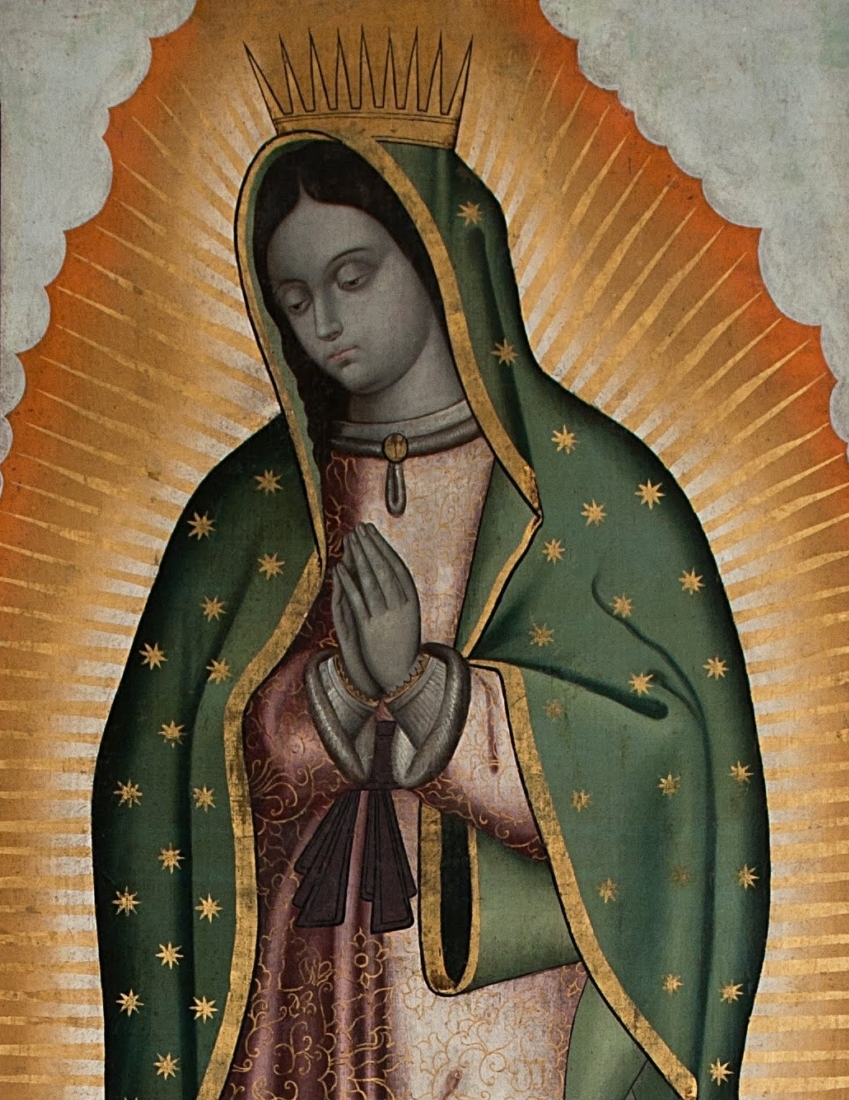
The Spiritual Path of Juan Diego Cuauhtlatoatzin
In this setting of spiritual complexity, there emerges the figure of Juan Diego Cuauhtlatoatzin, an indigenous man from Texcoco, whose encounter with Our Lady of Guadalupe would become a landmark in the religious history of the continent. For Juan Diego, that encounter meant the revelation of the love of the one true God, a divinity who showed Himself through the maternal figure of Mary.
The Fall of the Aztec Empire: A Drama of Conquest and Conversion
The Spanish conquest of the Aztec Empire (1519-1521), led by the charismatic and belligerent Hernán Cortés, was an event filled with ironies and coincidences. Cortés, taking advantage of the prophecy of Quetzalcoatl’s return and of alliances with peoples subjugated by the Aztecs, brought the empire down. Epidemics such as smallpox played a crucial role, decimating a large part of the indigenous population. This period represented not only the fall of a political and military structure, but also the disintegration of the religious structure that gave meaning to the existence of the native peoples.
The Catholic Church and Its Confrontation with the American Reality
At the same time, the Catholic Church faced dilemmas of its own. Many Spaniards, including missionaries and scholars, questioned the morality of the conquest and of the enslavement of the indigenous peoples. The University of Salamanca became the stage for heated debates on the legitimacy of the invasion and on the rights of the natives. The first Franciscan missionaries, arriving in 1523, found a hostile and challenging context. Friar Juan de Zumárraga, appointed bishop of Mexico in 1527, was a central figure in this setting, facing not only the resistance of the natives, but also the cruelty of Spanish administrators such as Nuño de Guzmán.
From the Apparitions to Evangelization: The Virgin of Guadalupe as a Cultural Bridge
The apparitions of Our Lady of Guadalupe to Juan Diego in 1531 represent a crucial point in the religious history of Latin America. This narrative is not only about miracles and faith, but also about the inculturation of evangelization. The mestiza image of the Virgin became a symbol of unity and cultural transformation, as Saint John Paul II emphasized.
Our Lady of Guadalupe and the Renewal of Faith
The encounter between the indigenous and Spanish cultures, marked by conflicts, conquests, and religious and spiritual transformations, reveals the complexity of human history. The story of Juan Diego and the Virgin of Guadalupe stands as a testimony of hope and renewal, showing paths of mutual understanding. Even at the most turbulent crossroads of history, moments of profound revelation and union can arise.
The apparitions of Our Lady of Guadalupe are a landmark in the evangelization of the Americas. Pope John Paul II, in his encyclical Redemptoris Mater, presents Mary as a symbol of hope for all peoples. Access it at Redemptoris Mater (John Paul II).
Deepen your studies: explore Mariology, Marian Theology, Marian apparitions, and the Postgraduate Program in Mariology.
Postgraduate Program in Mariology
Would you like to deepen your formation in Mariology? Discover the Postgraduate Program in Mariology of Locus Mariologicus — an academic formation that unites theological rigor, spiritual life, and the living tradition of the Church.
See the complete list of Marian apparitions recognized by the Church.
Would you like to study Mariology seriously?
This article is born of the works in the library of Locus Mariologicus. The Postgraduate Program in Mariology takes you to that same source, with academic guidance: Scripture, the Fathers of the Church, and the Magisterium, from the first dogma to contemporary questions.




Responses