The Virgin of Guadalupe

The Virgin of Guadalupe: Mary and the Apparition to Juan Diego
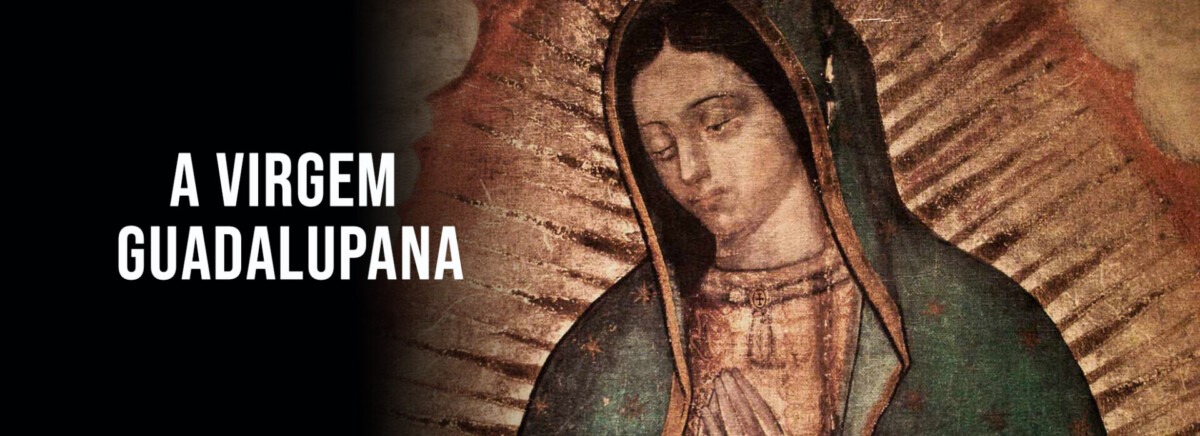
The most visited shrine in the world is not Lourdes, nor Loreto, nor even Fátima, but Guadalupe. Every year about twenty million people visit the places of the apparitions of “Our Beloved Lady of Guadalupe”, also known as “Patroness of Mexico” or “She Who Crushes the Serpent”.
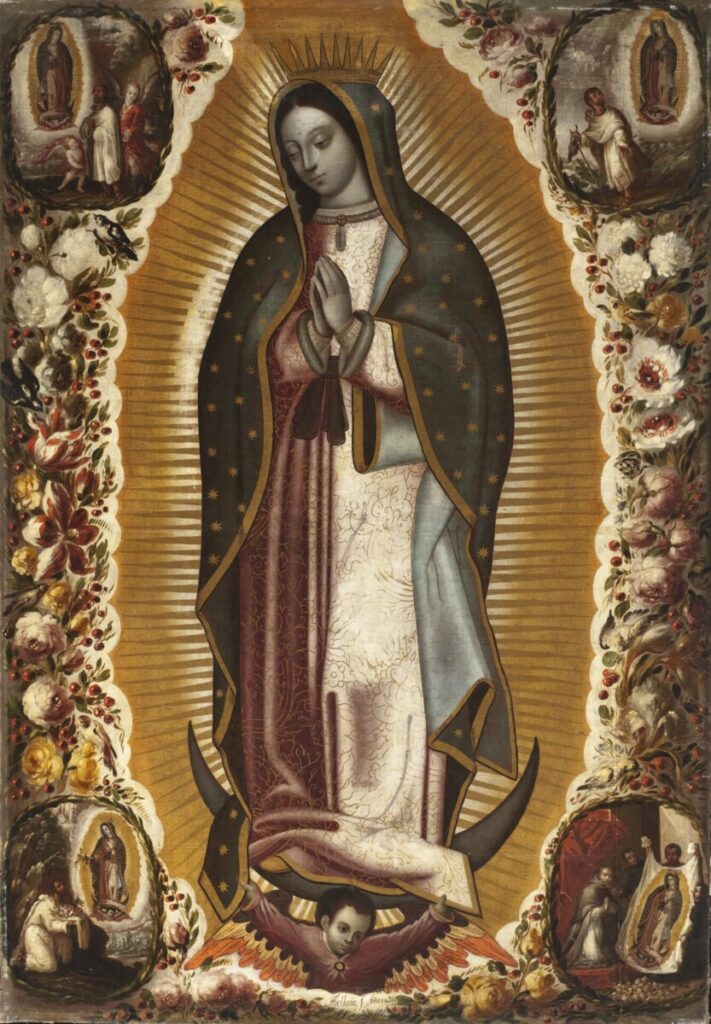
Mary appeared for the first time in this region in 1531 to the Aztec Cuauhtlatoatzin, born in 1474 and baptized in 1525 with the name of Juan Diego.
In order to appreciate deeply the meaning of Guadalupe, it becomes necessary to know the historical and religious context of the time of the apparition. The history of Guadalupe began in 1519 with the arrival in Mexico of the Spanish conquistadors under the orders of Captain Hernán Cortés. When the Spaniards, coming from the coast, entered the Aztec capital of Tenochtitlán, founded upon the island of Lake Texcoco, it was inevitable that they should admire the advanced state of this culture. The one who commanded this people, which numbered ten million persons, had been, since 1503, the emperor Montezuma, a man of great religious sense.
The Aztec god who was the object of supreme veneration was Quetzalcoatl (“the feathered serpent”), whose cult took place in a stone temple. To this god, every year, thousands of people were ritually sacrificed. According to the religious tradition of the Aztecs, this god of theirs dwelt physically in the primitive temples of that place. He was said to have been a wise ruler who had gone away with the promise of returning to take up his power once again.
In 1509, Montezuma’s sister, the princess Papantt, had a dream: she saw numerous ships on the ocean that came from very distant lands, bearing black crosses on their sails and guided by white men. These men intended to bring to the Aztecs the knowledge of the new God.
For strategic reasons, Cortés established an alliance with the Tlaxcaltecti, a people hostile to the Aztecs. Thus it was easy to demolish Montezuma’s power, even though he had received the Spaniards with religious festivities.
Cortés ordered that churches be built and asked the Aztecs to allow themselves to be baptized. In 1528, Charles V appointed the man of God, Juan Zumárraga, first bishop of the New World, who devoted himself fervently to the evangelization of Mexico. Among the first who voluntarily had themselves baptized were also Juan Diego, his wife, from the village of Cuautitlan, and an uncle who lived in the village of Tolpetlac. Many times they would travel to attend religious ceremonies in Tenochtitlán, in the church of Santiago de Tlatilolco, erected upon the ruins of the principal temple of Huitzilopochtli, the god of war of the Aztecs.
The Apparition of Tepeyac

The Holy Virgin appeared for the first time on a Saturday morning, on December 9, 1531, to Juan Diego (1474-1548), of Cuautitlan, belonging to the macetuales natives. This native had converted to Christianity and received baptism and, a short time later, was cultivating a profound relationship with the Queen of Heaven, whom he considered his mother. One day, on his way to the church of Santa Cruz de Tlatilolco, where the feast of the Immaculate Conception was being celebrated, he had set out at midnight in order to cover the twenty-four kilometers that separated his house from this celebration. Passing near the hill of Tepeyac (where in antiquity stood the temple of the pagan cult of the queen of the serpent), he heard a soft sound of sweet and celestial string music and, at the same time, saw a white cloud that surrounded him with a marvelous light.
Juan Diego believed himself to be in Paradise; he looked around and heard nothing. Everything was in the deepest silence. Then a voice breaks into this profound silence, and he heard his name, “Juanito”, called by a Lady. Without being afraid, he made his way upward and at once saw a majestic Lady who invited him to draw near. Once before her, he remained astonished at her superhuman beauty: her garment was radiant as the sun, and the rays that emanated from it penetrated the rocks around her. All the ground around her took on the colors of a rainbow and, finally, the bushes shone with every color. Diego, in ecstasy, fell to his knees and set himself to listen:
“Juanito, you are the least of my children, where are you going? Let it be well understood by you that you are the least of my children, that I am the ever Virgin, Holy Mary Mother of the true God, source of life, of the Creator who comprehends all things, Lord of Heaven and of earth. Ardently do I desire that a temple be built for me here, where I may offer all my love and my compassion, my help and my protection, because I am your Mother of Mercy. Yours and that of all the inhabitants of this land, of the devout who call upon me with confidence, and whose laments I feel. I therefore wish to place a remedy upon your sorrows, upon all your difficulties and sufferings, showing myself in this place of worship that will be built through you in order to accomplish my clemency. You will therefore go to the palace of the Bishop of Mexico City to tell him that I have sent you and that I desire that he build me a temple upon the plain. You will tell him exactly what you have seen and heard; be assured that I shall be very grateful to you for this office and that you will merit a reward for the effort and the toil of having carried out this mission of mine. Go and fulfill it! Now that you have well understood what I command you”.
Juan Diego declared himself ready for the service and set out to go to the residence of the bishop, Friar Juan de Zumárraga, of the Franciscan Order, to report to him the message of the Lady of Heaven. Only with great difficulty did he manage to make himself heard, but the bishop paid him no attention; he promised only that he would reflect upon what Juan Diego had recounted.
On returning, Diego reported to the Most Holy Virgin the bishop’s answer and urged her to entrust this mission to an important person who would have more credibility before the bishop. Then Mary reassured and encouraged him. After listening attentively to the Mother of God, Juan Diego felt reassured and encouraged to continue the mission. He therefore promised Our Lady that the following morning he would go once again to the bishop and that in the afternoon he would return with an answer.
On Sunday, in fact, he went first of all to Holy Mass and afterward waited for hours in line to speak with the bishop again. Juan begged the man of God, showing true and copious tears of suffering, to respond to the desires of the heavenly Mother.
This time the bishop began to believe him and, in order to be able to examine everything, he put precise questions to him and, finally, asked him for a sign from heaven. The devout man thanked the bishop and ran to bring the news to Mary. The man of God sent some of his servants to observe him from afar, but they lost sight of him on the hill and thought that the devout man was not credible. Diego, for his part, was already before Mary to report to her the bishop’s answer.
The Sign
On the following day, Juan Diego wanted to present himself before Mary, as he had agreed with her, but he could not keep the promise because he had found his uncle, Juan Bernardino, gravely ill with a very high fever. All that night and all the following day, the seer took care of his uncle: he called the physician and tried to treat him, but, as the sick man’s condition continued to worsen, on Tuesday morning he had to hurry to Tlatilolco to call a priest. In order to reach the city more quickly, he chose another route, going around the hill, and found himself before Our Lady, wrapped in a resplendent light, who cut off his path.
With her loving voice, she asked him: “What has happened to you, my little son, where are you going?” Fearful and confused, he told her what had happened and said to her that he had to go by the shortest road to the city, but that on the following day he would return to be in her presence on the hill. Finally, he asked her forgiveness for his fault. At that moment he felt Mary’s profound love penetrate the depths of his heart. Our Lady said some things to him, that he should not worry on account of his uncle, and expressed to him a desire. When the Virgin finished speaking, Juan Diego felt consoled and profoundly strengthened and, wishing quickly to fulfill the desire expressed by Mary, he climbed the hill of Tepeyac to gather the fresh and splendid roses of Castile, which had bloomed out of season. The seer collected them, spreading out his mantle (tilma) as if it were an apron, and thus showed them to Mary Most Holy. Then she gave him a message for the bishop.
Diego did not go to the priest but, following Our Lady’s instructions, made his way quickly toward the city. When he arrived, he was at once noticed by the bishop’s servants. When he was received, not only the bishop was present, but also important personages, such as Bishop Dom Sebastian Ramirez Fuenleal. Juan Diego knelt before the Franciscan, the man of God, and reported to him the message of Our Lady; then he opened the white mantle that he had until then held tight against his breast.
As soon as those roses fell, there appeared upon the mantle the most beautiful Mother of God, who can be admired today in the shrine of Tepeyac: Juan Diego himself remained deeply moved on seeing the image of the Holy Virgin, just as she had appeared to him at that time. This twofold miraculous phenomenon, first of the flowers in that season and then of the acheiropoietos image (not made by human hands), caused all those present to be profoundly touched and to fall upon their knees.
The news of the miracle spread rapidly through the surrounding area, reaching ever further. Zumárraga then ordered the construction of a chapel upon the place of the apparitions and, afterward, at once advanced the plans for the building of a basilica. The bishop then wished to visit this place with his servants.
Mary Appeared to the Uncle as Well
Diego was carried home in triumph by the devout and found that his uncle had received the miracle of healing. From this seer’s own mouth it was recounted that he saw a light resplendently flood the room and that a most beautiful Lady, radiating calm and peace, appeared to him. At that apparition alone, he felt himself freed from the illness, from the fever, and from the weakness, and he fell upon his knees at the feet of the silent Lady. Afterward, she informed him of the meeting with his nephew and of the image that had been imprinted on the tilma. Finally, the heavenly Lady made known to him her name and title in the local language, by which she wished to be called and venerated in that place: “The ever Virgin Holy Mary of Guadalupe”.
For the Mexican people, Mary Most Holy proclaims salvation by means of flowers and of song. The Lady of Heaven presents herself in the Nahuatl language, promising help and protection to all men. The image of an indigenous Mexican Mary, miraculously imprinted upon the mantle, the local language that she herself used as a devotional title, the relation to the ancient divinities, and the miraculous events connected with the apparitions stimulated a mass conversion among the Aztecs: almost nine million natives were baptized within a few years.
The Mission of Juan Diego
The seer consecrated himself entirely to the Holy Virgin of Guadalupe, withdrawing to live near the little church of Tepeyac. He devoted himself to the care of the pilgrims. He lived as an ascetic, a witness, and an apostle. When Zumárraga, after the death of the uncle, visited him, a spring of water gushed forth at the place of the last apparition. Juan Diego fell asleep for eternity on May 30, 1548.
In 1600, the chapel was for the first time considerably enlarged and, in 1622, restructured once again. In 1694, the first stone was finally laid for the foundation of the great basilica. In 1709, the image miraculously imprinted upon the tilma was placed on the high altar. The image, in an extraordinary way, has withstood centuries of the smoke of the candles and the sweat of the pilgrims, and even today one can contemplate the living colors that emanate from the infinite tenderness of the Mother.
The Tilma Painted Not by the Hand of Man
The cloth (168x105cm) is the fruit of a preparation of Mexican agave, made up of two pieces of this material, back and front, sewn with white thread. The image of the Virgin painted upon the cloth measures 143x55cm. Mary has a brown color like the natives, her hands joined, a noble appearance, a rose-colored dress embroidered with flowers. A veil or blue mantle, sea-colored, decorated with golden stars, covers her head and descends to her feet, which rest upon the light. Twelve rays of the sun crown her face.
The examinations carried out on Juan Diego’s tilma have shown that, in any case, the colors have no earthly origin and that the materials are completely unknown and, as such, not analyzable. In 1929, a meticulous scientific examination discovered, through lenses, that the pupils of Mary’s eyes reflect, as on photographic film, the image of the seer and of some of the persons present at the miracle of the roses. Despite all the research carried out and the examinations, the phenomenon remains scientifically inexplicable: a supernatural event on earth.
Reaction of the Church
After the apparition of the Guadalupana, Mary was considered the protectress of Mexico. Numerous copies of the image painted upon Juan Diego’s tilma were reproduced and became objects of veneration. In 1737, the Most Holy Virgin was declared patroness of Mexico. Saint John Paul II declared her the “Mother of the two Americas”. Today, Guadalupe is considered the heart of the pilgrimages of Central and South America.
Let us ask the intercession of the Virgin of Guadalupe for all our Latin America and for the world, that the Lord may deliver us from the evil of the pandemic.
Our Lady of Guadalupe is the patroness of the Americas and one of the greatest Marian prodigies in history. To deepen your study of the apparitions of Mary, read the encyclical Redemptoris Mater by Saint John Paul II.
Deepen your studies: explore Mariology, Marian Theology, Marian apparitions, and the Postgraduate Program in Mariology.
Postgraduate Program in Mariology
Would you like to deepen your formation in Mariology? Discover the Postgraduate Program in Mariology of Locus Mariologicus, an academic formation that unites theological rigor, spiritual life, and the living tradition of the Church.
See the complete list of Marian apparitions recognized by the Church.
Would you like to study Mariology seriously?
This article is born from the works in the library of Locus Mariologicus. The Postgraduate Program in Mariology brings you to the same source, with academic guidance: Scripture, the Fathers of the Church, and the Magisterium, from the first dogma to contemporary questions.



Responses