“But the greater love is: the hymn of charity, Cornelius and Cyprian, and Mary standing.”
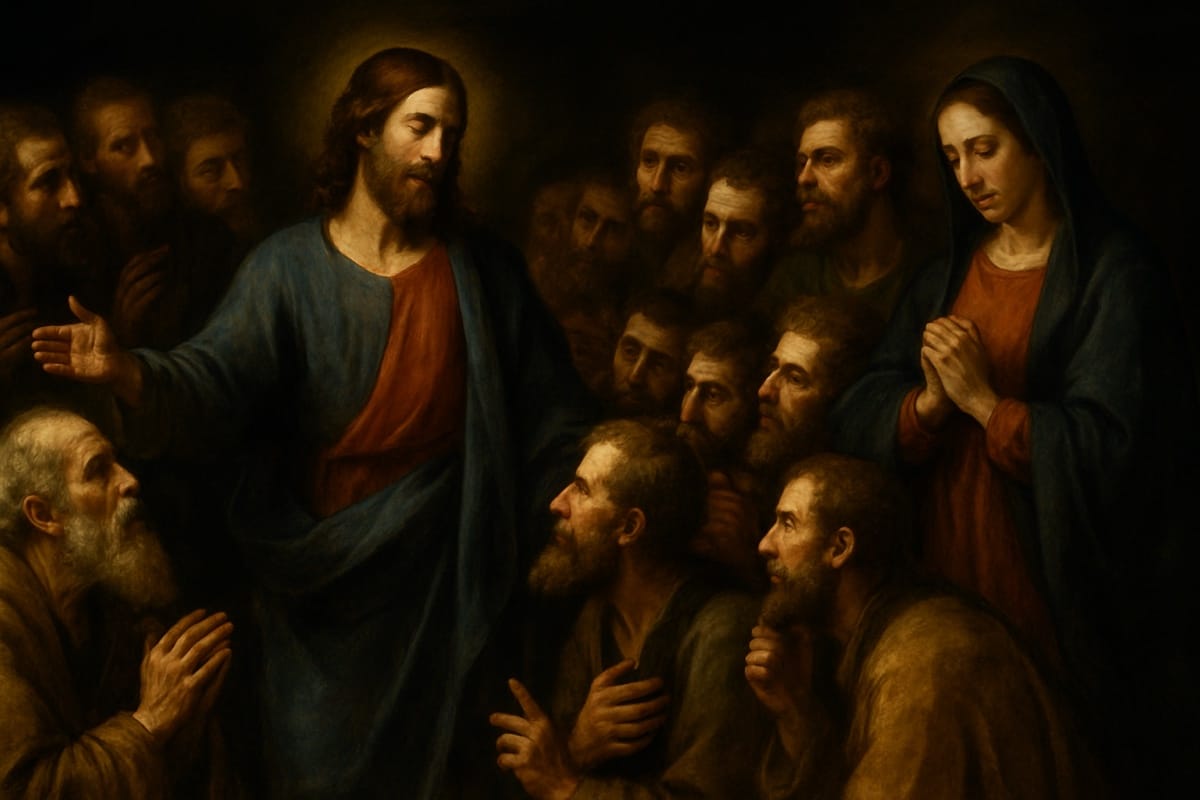
Now, however, faith, hope, and love remain, and the greatest of these is love. And wisdom is justified by all her children.
(1 Corinthians 13:13 and Luke 7:35)Wednesday of Week XXIV of Ordinary Time offers the Church a hymn of charity, followed by a portrait of a generation that refuses to accept anything. Paul shows that without charity all gifts are empty, and that it is the only thing that survives the passage of imperfection. Jesus compares his contemporaries to children in the marketplace who refuse to dance when the flute plays and to weep when laments are sung. On this day, the Church also remembers Saints Cornelius and Cyprian, a pope and bishop of the 3rd century who paid with their lives for the communion they desired to preserve.
I. The first reading: 1 Corinthians 12:31; 13:1-13
The chapter 13 is not a detached poem, but the heart of a discussion about charisms. Corinth was engaged in debates about hierarchical gifts, and Paul proclaims “a way of perfection that surpasses all knowledge” (12:31). He then proceeds with a three-part demolition, each time using the same structure: tongues of men and of angels, prophecy, and knowledge of all mysteries, giving of goods, and even one’s own body. In each case, the conclusion is the same: “if I have all faith, if I have the gift of prophecy, if I have all knowledge and all understanding, and if I have all devotion and if I can move mountains, but do not have charity, I am nothing” (v.2).
He continues with a description, and not a single word is about feelings. Charity is presented in fifteen verbs that are all actions: “is patient, is kind, is not envious, does not boast, is not arrogant, does not act unbecomingly, does not seek its own interest, is not easily provoked, does not keep account of wrongs, does not rejoice in injustice but rejoices with the truth” (v.4). The list concludes with four absolutes describing resistance: “endures all things, believes all things, hopes all things, endures all things” (v.7). Then comes the reason for primacy: prophecy, tongues, and knowledge fade away, “but charity never fails” (v.8). It is the only virtue that transcends death without changing its nature, because in heaven there is neither belief nor hope, only love. Therefore, Paul concludes where he began: “the greatest of these is charity” (v.13).
II. The Gospel: Luke 7:31-35
The parable of the children in the marketplace is brief and cruel. A group proposes a wedding game and plays the flute, but the others do not dance. They then propose a funeral game and sing laments, but the others do not weep. Nothing works, because the refusal was not in the proposal, but in those who received it.
Jesus applies the parable with two examples that cancel each other out. John the Baptist came in rigor, fasting and abstaining, and they said he had a demon. The Son of Man came in closeness, eating and drinking, and they said, “he is a glutton and a drunkard, a friend of tax collectors and sinners” (v.34). Both extremes were condemned by the same tribunal, proving that the criterion was not the behavior of the messenger but the pre-determined decision not to adhere. The final verdict shifts everything: “wisdom is justified by all her children” (v.35). God’s wisdom is not defended with arguments. It justifies itself through the children it generates.
III. Cornelius, Cyprian, and the price of communion
Today’s memory fits perfectly with these readings without forcing anything. Cornelius was Pope from 251 to 253, during a time when the Church was divided over what to do with those who had yielded during the persecution under Decius. Some wanted to readmit them without penance, while others wanted to close the door to them forever. Cornelius chose the more costly path, that of forgiveness with penance, and found himself opposed by Novatian’s rigorism. Cyprian, Bishop of Carthage, supported him. Both died for the faith, Cornelius in exile and Cyprian beheaded in 258.
What binds them to the readings is precisely the accusation of the square. The rigorist said they were slack, the laxist said they were hard. Neither of them was looking at the criterion, which was charity that builds up communion. Cyprian wrote that one cannot have God as Father who does not have the Church as Mother (CYPRIAN. *De Unitate Ecclesiae*, 6), and this phrase cost him his life, because the unity he defended was not a preference for administration but the very effect of the charity of which Paul speaks.
IV. Mary, the charity that remains
If charity is the only thing that does not end, then it is worth asking where it is seen whole. The answer of tradition is known and not rhetorical. The Council states that Mary faithfully preserved her union with the Son until the Cross, where she stood and suffered deeply with her Only-Begotten, associating herself with a maternal spirit to his sacrifice (LG 58).
Read now Paul’s description of this scene with the eyes of the square before it. “Everything excuses, everything believes, everything hopes, everything endures” is the most precise list of what happened at the Cross. There is no spectacular gift, no prophecy, no language of angels. There is a woman standing who does not withdraw. That is why the Church can recognize in her its type in the order of faith, charity, and perfect union with Christ (LG 63), and the order in which the three terms appear is not indifferent.
Regarding the Wisdom justified by her children, there is a Marian reading authorized by the liturgy for centuries by applying to Mary the sapiential texts of the Old Testament. God’s Wisdom did not convince the generation of the square, which had a ready answer for rigor and nearness. She justified herself by generating children, and the first of them, in the order of flesh and in the order of faith, was born of Mary. Whoever wants to know if Wisdom is right should not look for the decisive argument. He should look at those she generated.
Therefore, the Thursday of the XXIV Week leaves a warning for those who discuss much about faith. It is possible to have the right argument against the rigorist and the laxist, and be just another child sitting in the square. What remains is not reason. It is charity.
Postgraduate Mariology Program
Do you wish to deepen your formation in Mariology? Discover the Postgraduate Mariology Program at Locus Mariologicus – an academic formation that combines theological rigor, spiritual life, and the living tradition of the Church.
Would you like to study Mariology seriously?
This article draws on the works of the Locus Mariologicus library. The Postgraduate Programme in Mariology takes you to the same sources with academic guidance: Scripture, the Church Fathers and the Magisterium, from the first dogma to contemporary questions.





Responses