The hour to awake: Is 2, Rom 13 and the vigilance of the First Sunday of Advent, Year A
Hora est iam nos de somno surgere.
Rom 13:11
The First Sunday of Advent in Year A opens the new liturgical year with three texts that converge on the urgency of vigilance. Is 2:1-5 proclaims that in the last days the mountain of the Lord will be established at the top of all the mountains, that all the nations will stream to it, and that God will arbitrate between the peoples: swords will be forged into plowshares. Rom 13:11-14 announces that the hour has already come for us to rise from sleep: the night has passed, the day is near, it is time to cast off the works of darkness and to put on the Lord Jesus Christ. Mt 24:37-44 recalls the days of Noah and urges vigilance: the Son of Man will come like a thief in the night, and we know neither the day nor the hour. The three texts describe the same movement: that of one who is asleep and needs to wake up, of one who lives in the past and needs to look at what is coming.
I. The first reading: Is 2:1-5
Isaiah sees in the last days the mountain of the temple of the Lord established on the top of the mountains and raised above the hills (Is 2:2). All the nations will stream to it, all the peoples will come on pilgrimage. And they will say: “Come, let us go up to the mountain of the Lord, to the house of the God of Jacob. He will teach us His ways and we will walk in His paths” (v.3). For out of Zion shall go forth the law and from Jerusalem the word of the Lord. He will judge between the nations and will decide for many peoples: “They shall turn their swords into plowshares and their spears into pruning hooks” (v.4). Nation shall not lift up sword against nation, nor shall they learn war any more. And the final invitation: “House of Jacob, come, let us walk in the light of the Lord” (v.5). Isaiah does not describe a present but a future that already calls for a present response. The image of the mountain is eschatological: the center of gravity of the universe will be shifted to the mountain of the Lord, and the nations that today make war on one another go on pilgrimage to learn peace. Advent begins with this broad vision: the coming we await is not merely a private event of devotion, but the transformation of history.
II. The second reading: Rom 13:11-14
Paul addresses the Romans with urgency: “You know what the present moment requires: it is already the hour for you to rise from sleep” (Rom 13:11a). The reason: “Our salvation is now nearer than when we embraced the faith” (v.11b). Time grows short: “The night is passing away and the day is drawing near” (v.12a). The practical response is twofold: “Let us cast off the works of darkness and put on the armor of light” (v.12b). The concrete behavior: to walk becomingly, as in broad daylight, without orgies or drunkenness, without debauchery and licentiousness, without quarreling or jealousy (v.13). And the foundation: “But put on the Lord Jesus Christ” (v.14a). The metaphor of clothing is baptismal: the Christian who “puts on Christ” becomes what he wears. Paul articulates the paradox of Advent: salvation has not yet arrived in its fullness, but the fitting behavior is that of one who has already reached the day. The Christian lives on the threshold, astride the night that is passing and the day that is coming.
III. Evangelium: Mt 24:37-44
Jesus has recourse to the image of the days of Noah in order to describe the coming of the Son of Man. Before the flood, they were eating, drinking, marrying and giving their children in marriage, until the day when Noah entered the ark, and they suspected nothing until the flood came and swept them all away (Mt 24:38-39). The indifference of Noah’s contemporaries was not malice: it was distraction, the incapacity to recognize the moment. Two men will be in the field: one will be taken, the other left (v.40). Two women will be grinding at the millstone: one will be taken, the other left (v.41). The distinction is neither obvious nor visible: the two are in the same field, doing the same work. What distinguishes them is interior vigilance. “Watch, therefore, for you do not know on what day your Lord is coming” (v.42). The image of the thief: if the master of the house had known at what hour of the night the thief was coming, he would have stayed awake (v.43). “Therefore you also must be ready, for the Son of Man is coming at an hour you do not expect” (v.44). Matthew places Advent under the sign of unpredictability: it is not anxiety that prepares for the encounter, but constant vigilance, which is the disposition of one who is always ready.
IV. Mary and the vigilance of Advent
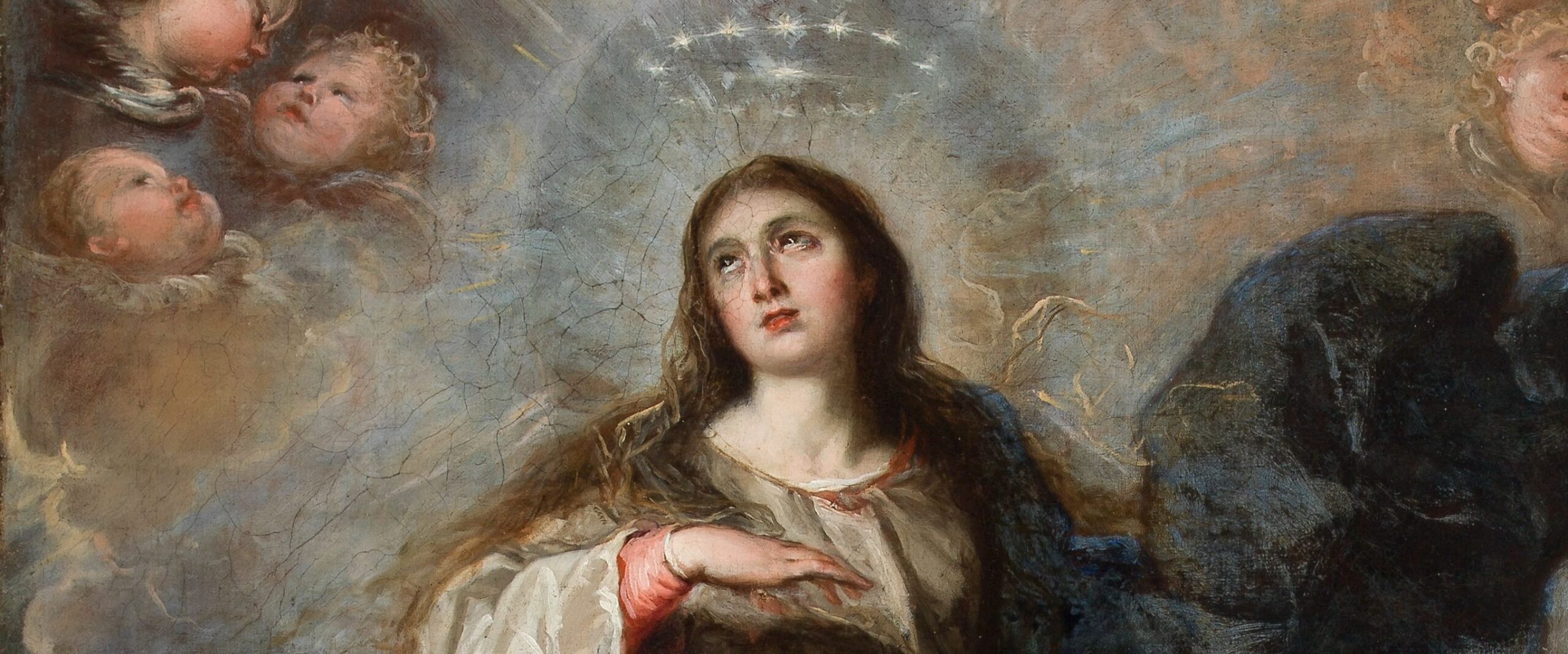
The vigilance that Mt 24 demands and that Rom 13 formulates as “rising from sleep” has its most perfect icon in Mary. The Annunciation is the moment in which the Son of Man arrives at the hour no one expected: not the priests, not the scribes, not the Pharisees, but a young woman of Nazareth, who was awake. Isaiah describes the mountain of the Lord to which all the nations stream: Mary is, in the tradition of the Fathers, the living Zion, the mountain inhabited by the Lord who came into the world not in a temple but in a womb. The liturgy of Advent sings of her as the one who received the Word before any other, as the beginning of the fulfillment of the prophecy of Is 2:14-20. Rom 13 exhorts: “Put on the Lord Jesus Christ.” Mary clothed Christ with humanity: she who wove Him in her flesh, she who most literally “put on Christ” by carrying Him for nine months. Advent is the preparation for the Christmas that she lived from within. Every one of the faithful who awaits the coming of the Lord learns from Mary what active vigilance is: not the anxiety that is extinguished at the least sign of delay, but the serene availability of one who says “let it be done” before understanding everything.
Postgraduate Program in Mariology
Would you like to deepen your formation in Mariology? Discover the Postgraduate Program in Mariology of Locus Mariologicus – an academic formation that unites theological rigor, spiritual life, and the living tradition of the Church.




Responses