Advent: How It All Began

Definition of Advent
For Western Christians, these are the four weeks that prepare for Christmas and form the beginning of the liturgical year. They are marked by a reduction of festive signs: the Gloria is not said (except on the Solemnity of the Immaculate Conception). The liturgical color is the penitential one, that is, violet (except on the Third Sunday of Advent, when rose may be used). The term “Advent” also refers to the “Second Coming” of Christ at the end of history. In the East, the Byzantines begin Advent with a forty-day fast starting on November 15, and the West Syriac Church observes six weeks of preparation for Christmas.
Origin and development of Advent
The celebration of Easter in the Church of the first centuries was dominated by the expectation of the Lord’s definitive manifestation. For this reason, the Easter Vigil lasted into the night. Only at that moment could the Eucharistic liturgy begin. The Risen One appeared among His own in a sacramental way, like the morning sun that symbolically announces the day without end.
This expectation of Christ’s second coming, hence the invocation “Maranatha: Come, Lord!” (Rev 22:17, 20), was one of the characteristics of ancient Christian piety.
In the pagan conception, the deity came on a set day, once a year, to dwell in its temple: this presence or coming, in Latin adventus, could also last several days, for as long as the festivities lasted. The cult of the emperor made use of this idea: the adventus became the visit or anniversary or feast of the emperor, which was celebrated as if it were his return.
Christian Advent points to Christmas-Epiphany, which must be seen together as complementary celebrations. Epiphany, a Greek word, indicates the aspect of manifestation of that coming. These feasts have neither the antiquity nor the importance of Easter; but when they arose in the fourth century, after the freedom granted by Constantine, they spread rapidly and simultaneously in the West and in the East, though with different characteristics and sensibilities. It was evidently something that was already in some way present in, and awaited by, the Christian people.
In the struggle against Arianism, the heresy that denied the divine sonship of Jesus of Nazareth, Christmas became the feast of the dogma of Christ’s divinity, defined at the Council of Nicaea (325), and its celebration amounted to the triumph of orthodoxy.
What was the Council of Nicaea?
The first ecumenical council, convoked by the Emperor Constantine the Great (d. 337) and held at Nicaea (today Iznik, Turkey) to deal with the Arian heresy, which threatened to break the unity of the Church and of the Roman Empire. Arius, an Alexandrian priest, held that Christ, far from being fully and truly divine, was simply God’s first creature. The Council responded by teaching that Christ is the Only-begotten Son of the Father and is homoousios (a Greek word meaning “of the same being” or “consubstantial”) with the Father. The Council also recognized the patriarchal rights of Alexandria, Antioch, and Rome, and prescribed the Alexandrian solution regarding the date of Easter for everyone. A rising star of the Council was Saint Athanasius, later Bishop of Alexandria (d. 373), who attended as archdeacon and companion of his bishop, Alexander of Alexandria.
Meaning of the word Advent
A Christian word of pagan origin, ADVENT first designated the anniversary of the Lord’s birth and the celebration of His manifestation (that is, His return or His visit).
In the beginning, then, Advent, in keeping with the meaning of the word, designated the feast, not its preparation or expectation. This word (adventus Domini) was used to designate Christmas in the homilies of the Fathers of the Church, in the prayers of the ancient sacramentaries, and in the earliest Christian calendars. Here one point must be recovered. In the liturgical celebration, the three dimensions of history always coexist:
- the memory of the past.
- the mystery celebrated in the present.
- the anticipation of the future.
It is necessary to emphasize this threefold dimension of the mystery of Advent, lest its meaning be impoverished or even distorted, overwhelmed by the wave of popular sentiment that devoutly surrounds the birth of the Child Jesus, a pagan temptation, always arising and never completely overcome.
In our case, these overlap: the expectation of the Savior’s birth, lived for many centuries by the people of God, Israel. His human birth, or incarnation. The manifestation in glory, at the fulfillment of history, the so-called parousia.
Definition of parousia:
The official visit of a sovereign. In the earliest Christian documents (1 Thess 4:15; 1 Cor 15:23), the term parousia denotes the glorious return of Christ at the end of history to judge the world (Mt 24:29-31; 25:31-46). This will be the day of the Lord (1 Cor 1:8) when Christ “will appear a second time” (Heb 9:28). Christians must wait patiently for this coming (Jas 5:7-8; 2 Pet 1:16; 3:4; 1 Jn 2:28). The Synoptics link the expectation of the end with the admonition to vigilance (Mt 24:36; 25:13; Mk 13:1-37; Lk 21:5-36). The Gospel of John speaks of the resurrection that will take place on the last day (Jn 6:39, 40, 44, 54; 11:24). The future coming of Christ in glory to judge the living and the dead is professed in various creeds. Eastern Christians emphasize the collective dimension of this future fulfillment more than Western Christians do. Some contemporary theologians prefer not to speak of the “second” coming, since the parousia is nothing other than the final consequence of Christ’s first coming in the incarnation. Today we can say that it will be the world that comes to God at the parousia, rather than Christ to the world.
The history of Advent
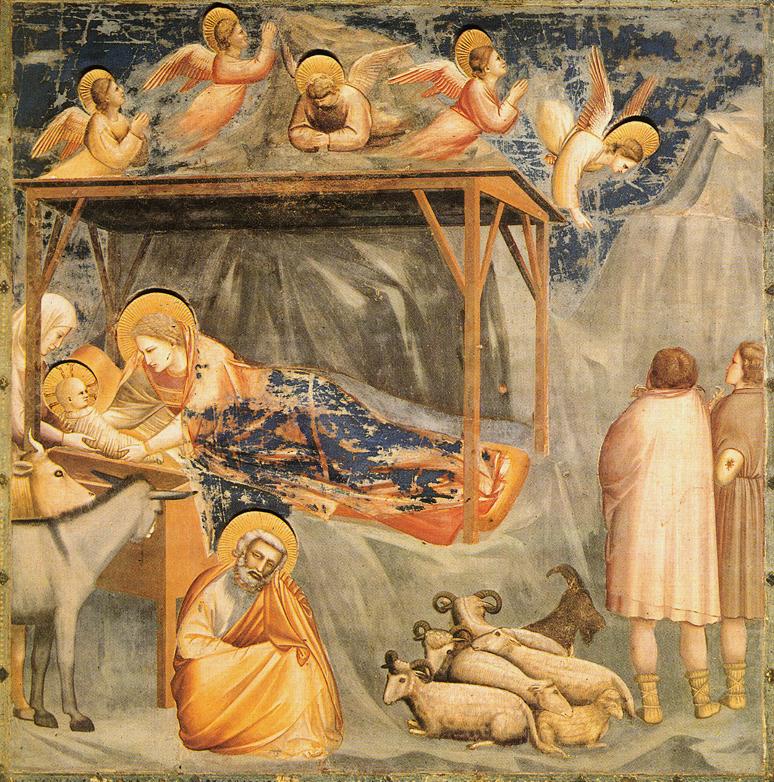
Historically speaking, the birth of the Savior was prepared in the Old Testament. Psychologically, the mystery of Christmas, because of the growing popular success this feast was acquiring, to the point of threatening to supplant Easter, required a period of preparation. But this season was never made into a parallel of the preparation for Easter, Lent, which has a completely different meaning (above all because of the joyful, though restrained, tone that permeates Advent).
While the Paschal Cycle (Lent and the season after Easter in particular) appears uniform and solidly structured in the liturgical calendars of the Christian East and West, the season of Advent presents extremely varied solutions in the different churches.
From the standpoint of its Sundays, it is a peculiarity of the Latin West. Even today, while the Roman Rite celebrates it over four weeks, in the Church of Milan it consists of six Sundays, as in the Syriac Church.
The history of Advent is complex, at times even obscure. Advent does not have a single birthplace; rather, it emerges almost simultaneously in various places and with diverse characteristics, among them a baptismal one (in Spain and Gaul, owing to Eastern influence, it consisted of three weeks of intense catechumenate, from December 17 to January 6, Epiphany being the feast of the baptism of Jesus in the Jordan). It arose relatively late (sixth–seventh centuries). Its ascetical and spiritual character prevailed over the liturgical dimension.
It is impossible to trace here the history of Advent in the Western churches (Hispanic, Gallican, and Ambrosian, among others). However, it must be acknowledged that its eschatological character (the expectation of the final manifestation of Christ the Judge), so strongly felt at the beginning, faded and grew dim over the centuries, almost to the point of disappearing, owing to the growth, until it became almost exclusive, of the view of Christmas as the feast of the birth of Jesus from Mary. Advent is increasingly understood as a sacred representation: the annual repetition of the expectations and preparations of the Old Testament.
The current liturgical reform, as is evident in the texts of the Lectionary, the Missal, and the Liturgy of the Hours, seeking to recover the eschatological dimension, carried out an operation of a practical kind:
- it gave the first weeks a predominantly eschatological character (eschatological Advent).
- the days from December 17 to 24 received a markedly Christmas character (Christmas Advent, and it is here that the most important Marian elements are found).
- the feast of Christmas, although the other themes are not lacking, celebrates the incarnation, that is, the earthly birth of Jesus (all the other feasts that follow it keep to this line, including Epiphany).
It can be said that the state and situation of Advent are permanent: the Church lives a perpetual Advent until the Lord comes. The mystery of Advent coincides with the mystery of history, which reveals itself as a manifestation of God’s judgment on the world. Indeed, expectation and hope are the distinctive mark of the Christian faith. For Saint Bernard, the ‘sacrament’ of Advent is equivalent to the mystery of Christ’s presence in the world: its four weeks are an effective sign of the interval between the first and the second manifestation, that is, of the time of the Church.
Prayer of Adrienne von Speyr:
Mary’s prayer in the sweet expectation of the Child
Father, You have given me Your Son. He comes to me as God and also as the Child I am expecting.
I spoke the first yes in faith, in trust, in hope, knowing that Your will must be done in me.
I spoke that yes in the Spirit of Your Son, who will be my Son. I could not leave it unanswered, because through You my Son asked a question.
Father, now there is a great fear in me. It is anguish before Your mystery, the anguish of not being equal to the mission You set before me. How am I, Your handmaid, to raise Your Son? How am I to accompany Him in His first years? How can He learn to speak with You through me? How can He understand from me how to adore You?
Father, I ask only one thing: keep my yes. Keep it now too, when anguish throbs within me. Keep it always as the word that I do not have the strength to speak and that I nevertheless gave to my Son.
God the Spirit, I also said yes to You. I said yes to being a mother, the mother I must be for my Son. The Child was given to me, entrusted to me, because He Himself had always destined me to be His Mother.
And before this mystery a great fear now overwhelms me. I know that I have given You not only my body but also my soul, so that You may make body and soul fruitful, so that both may truly serve the Son of the Father whom You brought to me.
But I am afraid. And I do not know whether Your Spirit takes the anguish from my soul or causes it. I only implore You: keep my yes, give me the strength to show You every day anew that I truly want to say yes. That is why I plead for Your Spirit, who belongs to the Father and to my Son.
My little Son, my God, I adore You. You are still too small to understand my anguish. And yet You are my God. You are the God for whom we have waited so long and who chose me to be Your Mother.
And if I now experience this anguish, I am truly anguished for You, because I know that You will know anguish as no one has ever known it. I do not ask You to take this anguish from me. I only ask You to let it bear fruit in You, and that, knowing the deep anguish of man when the Father and the Spirit abandon You, You may nevertheless know that You still have a Mother. A Mother who knows Your anguish, at least in part.
Grant, Father, Son, and Spirit, that by Your grace I may fulfill my task, which I certainly cannot understand. May I fulfill it as You expect of me. And dispose of me day after day according to Your good pleasure, always hearing the yes, even when I no longer have the strength to speak it. Amen.
To explore more deeply the role of Mary in the season of Advent, consult the Apostolic Exhortation Marialis Cultus of Paul VI, on the presence of Mary in the liturgical year.
Deepen your studies: explore Mariology, Marian Theology, Marian apparitions, and the Postgraduate Program in Mariology.
Postgraduate Program in Mariology
Would you like to deepen your formation in Mariology? Discover the Postgraduate Program in Mariology of Locus Mariologicus, an academic formation that unites theological rigor, spiritual life, and the living tradition of the Church.




Responses