Marian icon: the theology and the types of the Eastern tradition
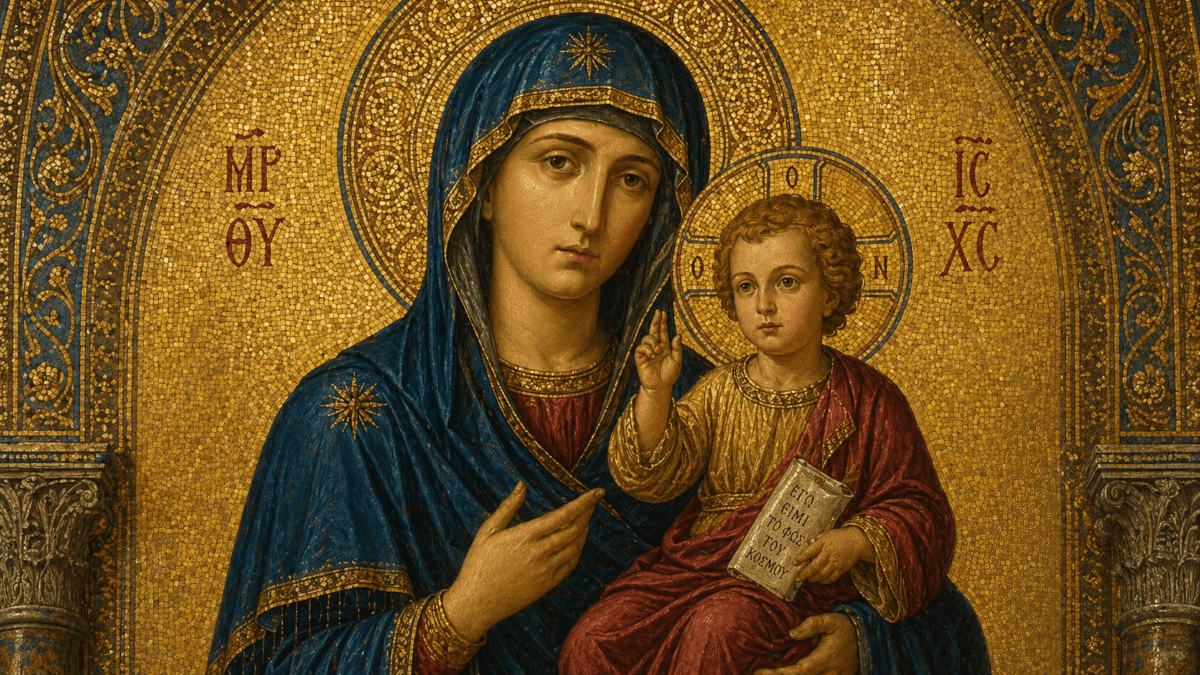
Marian icon, the theology and the types of the Eastern tradition
In the Eastern Christian tradition, the Marian icon is much more than a work of art: it is a sacramental and a channel of grace, considered on a par with the Bible and Tradition as an expression of the faith of the Church. The Second Council of Nicaea (787) defined as doctrine the veneration of sacred images, distinguishing between proskynesis (the veneration due to images) and latreia (the adoration due to God alone). The traditional technique is egg tempera on wood, carried out in prayer and fasting: the iconographer does not “paint” but “writes” the icon.
The tradition of Saint Luke and the beginnings
The Eastern tradition attributes to Saint Luke the first portraits of Mary. The Quinisext Council (692) and the Second Council of Nicaea established the norms of sacred iconography. The iconoclast crisis (726-843) was the great test of the theology of images: the defenders of the icons, with Saint John Damascene at their head, affirmed that refusing to venerate the images of Christ implied denying the reality of the Incarnation. The victory of orthodoxy in 843, the “Triumph of Orthodoxy,” definitively established the place of icons in the Eastern Church.
The great Marian iconographic types
The Eastern tradition codified the principal types of Marian icons. The Hodigitria (“she who guides”) represents Mary frontally, pointing to Christ with her right hand: it proclaims Christ as the only way, and is the missionary icon par excellence. The type is attributed to Saint Luke, and the original, venerated in Constantinople, was destroyed in 1453. The Eleusa (“the merciful one”) represents Mary and the Child face to face, their faces touching: it expresses the tenderness of the divine motherhood and insists on the humanity of Christ. The most celebrated example is the Madonna of Vladimir (Constantinople, early twelfth century), today in the Tretyakov Gallery in Moscow. The Orans represents Mary in a posture of intercessory prayer, with her arms raised. The Galaktotrophousa (“she who nurses”) shows Mary nursing the Child, evoking Lk 11:27, with Egyptian examples from the sixth century. The Madonna of the Passion, known in the West as Our Lady of Perpetual Help, represents two angels showing the Child the instruments of the Passion: the Child clutches His Mother’s hand in fright. A celebrated copy has been venerated since 1865 in Rome in the Church of the Redemptorists. The Znamenie or Madonna of the Sign (also Platytera, “more spacious than the heavens”) represents Christ in Mary’s womb within a medallion, evoking Is 7:14. The Kyriotissa or “Queen” represents Mary seated on an imperial throne: the triumphal type took hold after the Council of Ephesus (431).
Theological and spiritual value
Marian icons have four inseparable dimensions. The historical dimension: each icon represents a concrete event in the life of Mary or of the Church. The cultic-liturgical dimension: the icon is an object of veneration, integrated into the cycle of the liturgical year. The spiritual dimension: the art of the icon represents the human being already transfigured by the Spirit of God. The dogmatic dimension is particularly rich: the Hodigitria underscores the divinity of Christ. The Eleusa insists on the humanity of Christ. The three stars that are never absent from Mary’s forehead and shoulders express her perpetual virginity. The gesture of the Hodigitria and the Deesis allude to Mary’s mediation. The Kyriotissa affirms Mary’s queenship. The icons of the Dormition and of the Assumption express the glorification of Mary in body and soul.
Deepen your studies: explore Mariology, Marian Theology, Marian ecumenism, and the Postgraduate Program in Mariology.
Postgraduate Program in Mariology
Would you like to deepen your formation in Mariology? Discover the Postgraduate Program in Mariology of Locus Mariologicus, an academic formation that unites theological rigor, spiritual life, and the living tradition of the Church.
Discover the oldest Marian image in the Catacomb of Priscilla.
Learn what the Church teaches about Mary, Mediatrix of All Graces.
Would you like to study Mariology seriously?
This article grows out of the works in the Locus Mariologicus library. The Postgraduate Program in Mariology takes you to the same source, with academic guidance: Scripture, the Fathers of the Church, and the Magisterium, from the first dogma to contemporary questions.




Responses