The Magnificat of the new creation: Zeph 3:14-18 and Lk 1:46-55, the Visitation of Our Lady
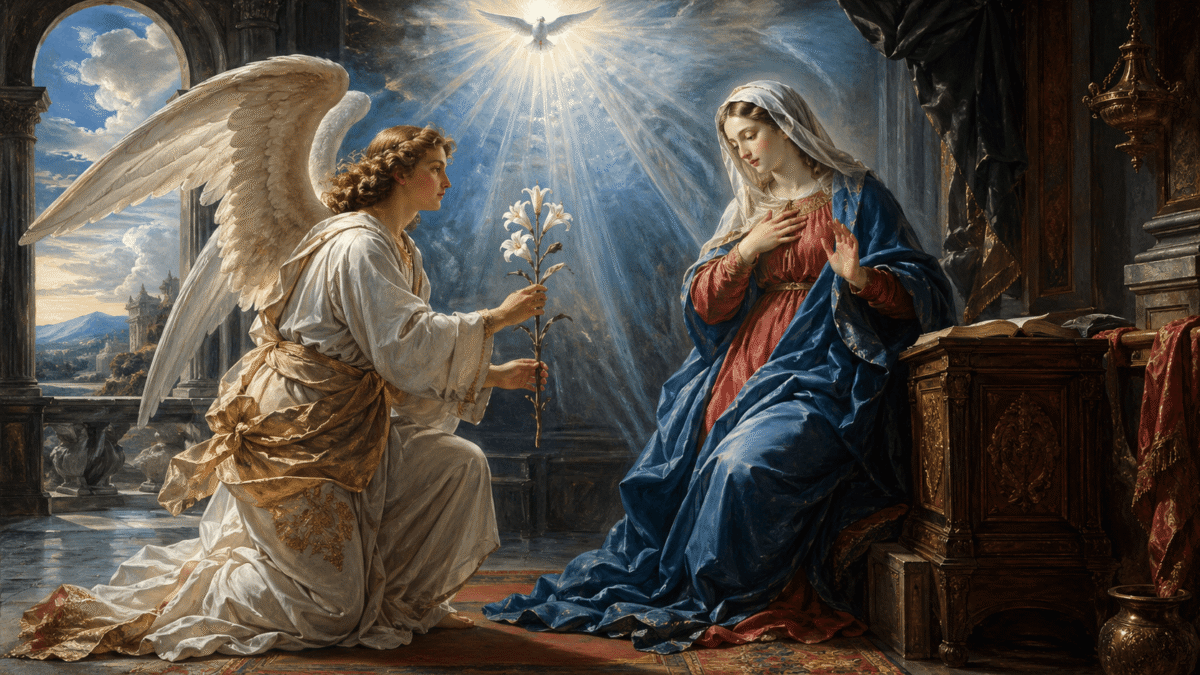
Magnificat anima mea Dominum, et exsultavit spiritus meus in Deo salutari meo.
“My soul magnifies the Lord, and my spirit has rejoiced in God my Savior”. (Lk 1:46-47)
Magnificat of the new creation: 4 Marian keys (Lk 1:46-55)
Magnificat of the new creation: the foundation of this joy is the presence of the Lord “in your midst”. The Hebrew expression beqerebek literally means “in your womb”, “in your inmost parts”. The Mariological tradition grasped the depth of this language: when Mary goes to visit Elizabeth, she goes with the Lord “in her midst”, literally in her womb. The “daughter of Zion” whom the prophets invited to exult found her most perfect realization in Mary, who carries within her the King of Israel, Emmanuel, the Lord whom the prophets had promised.
Magnificat of the new creation: 4 Marian keys of the Visitation between Zeph 3:14-18 and Lk 1:46-55 in the liturgy of the Church.
II. The Visitation: the first eucharistic procession
Luke’s account of the Visitation, read in the key of the Magnificat of the new creation, begins with a note of movement: “In those days Mary arose and went in haste into the hill country, to a city of Judah”. Mary’s haste is not anxiety but the impulse of a love that went out to meet a need. Elizabeth, advanced in years, is with child. Mary, young, having just received the annunciation, goes to serve her. This movement, setting out from oneself in order to go and meet the other, is the fundamental gesture of the Christian apostolate. Mary does not wait for the world to come to her. She goes to the world.
When Mary, the living antiphon of the Magnificat of the new creation, entered the house of Zechariah and greeted Elizabeth, something happened that goes beyond simple hospitality. “As soon as Elizabeth heard Mary’s greeting, the child leaped in her womb and Elizabeth was filled with the Holy Spirit”. John the Baptist, still in his mother’s womb, recognized the presence of Christ in Mary’s womb. Mary’s greeting was the instrument through which the presence of the Lord was communicated: John leaped for joy like David before the Ark of the Covenant. Mary is the new Ark who carries the Lord through the hill country of Judea.
Within the horizon of the Magnificat of the new creation, Elizabeth’s exclamation is the first Christian proclamation: “Blessed are you among women, and blessed is the fruit of your womb! Whence comes this grace to me, that the mother of my Lord should come to visit me?” The title “mother of my Lord” is the Lucan equivalent of the Theotokos of Ephesus: Elizabeth recognizes in Mary the mother of the one who is the Lord. And she adds the beatitude that echoes down the centuries: “Blessed is she who believed, for what the Lord said to her will be fulfilled”. Mary’s faith, and not only her physical motherhood, is the foundation of her beatitude.
III. Magnificat of the new creation: canticle of the eschatological reversal
The Magnificat is the longest biblical text attributed to a woman and the richest canticle of the Christian liturgical tradition. Luke built it upon the matrix of the Old Testament prayers of thanksgiving, particularly the canticle of Hannah (1 Sam 2:1-10), enriching it with the specificity of Mary’s experience. The structure is threefold: thanksgiving for personal experience (vv. 46-50), proclamation of God’s work in history (vv. 51-53), and synthesis in fidelity to the promises made to Abraham (vv. 54-55).
The theological center of the Magnificat is the eschatological reversal that God works in history: “he has cast down the mighty from their thrones and has exalted the lowly. He has filled the hungry with good things and has sent the rich away empty”. This reversal is not a vague promise for an indeterminate future. It is proclaimed in the past tense, the Greek aorist of an accomplished action. God has already acted in this way. The Incarnation is the most radical reversal: the eternal Son of God becomes the newborn child of a young woman without social power in an obscure village of Galilee.
Liberation Mariology, developed in Latin America by authors such as Ivone Gebara and Maria Clara Bingemer, found in the Magnificat the biblical foundation of a reading of Mary as a prophetess of social justice. Without reducing Mary to a political figure, the Magnificat keeps Marian piety from becoming alienating: Mary praises a God who is not indifferent to injustice, who identifies himself with the hungry and the lowly, and who acts in history to restore the order that sin has disturbed. The Magnificat is at once a prayer and a program.
IV. Magnificat of the new creation: the Visitation as a model of the Church’s mission
On the liturgical feast of the Visitation of Our Lady (May 31 or June 1), the Church proclaims with particular intensity the Magnificat of the New Creation. Mary becomes the first evangelizer, carrying the incarnate Word to the threshold of the family of Zechariah and Elizabeth. This gesture inaugurates the missio Ecclesiae: to go out to meet others, to share the anticipated paschal joy, to make the canticle of the new creation resound in human homes.
The Magnificat of the New Creation also resounds in the Liturgy of the Hours at every Vespers: the universal Church, every day, takes up the Marian canticle again and joins the Virgin in proclaiming the mercy of the Lord that reaches “from generation to generation”. Thus the Magnificat becomes the permanent prayer of the pilgrim Church, the liturgical anticipation of the heavenly Jerusalem where Mary already reigns as Mother of the new creation.
Zephaniah 3:14-18 announces to the “daughter of Zion” the joy of the Lord who comes to dwell in her midst. Luke 1:46-55 shows Mary as the true daughter of Zion in whom this promise is fulfilled. The Magnificat of the New Creation is therefore the point of convergence between Old Testament hope and New Testament fulfillment, between Israel and the Church, between creation and new creation in Christ.
The Feast of the Visitation closes the month of May, the Marian month par excellence, with a scene of movement and of encounter. Mary did not stay in Nazareth with her joy. She went to share it. And in sharing it, she made it possible for the Holy Spirit to come down upon Elizabeth and for John the Baptist to recognize the Lord. The mission of the Church has this wayfaring structure: to set out, to go and meet others, to bring the presence of Christ to those who do not yet know him or who need to find him again.
Mary’s remaining with Elizabeth for three months reveals that mission is not a one-time gesture. It is a presence. Mary did not arrive, announce, and depart. She stayed for three months. This detail has a density that Marian spirituality has frequently underlined: the mission that is undertaken in haste in order to go and meet the other must also have the patience to remain, to accompany, to serve day by day. Great evangelization begins in the small gestures of faithful service.
The Feast of the Visitation invites the Church and every Christian to imitate Mary’s movement: to arise in haste, to go up into the hill country, to go out to the one who suffers and the one who waits, to carry the presence of Christ who dwells in the heart through baptism. Wherever one of the faithful goes carrying Christ with him, what happened when Mary entered Elizabeth’s house can happen: the Spirit comes down, what was in darkness recognizes the Light, what was waiting in silence can at last leap for joy. The Visitation is the eternal icon of the Christian mission.
Postgraduate Program in Mariology
Would you like to deepen your formation in Mariology? Discover the Postgraduate Program in Mariology of Locus Mariologicus, an academic formation that unites theological rigor, spiritual life, and the living tradition of the Church.
Would you like to study Mariology seriously?
This article is born of the works in the library of Locus Mariologicus. The Postgraduate Program in Mariology brings you to the same source, with academic guidance: Scripture, the Fathers of the Church, and the Magisterium, from the first dogma to contemporary questions.
Responses