Mary in the Bible, presence, typology, and key texts
Mary in the Bible, presence and meaning in the Old Testament
The presence of Mary in the Bible does not begin with the Annunciation of Luke 1: it begins with the Old Testament figures and types that Christian tradition, under the guidance of the Holy Spirit, recognizes as prefigurations of the Mother of the Messiah. The Protoevangelium of Genesis 3:15, “I will put enmity between you and the woman,” is, according to the patristic reading and the Magisterium (LG 55), the first biblical allusion to Mary: the Woman whose offspring crushes the head of the serpent is the starting point of Marian typology.
The prophecy of Isaiah 7:14, “the almah shall conceive and bear a son,” is the Old Testament text most directly cited by the New Testament in relation to Mary (Mt 1:23: “the virgin shall conceive”). The exegetical debate surrounding the Hebrew term almah (a young woman of marriageable age, not necessarily a virgin in the technical sense) was resolved by the LXX translation with parthenos (virgin) and by its fulfillment in the person of Mary, the virgin who conceived by the Holy Spirit (Lk 1:35).
Mary in the Gospel of Luke, the Annunciation and the Magnificat
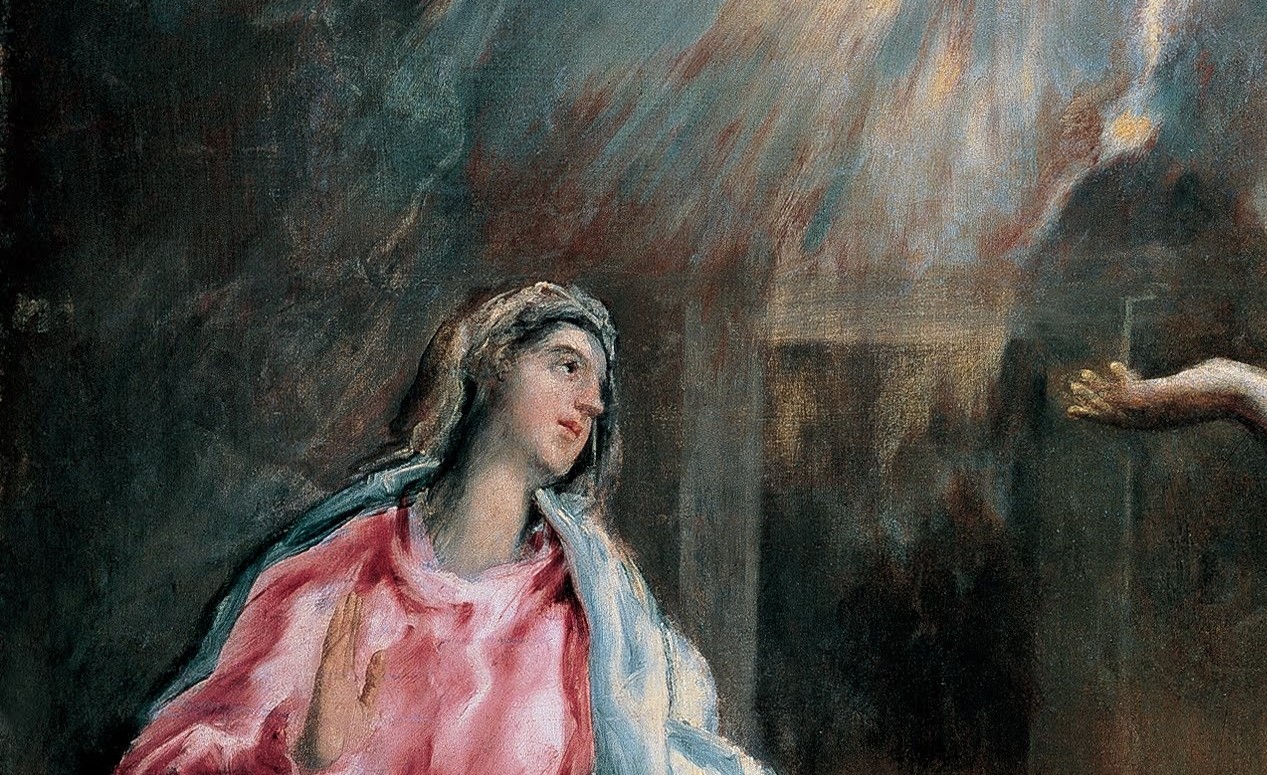
The Gospel of Luke is the richest biblical source for the study of Mary. The narrative of the Annunciation (Lk 1:26-38) presents Mary as the recipient of the announcement of the archangel Gabriel, as the one who is greeted with the unique term Kecharitōménē (κεχαριτωμένη), “full of grace” or, more exactly, “she who has been and continues to be transfigured by grace” (perfect passive). This perfect participle, which expresses a state resulting from a prior and permanent divine action, is the biblical foundation of the dogma of the Immaculate Conception defined by Pius IX in 1854 (DH 2803).
The Magnificat (Lk 1:46-55) is the biblical prayer of Mary par excellence. Composed of echoes of the Old Testament, especially of the Canticle of Hannah (1 Sam 2:1-10), the Magnificat reveals Mary as the personification of faithful Israel, the “daughter of Zion” who receives and proclaims divine mercy. The expression “all generations will call me blessed” (Lk 1:48) is the biblical basis of the universal veneration of Mary in the Church.
Mary in the Gospel of John, Cana and Calvary
The Gospel of John, although it never mentions the name “Mary” in the narrative, presents the Mother of Jesus at two key moments that form a theological diptych: the Wedding at Cana (Jn 2:1-11) and the Cross (Jn 19:25-27). In both, Jesus addresses His Mother with the vocative “Woman” (γύναι), establishing an intentional inclusio. At Cana, Mary intercedes and obtains the first sign. On Calvary, Jesus entrusts to her the Beloved Disciple (“Woman, behold your son”) and, to him, the Mother (“Behold your mother”). This testamentary act is the biblical foundation of Mary’s universal spiritual motherhood in relation to the faithful.
Revelation 12:1-6 presents the “Woman clothed with the sun, crowned with twelve stars” in the labor of childbirth, pursued by the dragon. Patristic exegesis and the Magisterium (LG 63) identify this figure as Mary and as the Church, an identification that is not exclusivist but inclusive: Mary is the icon of the Church, and the Church is the historical prolongation of Mary’s motherhood.
Deepen your studies: explore Mariology, Marian Theology, the Wedding at Cana, Magnificat, Gabriel the Archangel, and the Postgraduate Program in Mariology.
Postgraduate Program in Mariology
Would you like to deepen your formation in Mariology? Discover the Postgraduate Program in Mariology of Locus Mariologicus – an academic formation that unites theological rigor, spiritual life, and the living tradition of the Church.
The biblical journey of Mary at Locus
Old Testament (typology)
- Mary in the Old Testament
- Mariological dossier of the Old Testament
- The Mother of the Redeemer in the OT: prophecies and typology
New Testament (scene by scene)
- The Annunciation (Lk 1:26-38)
- The Visitation and the Magnificat (Lk 1:39-56)
- The Presentation in the Temple (Lk 2)
- The Wedding at Cana (Jn 2:1-12)
- By the Cross: Mother of the disciple (Jn 19:25-27)
- In the Upper Room, at Pentecost (Acts 1:14)
- The Gospels and Mary: an overview
Frequently Asked Questions
Where does Mary appear in the Bible? From the promise of Genesis (3:15) to the Woman of Revelation (12), passing through the Annunciation, Cana, the Cross, and Pentecost.
Is Mary the “new Eve”? Yes – the Fathers read Gen 3:15 and Lk 1 in parallel: where Eve disobeyed, Mary accepted.
What does “full of grace” mean? (Lk 1:28) That Mary was fully graced by God – the biblical basis of the Immaculate Conception.
{“@context”:”https://schema.org”,”@type”:”FAQPage”,”mainEntity”:[{“@type”:”Question”,”name”:”Onde aparece Maria na Bíblia?”,”acceptedAnswer”:{“@type”:”Answer”,”text”:”Da promessa do Génesis (3,15) à Mulher do Apocalipse (12), passando pela Anunciação, Caná, a Cruz e o Pentecostes.”}},{“@type”:”Question”,”name”:”Maria é a «nova Eva»?”,”acceptedAnswer”:{“@type”:”Answer”,”text”:”Sim – os Padres leem Gn 3,15 e Lc 1 em paralelo: onde Eva desobedeceu, Maria acolheu.”}},{“@type”:”Question”,”name”:”O que significa «cheia de graça»?”,”acceptedAnswer”:{“@type”:”Answer”,”text”:”(Lc 1,28) Que Maria foi plenamente agraciada por Deus – base bíblica da Imaculada.”}}]}📖 Would you like to study this seriously? Discover the Postgraduate Program in Mariology at Locus, a rigorous academic formation for theologians, priests, religious, and laypeople.


Responses