Nisi abundaverit iustitia vestra: Mary and the Righteousness of the Heart
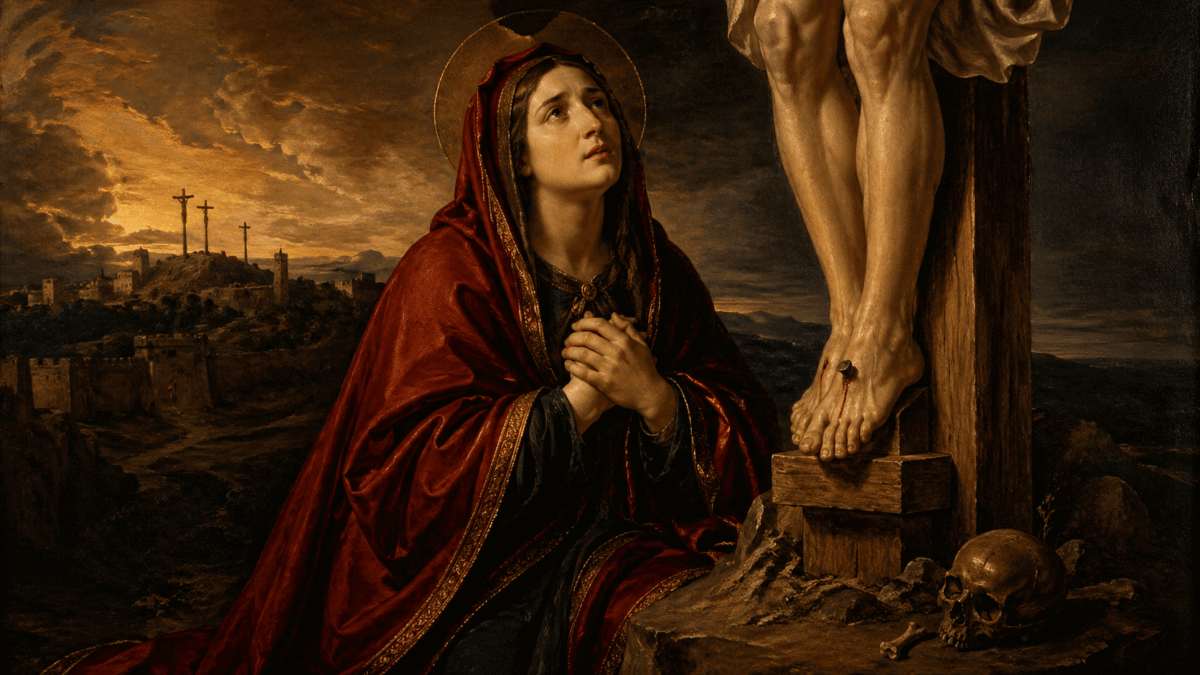
Nisi abundaverit iustitia vestra plus quam scribarum et pharisaeorum, non intrabitis in regnum caelorum.
Mt 5:20
Mt 5:20-26 presents the first of the six “antitheses” of the Sermon on the Mount: “You have heard that it was said to the men of old: You shall not kill. And whoever kills shall be liable to judgment. But I say to you: Everyone who is angry with his brother shall be liable to judgment” (Mt 5:21-22). Jesus does not abolish the precept “you shall not kill”; He radicalizes it, going to the root of the act of murder: anger, contempt, insulting the other. The “righteousness” that Jesus asks of His disciples “exceeds” (perisseuô, overflows) that of the scribes and Pharisees not because it observes more precepts, but because it goes deeper: down to the heart, down to the root of the attitudes and intentions that external precepts can regulate only superficially.
I. The Righteousness That “Exceeds”: From Exteriority to Interiority
The “righteousness” (dikaiosynê) of the scribes and Pharisees was a righteousness of external observance: fulfilling the precepts of the Torah in their visible, behavioral dimension. This observance was not to be despised; it demanded effort, discipline, and fidelity. The problem Jesus points out is not exteriority in itself, but the sufficiency of exteriority: when external observance is considered sufficient for “righteousness,” and there is no concern for the interior state of the heart that external acts express.
The “righteousness that exceeds” that Jesus asks for is the one that moves from exteriority to interiority. It is not enough not to kill; one must not hate, not despise, not insult. It is not enough to offer sacrifices; one must be reconciled with one’s brother before making the offering (Mt 5:23-24). This radicalization does not make the precepts harder to observe in their letter; it makes them impossible to observe without the interior transformation that only grace can bring about. That is why the “righteousness that exceeds” is not an additional effort of human free will; it is the fruit of grace, which transforms the heart from within.
The exhortation of Mt 5:23-24, “If you are presenting your offering at the altar, and there you remember that your brother has something against you, leave your offering there before the altar, go first and be reconciled with your brother, and then come back and present your offering,” is one of the most radical in the Sermon. Reconciliation with one’s brother takes priority over the worship of God: not because worship is secondary, but because worship that does not spring from a reconciled heart is a contradiction in terms. One cannot adore the God of love with a heart that hates one’s brother, made in the image of God.
The urgency of reconciliation before judgment (Mt 5:25-26: “go and be reconciled with your adversary while you are on the way with him”) applies the principle to the eschatological plane: there is a “moment” for reconciliation, the present time of earthly life, which cannot be postponed indefinitely without consequences. This eschatological urgency of reconciliation is one of the most consistent themes of the New Testament: love of one’s brother as a sign of love of God (1 Jn 4:20), and reconciliation as a condition of effective prayer (Mt 6:12, 14-15).
II. Mary and the “Righteousness of the Heart”
Mary is the model of the “righteousness that exceeds”: not the kind that multiplies external precepts, but the kind that flows from an undivided heart. The Gospels record no conflict between Mary and anyone; there is no anger, no contempt, no insult. This is not an argument from silence (the Gospels record very little of Mary’s life in general), but it is significant: the tradition that meditated on Mary never found in her the shadow of an interior injustice.
The episode that comes closest to a “conflict” between Mary and anyone is the scene in Mt 12:46-50, where Jesus seems to distance Himself from His mother and His brothers, who are seeking Him from outside: “Who is my mother, and who are my brothers?” Tradition has interpreted this episode in various ways, but the most common interpretation is that Jesus does not reject Mary; He deepens the foundation of their relationship: what binds Jesus to Mary is not only the biological bond, but the bond of faith, and Mary is on the side of those who “do the will of the Father.” There is no conflict between Jesus and Mary; there is a deepening of the bond.
Reconciliation as a priority over worship (Mt 5:23-24) has an important Marian dimension: Mary, who intercedes with the Son on behalf of mankind (as at Cana), is the mediatrix of reconciliation between mankind and God. But her mediation does not replace direct reconciliation between brothers; on the contrary, it points toward it. The most effective Marian prayer is the one that, in invoking Mary, also becomes a readiness to be reconciled with one’s brother. Mary, who stood by the Cross, where Jesus accomplished the supreme reconciliation, is the icon of a faith that does not separate love of God from love of neighbor.
III. “Do Not Be Angry with Your Brother”: Anger and Its Root
Jesus’ radicalization concerning anger (Mt 5:22) points to the biblical anthropology of the heart as the source of all acts: “it is from the heart that evil thoughts come” (Mt 15:19). Anger, the Greek orgê, which ranges from passing irritation to deep-rooted hatred, is the root of murder; it is not merely that murder is the fruit of anger. To fight only the fruits (violent acts) without fighting the root (the anger of the heart) is a superficial approach that does not solve the problem.
The ascetical and mystical tradition (in particular Evagrius Ponticus, John Climacus, and, more recently, Thomas Merton) treated anger as one of the fundamental “thoughts” that disturb prayer and the spiritual life. The cure for anger is not repression but transformation: recognizing its causes (the wound of injured pride, the fear of loss, the sense of injustice, whether real or perceived) and surrendering it to God. Mary, who never appears angry in the Gospels, who “keeps in her heart” instead of reacting with irritation, is the model of this interior transformation of anger into serene trust in God.
The connection between the “righteousness of the heart” that Mt 5:20-26 describes and Marian spirituality is deeper than it may seem: the “righteousness” that Mary practices is not that of the law that regulates external behavior; it is that of the love that transforms the heart and, through the transformed heart, transforms behavior. It is the “righteousness” that springs from the “poverty of spirit” of the Beatitudes: the kind that has nothing to prove, nothing to defend, nothing to impose, only the serene clarity of one who is, at the same time, completely dependent on God and completely available to one’s brother.
Mary, whose “righteousness exceeds” all legalistic observance because it springs from a heart without anger and without division, is the model of the interior reconciliation that Jesus asks for in the Sermon on the Mount as the condition for authentic worship of God.
References
- Second Vatican Council, Gaudium et Spes, no. 22 (1964).
- John Paul II, Redemptoris Mater, nos. 39-41 (1987).
- U. Luz, Das Evangelium nach Matthäus, vol. I (1985).
- R. Schnackenburg, Die Bergpredigt (1984).
Postgraduate Program in Mariology
Would you like to deepen your formation in Mariology? Discover the Postgraduate Program in Mariology at Locus Mariologicus – an academic formation that unites theological rigor, spiritual life, and the living tradition of the Church.
Would you like to study Mariology seriously?
This article grows out of the works in the Locus Mariologicus library. The Postgraduate Program in Mariology takes you to the same source, with academic guidance: Scripture, the Fathers of the Church, and the Magisterium, from the first dogma to contemporary questions.




Responses