Nisi granum frumenti: Saint Lawrence the martyr and Mary, Mother of the grain that fell into the earth
Amen, amen dico vobis, nisi granum frumenti cadens in terram mortuum fuerit, ipsum solum manet. Si autem mortuum fuerit, multum fructum affert. Qui amat animam suam, perdet eam. Et qui odit animam suam in hoc mundo, in vitam aeternam custodit eam.
Jn 12:24-25
The Feast of Saint Lawrence, Deacon and Martyr (August 10), has as its Gospel Jn 12:24-26, the parable of the grain of wheat that falls into the earth and dies in order to bear fruit. The liturgical choice is theologically precise: Lawrence died like a grain that falls into the earth, and the Church of Rome, which was expected to be wiped out under Valerian, became still more fruitful through the blood of her martyrs. Jesus’ “nisi mortuum fuerit” is the law of the Kingdom that martyrdom makes visible in the most radical way: life freely given out of love begets more life than life preserved out of fear.
The context in John is significant: Jn 12:20-36 recounts the coming of “some Greeks” who wanted to see Jesus, the arrival of the Gentiles as a sign that the hour of glorification has come. “The hour has come for the Son of Man to be glorified” (Jn 12:23), and John’s “glorification” is the Cross: the “being lifted up” (Jn 12:32) that is at once crucifixion and exaltation. The parable of the grain of wheat explains this logic: death does not interrupt the mission of Jesus but universalizes it, “if I am lifted up from the earth, I will draw all to Myself” (Jn 12:32).
I. “Nisi mortuum fuerit”: the law of the grain
“If the grain of wheat does not fall into the earth and die, it remains alone. But if it dies, it bears much fruit” (Jn 12:24), the parable of the grain is one of the densest in the fourth Gospel. The grain that “remains alone” is life closed in on itself: fruitful in potency but sterile in act. The death of the grain is not destruction but transformation: the husk that preserved the seed dissolves in order to free the embryo that will bear fruit. The “death” of Jesus on the Cross is not defeat but the liberation of the fruitfulness that was contained in His humanity.
The law of the grain applies to every Christian vocation: “whoever loves his life loses it. Whoever hates his life in this world will keep it for eternal life” (Jn 12:25). This inversion is not masochism but eschatological realism: life closed in on itself loses what it seeks to preserve. Life given opens itself to a fruitfulness that exceeds the horizon of the giver himself. The “hatred of one’s own life” is not a disparagement of existence but a detachment from the self that impedes total self-giving, the radical availability for life to be a grain that falls and bears fruit.
The missionary application is explicit: “whoever serves Me, let him follow Me. And where I am, there also will My servant be” (Jn 12:26). To follow Jesus is to follow the grain, to accept the logic of fruitful death. This logic is not reserved for the martyrs of blood but belongs to all discipleship: the Christian life is a series of partial “deaths” (to the ego, to self-sufficiency, to comfort) that bear invisible fruit.
II. Saint Lawrence: the grain that became a burning coal
Lawrence was one of the seven deacons of Rome under Pope Sixtus II, martyred on August 10, 258, during the persecution of Valerian. Tradition recounts that, when Sixtus II was arrested, Lawrence asked to die with his bishop. Sixtus prophesied that Lawrence would follow him in three days, and so it was. His death on the burning gridiron gave rise to the tradition (attested by Ambrose and Prudentius) that Lawrence said to his executioner: “I am already roasted on this side. Turn me to the other”. Serenity in the face of death is the sign of the grain that accepts falling into the earth.
Lawrence’s role as a deacon is theologically relevant: the deacons administered the goods of the Church of Rome and distributed them to the poor. When the prefect demanded that Lawrence hand over the “treasures of the Church”, Lawrence presented the poor: “Behold the treasures of the Church”. This gesture, which condemned him to death, is the literal application of “where your treasure is, there also will your heart be” (Mt 6:21). Lawrence’s grain fell into the earth. The Church of Rome flourished.
III. Mary: Mother of the grain that fell into the earth
Mary is, in the theology of the Redemption, the one who received the Grain that the Father sowed in the world: the Word made flesh who “fell” into human earth through the virginal womb of Mary. The Incarnation is the “falling of the grain into the earth”, the eternal Son who enters the mortal condition, the fragility of the flesh, the limit of space and time. Mary, who welcomed this Grain, was the “earth” in which the Father chose to sow the Son: not just any earth but the earth prepared by the Immaculate Conception, clean, fruitful, ready to receive.
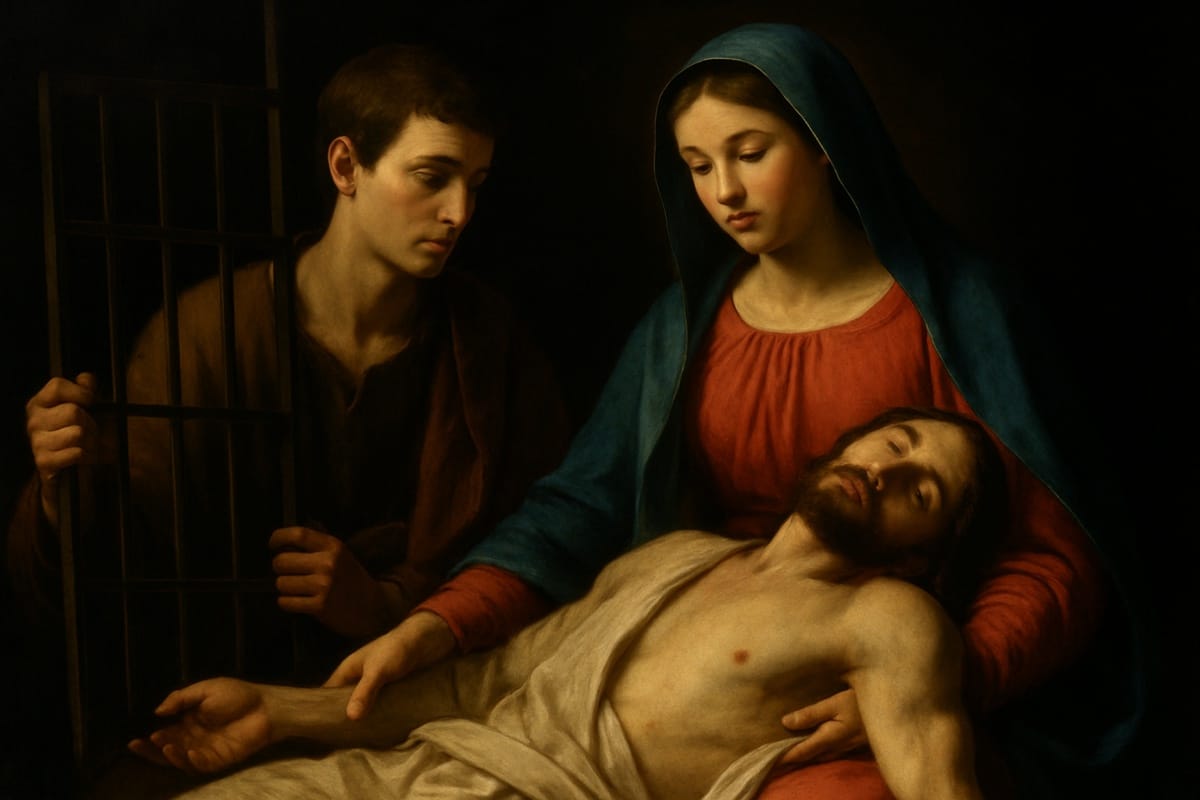
The image of the Pietà, Mary holding the dead body of the Son, is the image of the grain that fell into the earth: the body that Mary received alive (Annunciation) and offered dead (Calvary). The death of Jesus is, in the Marian perspective, the fulfillment of the “nisi mortuum fuerit”: the Grain that Mary bore needed to die in order to bear fruit. This cooperation of Mary in the sacrifice is not passive; “stabat Mater” indicates the active fidelity of the Mother who does not flee the law of the grain but accompanies it to the end.
The fruitfulness of the Grain, “it bears much fruit”, has in Mary its first expression: the Assumption (August 15, five days after the Feast of Saint Lawrence) is the “fruit” of the grain that the Son sowed. Mary, who cooperated in the death of the Son, shares first in His glorification. The liturgical cycle of August, Saint Lawrence (the 10th), the Assumption (the 15th), is a diptych of the grain: the martyr who fell (Lawrence) and the Mother who was exalted (Mary), two faces of the fruitfulness of the grain that dies.
IV. “Ubi ego sum, illic et minister meus erit”: mission and martyrdom
“Where I am, there also will My servant be” (Jn 12:26), the promise of Jesus to the disciple who follows Him in the logic of the grain is the promise of eschatological communion: to follow Jesus in death means to share in His resurrection. Saint Lawrence, who followed Sixtus II into martyrdom within three days, is “where Jesus is”, in the glory of the Father. Mary, who followed the Son to Calvary, is “where Jesus is”, assumed into the glory of the Resurrection.
The vocation to martyrdom, red (the shedding of blood) or white (the daily giving of one’s life), is the law of the grain applied to Christian existence. The “white martyrdom” that the monastic tradition identified with the life of prayer and service is the everyday form of “dying” in order to bear fruit: the mother who offers her children to the service of the Gospel, the priest who spends his life in the confessional, the volunteer who serves the poor with joy. Mary is the supreme model of this white martyrdom: a life entirely given, a grain entirely planted, an unimaginable fruit.
The feast of Saint Lawrence is an invitation to contemplate the law of the grain in one’s own life: where am I called to “die” in order to bear fruit? Mary, who bore the Son and offered Him to the Father, is the teacher of this law: she who said “fiat” without reserve and thus allowed the greatest of Grains to fall into human earth and to give the fruit of salvation to all humanity.
Postgraduate Program in Mariology
Would you like to deepen your formation in Mariology? Discover the Postgraduate Program in Mariology of Locus Mariologicus — an academic formation that unites theological rigor, spiritual life, and the living tradition of the Church.
Would you like to study Mariology seriously?
This article grows out of the works in the Locus Mariologicus library. The Postgraduate Program in Mariology takes you to the same source, with academic guidance: Scripture, the Fathers of the Church, and the Magisterium, from the first dogma to contemporary questions.




Responses