Nolite iudicare: Mary and the Gaze That Does Not Judge
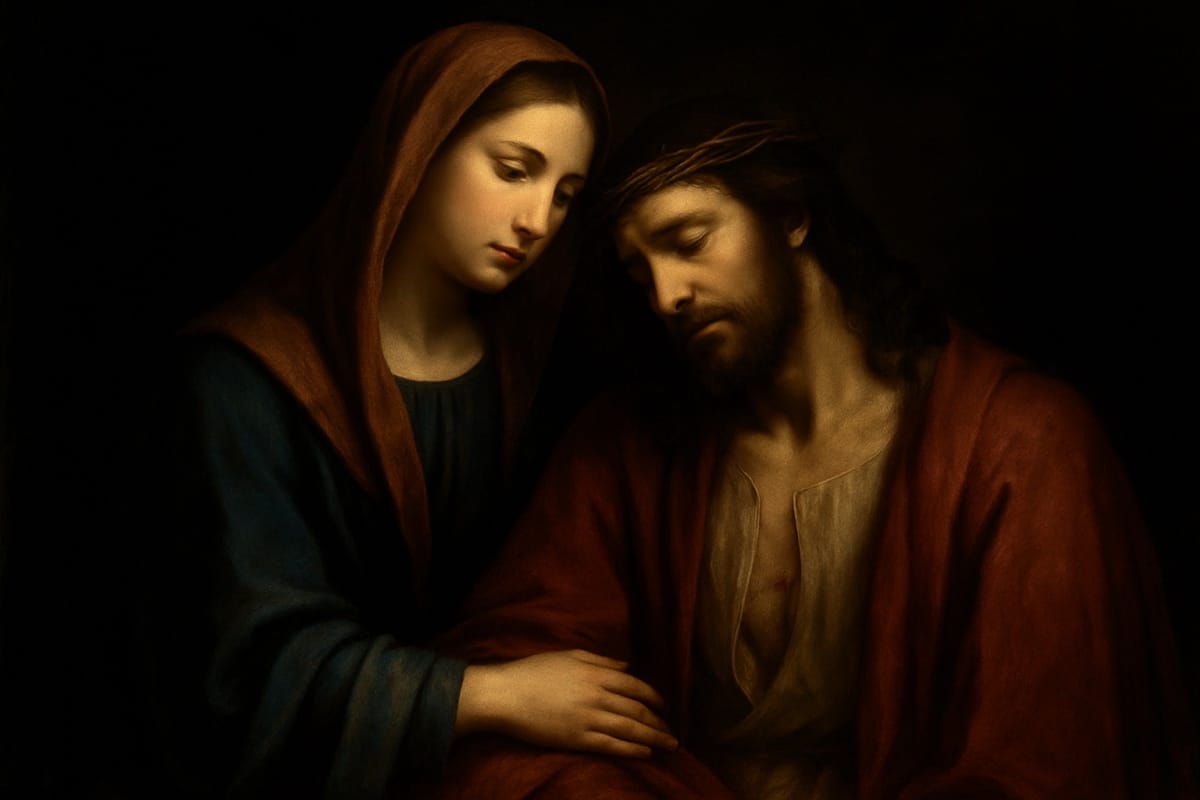
Nolite iudicare, ut non iudicemini. In quo enim iudicio iudicaveritis, iudicabimini.
Mt 7:1-2
The opening of chapter VII of the Sermon on the Mount, “Judge not, that you be not judged,” is one of the most quoted and most misunderstood sayings of Jesus in the Christian tradition. It is not a prohibition of moral discernment: the same pericope ends with the warning against false prophets, which demands discernment. It is rather the prohibition of a specific kind of judgment: the condemnatory judgment that presumes to know a person’s interior, that puts itself in the place of God, that turns the moral evaluation of an act into a sentence on the person. The distinction between discernment and condemnation, between evaluating what someone does and decreeing what someone is, lies at the heart of this Gospel instruction.
The image of the “beam in one’s own eye” (Mt 7:3-5) is among the most humorous in the Gospel, a grotesque hyperbole that Jesus uses to describe the blindness of the self-justified person who criticizes others. The “beam” is not necessarily the greater sin: it is the inability to see one’s own moral condition with the same clarity with which one sees that of one’s neighbor. Jesus’ criticism is not directed at the pastoral care that helps another to see; it is directed at the reversal of perspective that makes the critic at once blind and confident in his diagnosis. Only someone who has recognized his own “beam” is in a position to help another with the “splinter.”
I. Judgment and the Beam in the Eye
The prohibition of judgment in Mt 7:1 has a precise theological structure: the standard by which one judges becomes the standard by which one is judged. This symmetry, “the measure with which you measure will be measured out to you” (Mt 7:2), is not a threat of divine vengeance but a description of the inner logic of judgment: whoever judges according to the law sets up a tribunal in which the law will judge him. Whoever judges according to mercy will find mercy. The horizon of the final judgment, in which God Himself is the judge, makes any human judgment that anticipates that horizon presumptuous.
Patristic and medieval theology distinguished between iudicium discretionis (the judgment of discernment, necessary for moral and communal life) and iudicium condemnationis (the judgment of condemnation, reserved to God). Thomas Aquinas, in the Summa Theologiae (II-II, q. 60), developed this distinction: prudential judgment, evaluating acts in order to guide one’s own conduct and that of others, is not only permitted but necessary. What Jesus forbids is the judgment that condemns the person as a whole on the basis of partially known acts, without knowing the intentions, the circumstances, the inner history.
The twentieth century brought the Christian tradition a new awareness of this distinction, partly through dialogue with psychology. The capacity to separate the behavior from the person, “I condemn the act, not the person,” is a moral and spiritual achievement that the Gospel tradition prepared but that contemporary reflection articulated with greater precision. Pope Francis, in Amoris Laetitia (2016), insisted repeatedly on this logic: the pastoral accompaniment of irregular situations requires precisely this capacity not to collapse the person into the act, to see the person’s history, efforts, and limitations with mercy, the logic of the “beam and the splinter” applied to concrete pastoral care.
The image of the beam has a communal dimension that goes beyond individual introspection. Christian communities can develop institutional “beams,” forms of collective blindness to their own sins that coexist with a critical hypersensitivity to the sins of others. A Church that criticizes the sexual immorality of society while covering up its own abuses has an institutional “beam.” A Christian who condemns political corruption while committing tax fraud has the beam of the Pharisee. Jesus’ instruction is therefore not only a rule of individual conduct but a grammar of communal discernment.
II. Mary beneath the Cross: The Gaze That Does Not Condemn
The scene of Mary at the foot of the Cross (Jn 19:25-27) is the privileged place for contemplating the “gaze that does not judge” in its most radical form. Around her, those who condemned Jesus (the chief priests, the soldiers, part of the crowd) exercised the condemnatory judgment that Mt 7:1 forbids: they decreed that Jesus was a blasphemer, a criminal, deserving of death. Mary remained present, without judgment, without cursing, without turning away. Her silence beneath the Cross is not passivity or weakness: it is the most intense expression of a love that refuses to be governed by the logic of condemnatory judgment.
The theology of Marian compassion, com-passio, suffering-with, describes Mary’s presence beneath the Cross as a participation in the suffering of the Son that does not require judgment as a condition. Mary did not need to understand fully what was happening in order to remain. She did not need to resolve the theological scandal (“how can the Son of God die like this?”) in order to stay at His side. Her love was greater than her understanding, and that is why her gaze remained merciful where other gazes became condemning or despairing.
The iconographic tradition of the Pietà, Mary holding the dead body of her Son, represents this gaze without judgment in its most concentrated form. Michelangelo, Bellini, Michelangelo captured in Mary’s expression something that is neither resignation nor triumph: it is the peace of one who has loved completely and has no regrets. There is no reproach on the face of the Pietà, not against Pilate, nor against the Pharisees, nor against the disciples who fled, nor against God who “allowed” this. It is the gaze of love which, in the words of 1 Cor 13, “endures all things” and “thinks no evil.”
The parallel with Mt 7:1-5 is theological, not merely devotional. If the judgment that Jesus forbids is the one that “thinks it knows” a person’s interior from the outside, Mary beneath the Cross demonstrates the contrapositive: the love that remains even when outward appearances (the appearance of failure, of abandonment, of death) could justify desertion. The Marian gaze needed neither to “understand in order to believe” nor to “see in order to love.” It is the gaze that, by refusing condemnatory judgment, became capable of contemplating the Resurrection.
III. Mercy as the Logic of the Kingdom
The context of the saying “judge not” in the Sermon on the Mount is a theology of mercy that runs through the whole narrative tradition of Luke and Matthew. The Beatitudes begin with “blessed are the merciful, for they shall obtain mercy” (Mt 5:7), the same structure of reciprocity that Mt 7:2 repeats: the standard by which one treats others becomes the standard by which one is treated. The logic of the Kingdom is not that of transactional justice (giving what is deserved) but that of the mercy that creates possibility where the logic of merit shuts the door.
The parable of the unforgiving servant (Mt 18:23-35) develops the same logic at greater length: whoever has had an unpayable debt forgiven and refuses to forgive a smaller debt “activates” the original debt once again. Forgiveness is not passed on automatically; it requires the inner conversion that makes the one forgiven capable of forgiving. But the refusal to forgive, the insistence on condemnatory judgment of the other, is incompatible with receiving God’s forgiveness. Not because God “takes back” His forgiveness, but because a heart that does not forgive is not open to the love that forgiveness requires.
Marian devotion grasps this logic intuitively: Mary is invoked as Mater misericordiae, “Mother of Mercy,” precisely because her love is presented as free of any conditions of merit. The Salve Regina invokes Mary as the refuge of those who do not deserve refuge, the “poor banished children of Eve” who groan “in this valley of tears.” Marian mercy does not wait for merit to be proven. It goes out to meet need. This Marian model of unconditional mercy is precisely the opposite of the condemnatory judgment that Mt 7:1 forbids, and its most perfect fulfillment.
Pope John Paul II, in Dives in Misericordia (1980), distinguished between mercy and pity: pity can condescend to weakness while keeping a position of superiority. Mercy, in its authentic Gospel form, renounces superiority and meets the other in his own dignity. It is the logic of the father in the parable who “ran to meet” the prodigal son before the son had finished his speech of self-abasement: love did not wait for complete repentance before showing itself. This is the model of Christian mercy that Mt 7:1 presupposes and that Mary embodies.
IV. Discernment without Condemnation
The prohibition of judgment in Mt 7:1 is not a prohibition of moral thinking, nor an ethical relativism that denies the distinction between good and evil. The Sermon on the Mount is precisely the text in which Jesus demands the highest moral standard: interiority of intention, love of enemies, perfection as the horizon. The One who forbids condemnatory judgment is not saying that there are no real goods and evils; He is forbidding the transformation of a moral judgment about an act into a definitive sentence on the person.
Spiritual discernment, the capacity to distinguish spirits, inner movements, and the tendencies of situations, is not only permitted but encouraged by the Christian tradition. Ignatius of Loyola, in the Rules for the Discernment of Spirits of the Spiritual Exercises, worked out a precise phenomenology of the inner movements that lead a person toward God or away from Him, an exercise that requires fine discernment, not condemnatory judgment. The Ignatian criterion is precisely that of “fruits”: not “this man is evil” but “does this tendency lead to consolation or to desolation?”
Mariology offers a model of discernment without condemnation in the scene at Cana (Jn 2:1-11): Mary noticed that “they have no wine,” a precise diagnosis of a problematic situation, and brought it to Jesus without condemning the hosts, without making the problem public, without any air of superiority. Her discernment was discreet, effective, and completely free of the self-satisfaction of the one who judges. “Do whatever He tells you” is the solution Mary proposes: not an assessment of the failure of others, but a pointing toward the remedy.
Jesus’ instruction on the “beam and the splinter” ends with a positive note that is often left out: “then you will see clearly to take the splinter out of your brother’s eye” (Mt 7:5). The aim is not indifference to the moral situation of others; it is the creation of the conditions for effective help. Whoever has recognized his own beam can genuinely help. Whoever has not recognized it helps poorly, even with good intentions. The instruction of Mt 7:1-5 is, paradoxically, a pedagogy for authentic fraternal accompaniment: not abandoning one’s brother to his splinter, but the humble discernment that creates the conditions for removing it.
Postgraduate Program in Mariology
Would you like to deepen your formation in Mariology? Discover the Postgraduate Program in Mariology of Locus Mariologicus, an academic formation that unites theological rigor, spiritual life, and the living tradition of the Church.
Would you like to study Mariology seriously?
This article grows out of the works in the Locus Mariologicus library. The Postgraduate Program in Mariology takes you to the same source, with academic guidance: Scripture, the Fathers of the Church, and the Magisterium, from the first dogma to contemporary questions.





Responses