The Servant Is Not Greater Than His Lord: Mary and the Service That Exalts
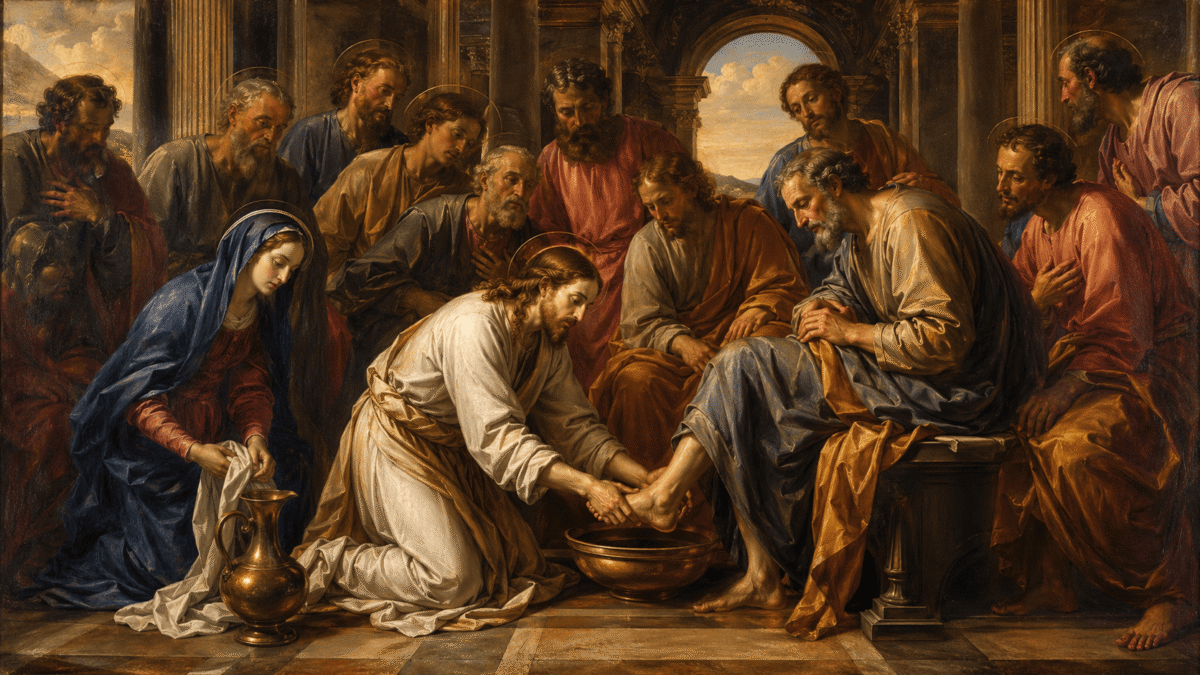
Non est servus maior domino suo, neque apostolus maior eo qui misit illum.
Jn 13:16
“The servant is not greater than his lord, nor is the one who is sent greater than the one who sent him.” Jesus speaks these words after washing the disciples’ feet (Jn 13:1-17), a gesture that overturned every expected hierarchy: the Lord serves, the Master washes feet, the Son of the Most High kneels before fishermen from Galilee. The principle Jesus formulates after the gesture is its interpretation: service does not diminish; it exalts. Mariology finds in this logic one of its most fruitful themes: the ancilla Domini, the handmaid of the Lord, receives her highest dignity precisely in service.
I. The washing of the feet: a reversal of hierarchy and a new model of greatness
Jn 13:1-17 narrates the washing of the feet with unusual solemnity. The evangelist prefaces the gesture with a remark of theological depth: “Jesus, knowing that the Father had given all things into his hands, and that he had come from God and was going to God…” (Jn 13:3). It is precisely this Jesus, who knows His divine origin and His eternal destiny, who rises, lays aside His outer garment, wraps Himself in the towel, and washes the disciples’ feet. Awareness of His own dignity does not prevent service; it is its foundation.
This Johannine principle is the exact opposite of worldly logic, for which greatness excludes service. In the logic of Jesus, true greatness is expressed in service: not as a magnanimous concession by one who “stoops” to the level of his inferiors, but as an expression of the very nature of love. “Having loved his own who were in the world, he loved them to the end” (Jn 13:1): the service of the washing of the feet is the expression of this love “to the end,” the same love that will culminate on the Cross.
Peter resists: “You shall never wash my feet” (Jn 13:8). His resistance reveals an understanding of dignity that is the opposite of the Gospel: for Peter, allowing the Lord to wash his feet would be a humiliation of the Lord. Jesus answers with a different logic: “If I do not wash you, you will have no part with me.” Being washed by the Lord, receiving His service, is the condition for communion with Him. To refuse the service of Jesus is to refuse the relationship with Jesus.
The interpretation of the washing of the feet as a figure of Baptism (the “part” Jesus speaks of in Jn 13:8 is interpreted baptismally by tradition) and as a figure of the Eucharist (in John, the washing precedes the Last Supper) opens up the sacramental dimension of this gesture. The service of Jesus is not merely a moral example of humility; it is the way He works salvation: descending, washing, purifying, from below and not from above.
II. “Ancilla domini”: Mary and the dignity of service
Lk 1:38: “Behold, the handmaid of the Lord” (idou he doule kyriou). Mary identifies herself, at the most solemn moment of her own history and of the history of the world, as “handmaid,” doule, which in Greek literally means “slave.” This self-designation is not self-deprecation: it is the most exact expression of her relationship with God and of her way of existing before Him. Mary is not God’s handmaid in the manner of one who obeys under coercion; she is His handmaid in the manner of one who gives herself totally, who makes the will of another her own will.
The title ancilla Domini has been explored in depth by the Mariological tradition. St. Augustine saw in Mary the model of “humility” (humilitas), which is the mother of all Christian virtues: not outward abasement, but the true recognition of one’s own position before God. Mary’s “humility” is not an inferiority complex; it is the realism of one who knows herself to be a creature and gives herself to the Creator with her whole being.
The Magnificat develops the theology of the ancilla in a surprising way: “For he has looked upon the humility of his handmaid” (Lk 1:48). The tapeinôsis, the “humble state,” the “low estate” of Mary, is what God “looked upon.” Not her holiness, not her merits, not her moral perfection, but her “humility,” her being a handmaid, her not having in herself the foundation of her greatness. And it is precisely because He looks upon this “humiliation” that God exalts her: “from now on all generations will call me blessed” (Lk 1:48).
The logic of the Magnificat is exactly the logic of the washing of the feet: greatness comes from service, exaltation from humility, honor from self-giving. “He has cast down the mighty from their thrones and exalted the humble” (Lk 1:52). Mary sets forth a principle that the history of salvation continually confirms: God does not follow the logic of the world, which honors those who assert themselves. God honors those who give themselves.
III. “As I have done, so you also should do”: Mary and the mandate of service
Jn 13:15: “I have given you an example, so that you may do just as I have done to you.” The gesture of Jesus is not only to be contemplated; it is to be imitated. The mandate of service is as constitutive of Christian identity as the mandate of love (Jn 13:34): one cannot truly love without serving, nor truly serve without loving. The washing of the feet is the bodily expression of the love that the “new commandment” of Jn 13:34 formulates in words.
In tradition, Mary is the model of the fulfillment of this mandate. The Visitation (Lk 1:39-56) is the most immediate gesture: no sooner had she received the news of Elizabeth’s pregnancy than she “went in haste” (meta spoudes) to her house. This haste is not impulsiveness; it is the urgency of love that shows itself in service. Mary, who has just received the greatest grace in history, does not keep it for herself: she sets out to serve someone who needs help.
The Wedding at Cana (Jn 2:1-11) reveals the same sensitivity: Mary is the first to notice that the wine has run short, the first to intercede, the first to direct the servants toward obedience to the Son. Her intercession at Cana is not spiritual exhibitionism; it is discreet service, attentive to the needs of others, aimed at solving the problem without taking center stage. “Do whatever he tells you” (Jn 2:5): Mary does not lead the solution; she points to the One who has it.
The monastic tradition saw in Mary the model of religious life precisely for this reason: the nun or monk who takes the vow of obedience repeats, in a certain way, Mary’s fiat, handing over his or her will to the superior as an expression of the surrender of that will to God. This analogy, explored from St. Benedict to the Rule of the Poor Clares and the Ignatian Constitutions, shows how Marian service has shaped Christian religious life: not servile obedience, but the loving self-surrender that finds in the will of another the expression of the will of God.
IV. “You are not of the world”: service as eschatological witness
Jn 15:19: “You are not of the world.” This paradoxical statement, that the disciples live in the world but are not “of the world,” defines the identity of the followers of Jesus as an identity of contrast. The washing of the feet is the most visible sign of this contrast: in the world, the powerful are served. In the community of Jesus, those who have more power serve more. This contrast is not a display of modesty; it is the witness of a different logic, the logic of the Kingdom of God.
Mary, who “is not of the world” in the deepest sense, who was preserved from sin, who lived wholly directed toward the Son, who was assumed body and soul into glory, continues to “serve” in the dimension of her spiritual motherhood. Her intercession, her presence beside her spiritual children, her role as auxiliatrix in the life of the Church: all this is the extension, beyond the limits of time, of the service she rendered in her earthly life.
Marian eschatology has a particular dimension here: the Assumption did not put an end to Mary’s service; it transformed it. She who served in history continues to serve in glory. She who interceded at Cana now intercedes with full authority before the glorified Son. The service that began with the “fiat” of the Annunciation has no end: it is as eternal as the love of the Son to whom she gave her whole existence.
Christian devotion to Mary’s “service” (the countless religious orders and congregations that have placed themselves under her name and imitate her in serving the poor, the sick, and the ignorant) is the ecclesial expression of this logic. Service does not diminish: it exalts. The servant is not “lesser” than the lord in ontological dignity; he is “lesser” in the logic of self-giving, which is the logic of love. And it is precisely in this “littleness” that his greatness lies.
Mary, the “handmaid of the Lord” who received her highest dignity in service, is the model of the Church that washes the feet of the world as Jesus washed the feet of His own.
References
- Second Vatican Council, Lumen Gentium, nos. 56-59 (1964).
- John Paul II, Redemptoris Mater, nos. 38-41 (1987).
- St. Augustine, In Iohannem, Tract. LVIII (on Jn 13).
- H. U. von Balthasar, Das betrachtende Gebet (1955).
- R. Laurentin, Lourdes: Dossier des documents authentiques (1957).
Postgraduate Program in Mariology
Would you like to deepen your formation in Mariology? Discover the Postgraduate Program in Mariology at Locus Mariologicus – an academic formation that unites theological rigor, spiritual life, and the living tradition of the Church.
Would you like to study Mariology seriously?
This article springs from the works in the Locus Mariologicus library. The Postgraduate Program in Mariology takes you to the same source, with academic guidance: Scripture, the Fathers of the Church, and the Magisterium, from the first dogma to contemporary questions.





Responses