Our Lady of Chiquinquirá, patroness of Colombia
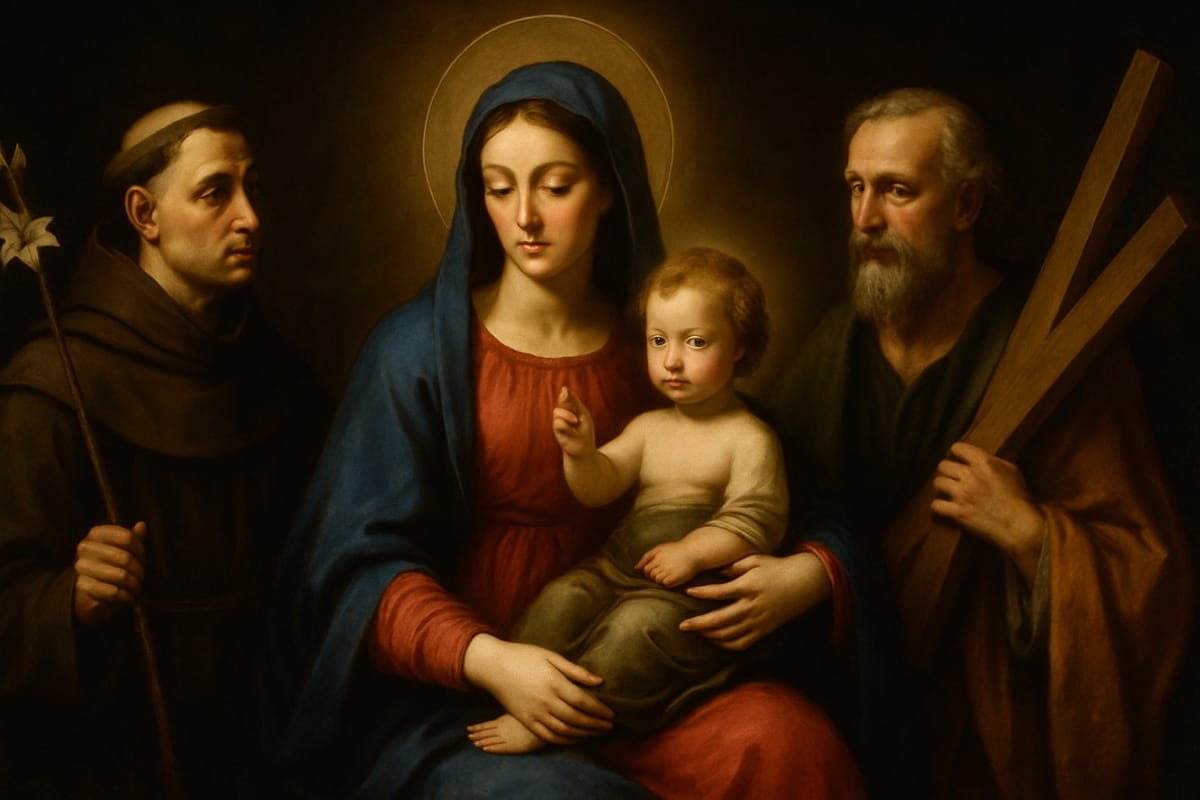
“Ecce ego facio nova. Nunc orientur, utique cognoscetis ea” (Is 43:19), “Behold, I am doing a new thing. Behold, it is already springing forth, do you not perceive it”?
I. Behold, I am doing a new thing: the prophetic theology of divine renewal
Chapter forty-three of Isaiah is one of the high points of Old Testament prophetic literature. Deutero-Isaiah, writing for the people in the Babylonian exile, announces that the Exodus is not merely a memory of the past, it is a promise of the future. “Remember not the former things, nor consider the events of old. Behold, I am doing a new thing. Behold, it is already springing forth, do you not perceive it? Yes, I will open a way in the desert and make rivers flow in the steppe” (Is 43:18-19). The theology of this promise is decisive: God does not act only in the past of sacred history, He acts in the present, and His action always produces something new. This newness is not the destruction of the old: it is restoration, it is renewal, it is the old that reappears with renewed vigor when divine grace reaches it. And it is precisely this theological category of renewal that was manifested in an extraordinary historical way in the Colombian shrine of Chiquinquirá, in the year 1586, when a Marian painting, already faded and almost invisible, miraculously reappeared in vivid colors before the astonished eyes of a humble indigenous woman.
II. Chiquinquirá, 1586: the miraculous renewal of the faded painting
In the middle of the sixteenth century, the Spanish painter Alonso de Narváez, settled in the recently founded city of Tunja, in what is now the Colombian department of Boyacá, executed a painting on indigenous cotton canvas for a rural chapel belonging to the encomendero Antonio de Santana. The painting represented Our Lady of the Rosary with the Child Jesus in her arms, flanked by Saint Anthony of Padua on her right and Saint Andrew the Apostle on her left. But the canvas was of modest quality and the pigments did not withstand time well. Within a few years the painting gradually faded, the colors dimmed, the figures became almost invisible. The canvas ended up abandoned in a small adobe shed in the village of Chiquinquirá, used as an improvised chapel for the Indians and the mestizos of the region. On December twenty-sixth, 1586, the indigenous woman Maria Ramos, a woman of pious life who was praying in the chapel, saw the old canvas gradually begin to light up. The Indian woman called the other people who were there. Before the eyes of several witnesses, the painting recovered its original colors in a few minutes, with a sharpness even greater than at first, the outlines of the three figures and the brightness of the garments restored. The event became known as “La Renovación,” the Renewal. The devotion spread rapidly throughout the viceroyalty of New Granada and later throughout Colombia. Pope Pius X declared Our Lady of Chiquinquirá Patroness of Colombia in 1910, and Pope Benedict XV authorized her canonical coronation in 1919. Pope John Paul II visited Chiquinquirá in 1986, on the fourth centenary of the Renewal.
III. The Magnificat: the canticle of the divine renewal of history
The Gospel of Luke that accompanies this celebration is the Magnificat, the canticle that Mary sang in the house of Elizabeth and which is, in the proper sense, the first Marian theology formulated by the Mother herself. “My soul magnifies the Lord and my spirit rejoices in God my Savior, because He has looked upon the lowliness of His handmaid” (Lk 1:46-48). And then comes the part of the canticle that describes God’s renewing action in history: “He has shown the strength of His arm, He has scattered the proud in the thoughts of their hearts. He has cast down the mighty from their thrones and exalted the lowly. He has filled the hungry with good things and sent the rich away empty” (Lk 1:51-53). This canticle is not a sequence of abstract ideas: it is a confession that God acts by renewing, by reversing, by restoring. And the Marian theology of Chiquinquirá is a historical confirmation of this program of the Magnificat. The faded painting, abandoned in an adobe shed, was chosen by God as the visible sign of His renewing action. A famous work of art from a European cathedral was not chosen: a humble painting from a peripheral viceroyalty was chosen, and it was before the eyes of an indigenous woman, and not of a bishop nor of a king, that the renewal was manifested. The logic of Chiquinquirá is the logic of the Magnificat made flesh on Colombian soil.
IV. Chiquinquirá and the Mariology of renewal as Mary’s constant signature
The miraculous renewal of the image of Chiquinquirá is not, in universal Marian history, an isolated case. Various other Marian images over the centuries have undergone analogous phenomena of inexplicable restoration, of self-illumination, of sudden revivification. This recurrence suggests a theological insight that universal Mariology has reflected in varied forms: Mary’s presence in history has renewal as its permanent characteristic. Where Mary enters, something is renewed. The grace that she mediated at the Incarnation is a grace of radical newness, and her permanent maternal ministry continues to work this newness in the places and in the people who welcome her. The Second Vatican Council recognized that Mary “occupies, in the Church, after Christ, the highest place and at the same time the one closest to us” (Lumen Gentium, 54), and that this closeness becomes a permanent source of renewal for the pilgrim Church. Chiquinquirá is, in this sense, the Colombian version of a universal promise: faded colors regain their brightness where Mary is, lost outlines become sharp again when she is invoked, and what seemed forgotten by time finds itself preserved by the loving memory of the Mother. The Patroness of Colombia taught her people, four and a half centuries ago, a lesson that remains timely: nothing is definitively lost as long as there is a Mother who remembers.
Postgraduate Program in Mariology
Would you like to deepen your formation in Mariology? Discover the Postgraduate Program in Mariology of Locus Mariologicus – an academic formation that unites theological rigor, spiritual life, and the living tradition of the Church.
Would you like to study Mariology seriously?
This article grows out of the works in the Locus Mariologicus library. The Postgraduate Program in Mariology takes you to the same source, with academic guidance: Scripture, the Fathers of the Church, and the Magisterium, from the first dogma to contemporary questions.



Responses