The Annunciation to Mary according to Blessed Angelico
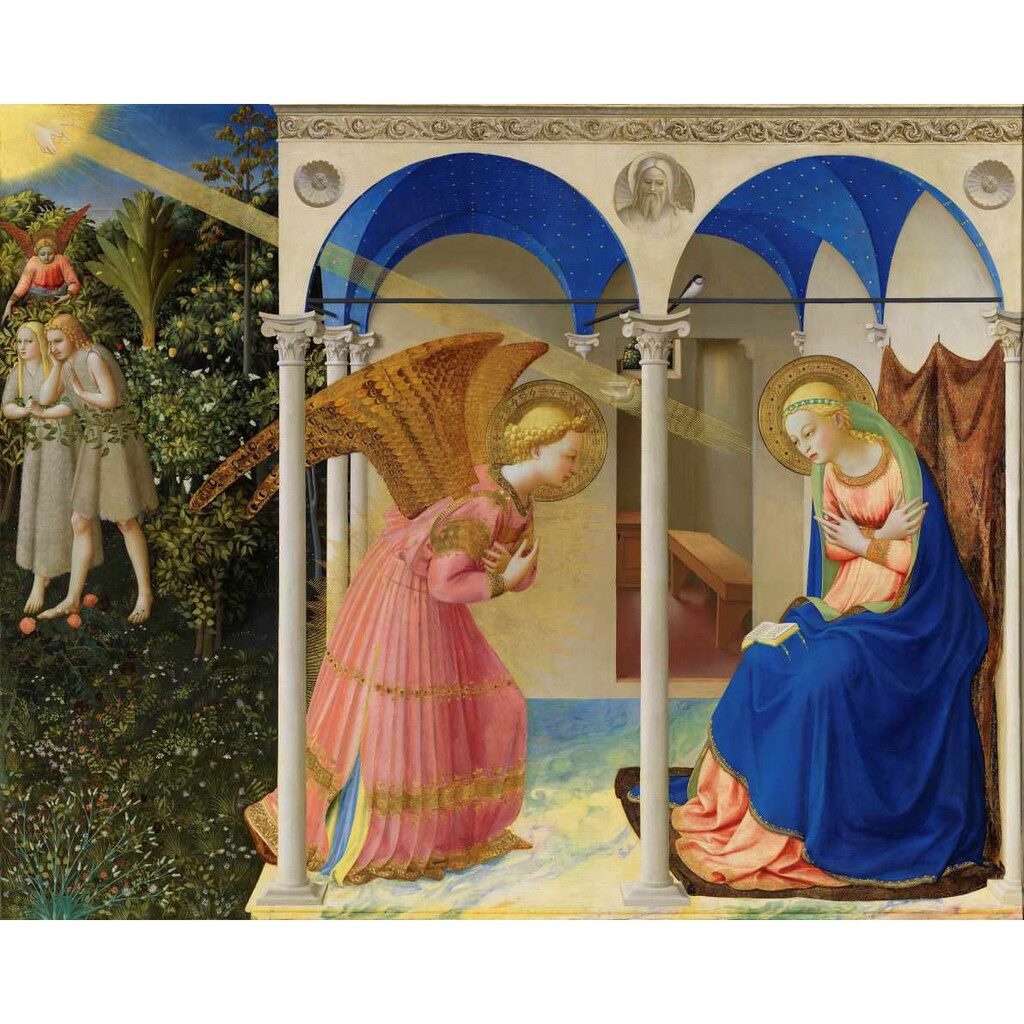
The Painter of Light
In the works of Angelico (14th century), art acquires meanings that transcend its artistic value and has other functions: they cannot be understood in their nature as art without this non-artistic significance and functionality of theirs. To make them objects of art, of purely artistic consideration, means not even understanding them as art.
Therefore, not indifferent to problems of aesthetics, art criticism, and art history, but also theological and liturgical problems: indeed, between the iconography of works of this kind and the iconology that founded them there exists an osmotic circle formed by culture, which, in this case, is Christian as a whole. As Saint Thomas Aquinas teaches:
“Beauty is essentially present in contemplation; hence it is said of the contemplation of Wisdom: I became a lover of her beauty”
(S.Th. a. 2 ad 3)
and Saint Gregory the Great adds: “the contemplative life, more lovable, is sweetness”.
The composite personality of Fra Angelico lies in this synergy; indeed, he is its supreme exponent. Gothic, the last of the Gothic and the first of the humanists, an independent artist and a preaching catechist, the first to share a sense of natural joys: as his gardens bring out the freshness and springtime joy in the frescoes of the Annunciation and in the Noli me tangere [Do not touch me] at San Marco.
If Blessed Angelico combines the charm of great visual beauty, a very intense expressive interest, and the attraction of the most delicate color, his scenes have a value so tactile and at the same time so indefinable that nothing more could be said.
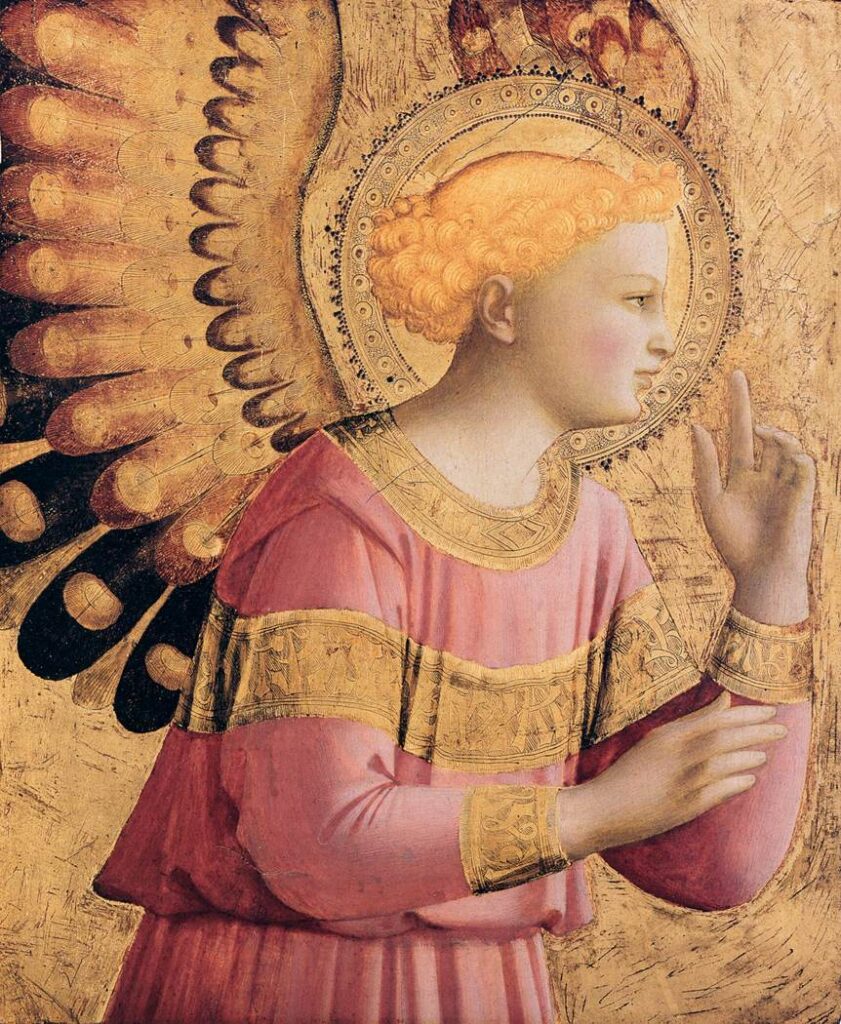
The gold of the background leaps into the gold, inlaid like a goldsmith’s lace, of the halos and the angelic wings, into the incised and dazzling rays of God’s power, into the honey-blond curls of the angels.
It is said that he would not take up a brush before praying. Being penetrated by God in prayer gave him a light that gave substance to his angelic ability to compose the face of the Virgin, of the saints, and of the Trinity. Perhaps, to feel the beauty of his painting, one must share with him that life of faith which moved him and made him live. Of course, Blessed Angelico stands at the turning point between the Middle Ages and Humanism, and art historians identify his connections with Masaccio, Ghiberti, Filippo Lippi, Lorenzo Monaco, and even the Flemish painters. But wholly his own are the clear spatial orchestration, the expanded breadth of the landscape, and the very brilliant chromatic range, rich within it in infinite and delicate gradations. Someone has even spoken, eloquently and rightly, of a sacred representation. It is he who, between Donatello’s realism and Alberti’s theories of historicity, created the compromise of naturalism, opening the way to an art that is no longer a motionless representation but, on the contrary, an animated discourse, a human conversation.
To understand Angelico, one must understand his enigma. He recounts salvation history iconographically, and to this end the new style of the Florentine Renaissance coincides in him, intentionally, with the existential contemplation of the sacrament of salvation.
Blessed John Angelico is a sacred writer (hagiographer); that is, he writes the revelation of God to men with color and light for the ministry of the Church. And he wrote it as a monk, to quote those Greeks who from 1439 to 1443 took part in the conciliar sessions in Florence. That is, he exercises in the Church the ministry of the sacred writer, composing his revelatory painting with the experience of the ministerial priesthood and of the conventual situation that he also lives in the Church. Thus the components of his work, each of which he realizes in privileged dimensions, as those who lived with him attest, are manifold, and all of them are influential at unusual levels. The liturgical assembly and the ecclesial community, the conventual community, the choir, the cloister, the cell, the refectory, the study of the Friar Preacher, and the technique of the painter fuse together and reinforce one another.
Friar John Angelico opens the small series of the twelve artists who over the centuries, from the Italian Renaissance to the present day, can legitimately claim to be authors of works of sacred art, of art for the liturgy. The spiritual tradition of the canons regular of Saint Dominic comes down to him, as does the liturgical tradition of the monks, from the art of Lorenzo the Camaldolese. His relationships are known, on the one hand with Antoninus of Florence, and on the other with Catherine of Siena. And there is also Thomas Aquinas. While Friar John finds himself in harmony with Friar Antoninus, the future bishop of Florence, through innate and acquired affinities, and while Saint Catherine is a mystical filter of pictorial intuitions and their execution, Saint Thomas is the doctor who offers and explains the impeccable biblical source he seeks. Blessed Angelico knows the Scriptures. Antoninus of Florence, Catherine of Siena, and Thomas Aquinas obey the contemplated aliis tradere [to hand on the fruits to others] of the Dominican habit.
From Aquinas, Friar John grasps the decisive theology of his spirituality and of his culture, organized around the cornerstones of the faith: the new humanity and the new creation, the Christological principle. The luminosity of the Incarnate Word and the divinization of man, the ecclesiological principle. There remains the today of the mysterious event, the sacramental principle, which is realized in the Transfiguration, on the Cross, and at Easter, according to the mystical taste of Catherine of Siena.
The Annunciation
In the icon of the Annunciation to Mary, Blessed Angelico sees forever prefigured the vocation and mission of the Church, a vocation and a mission that can be fulfilled in the world only through the Cross that the Word of God will bring into her life and her earthly adventure. Indeed, the greater the mission, whether visible or invisible, the greater the readiness of heart. To the Word who becomes flesh, Mary lends not only her flesh and her blood, but her whole self: her capacity for love and dedication, her efforts, her thoughts, her songs, her silences of adoration.
In the icon of the Annunciation every believer recognizes his own vocation. Great human abilities are not needed to render valid service to the work of salvation, but only a humble and total gift of love. Do not be afraid, Mary!
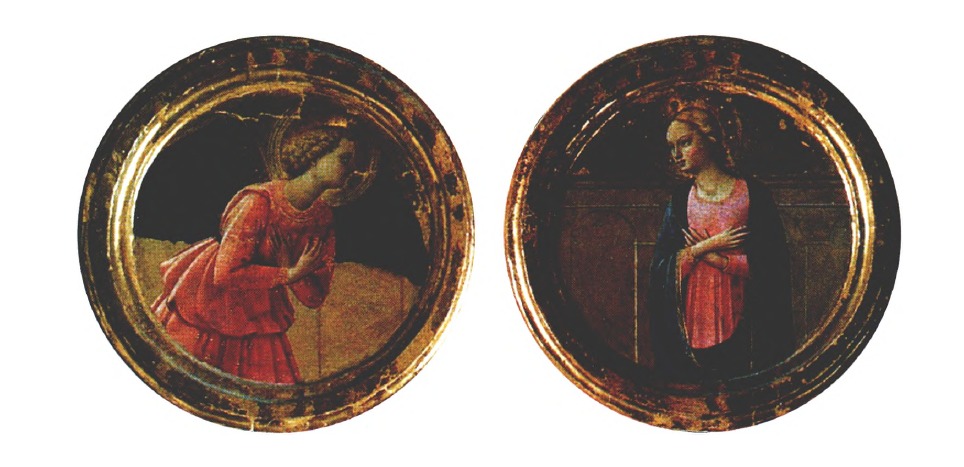
Sixteen times, as far as we know, Friar John paints the annunciation of the angel Gabriel to the Virgin Mary.
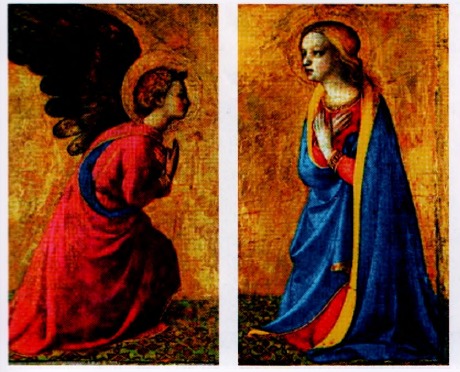
He portrays it in more elaborate treatments, in a reliquary for the altar of Santa Maria Novella.
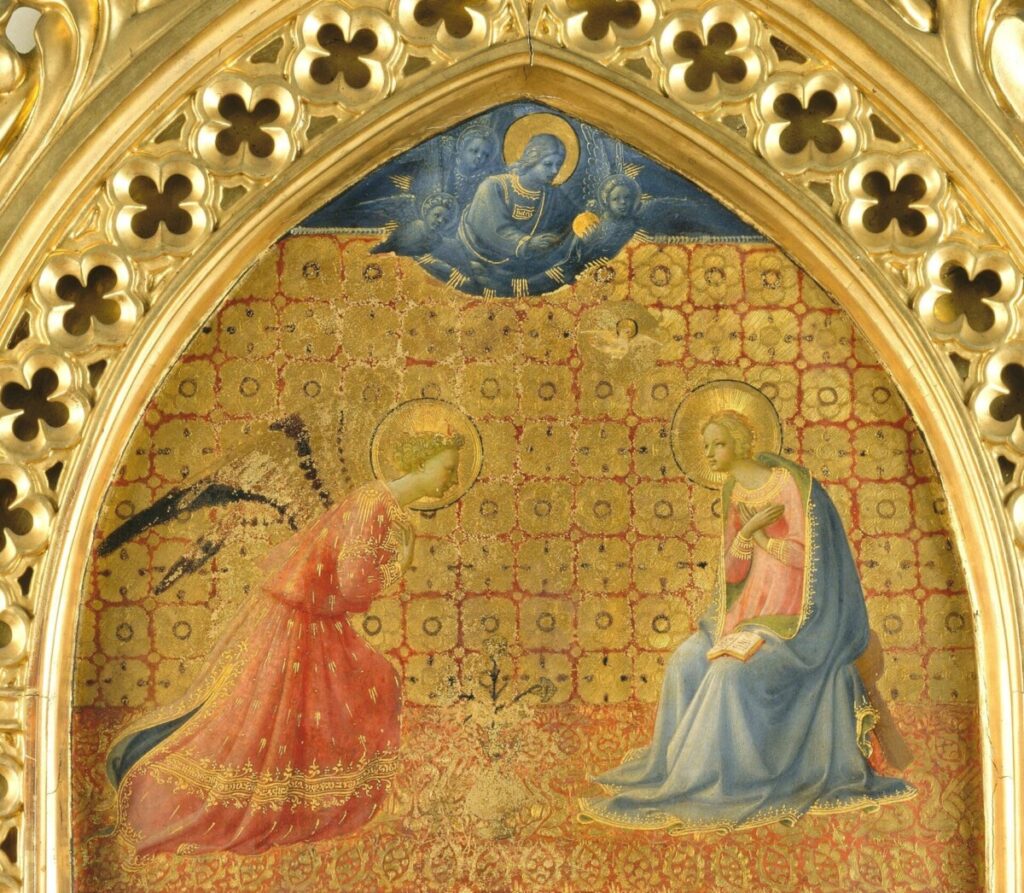
He paints it in a missal in the church of his first convent. He narrates it in the Dominican churches of Fiesole and Cortona, in the Franciscan church of Santa Croce in Florence, and among the Servants of Mary at Sant’Alessandro in Brescia, reworked by Jacopo Bellini in 1444. But the mysterious contemplation, again for the Dominicans and the Servants, offers above all, in the frescoes of the corridor and of cell 3 of the convent of San Marco and in panel 2 of the Armadio degli Argenti for the Annunciation, the liturgical memorial of the Incarnation of the Lord.
In the corridor fresco:
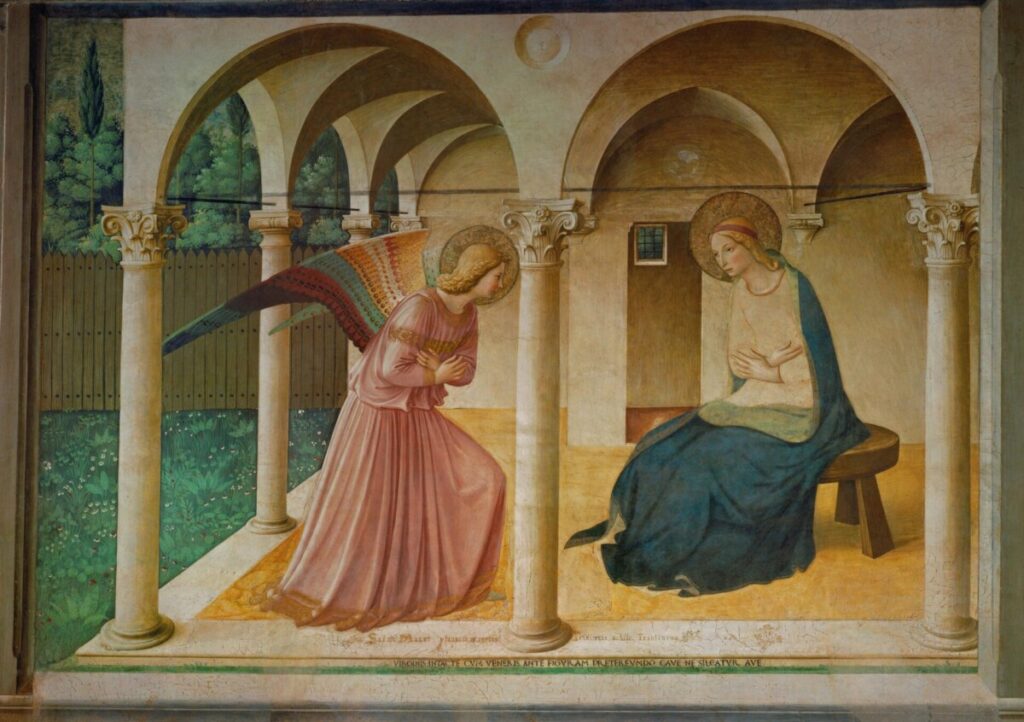
Friar John places the Annunciation in a templum, in a complex cutout of space, so as to clearly accommodate the hodie [today], the graced moment of the Lord’s Incarnation. It is an agile and solemn architecture, raised on an enclosed lawn, leading to a linear room in the midst of a wooded garden and pushed by it toward the portico. The twelve-leaf grille is framed by the morning light and open to the woods, especially since the essentials of time and space are emphasized from arch to arch and up to the wall with iron tie-rods above the capitals. The impression is strong and immediate. The contrast between the very bare, timeless cell, the fifteenth-century structure, and the ancient vegetation beyond and on this side of the palisade is a perceptible echo of Genesis: the Lord God planted a garden in Eden, in the east (Gen 2:8), in harmony with the Song of Songs:
“In the shade of him whom I desired I sit, and his fruit is sweet in my mouth. He, my beloved, brought me into the cellar of wine, and his sign over me is love. My beloved stood behind the wall, looking through the window, peering through the lattice. Now my beloved speaks and says:
“Arise, my friend, my lovely one, come! For behold, the winter is past, the rain has stopped and is gone, the flowers have appeared in the meadows; hear the voice of the dove. Arise, my friend, my beautiful one, come! O my dove, you who are in the clefts of the rock, show me your face, let me hear your voice, for your voice is sweet and your face is lovely”.
(Song 2:3-4, 9-12, 14)
The tondo carved into the spandrel of the arch over the middle column does not continue Isaiah with the prophetic scroll (Is 7:14), as in the Cortona and Prado panels, but is instead filled with a moving void. The fact that Friar John here omits the expulsion of Adam and Eve from the paradise of Eden is certainly meant to enhance the decisive marriage between God and humanity, finally accomplished. From the garden of Eden to the garden of the Song we pass, accompanied by the festive memorial that the liturgy offers to the Incarnation of the Lord.
Postgraduate Program in Mariology
Would you like to deepen your formation in Mariology? Discover the Postgraduate Program in Mariology of Locus Mariologicus, an academic formation that unites theological rigor, spiritual life, and the living tradition of the Church.



Responses