Qui viderit mulierem ad concupiscendum: Mary and the Purity of the Gaze

Omnis qui viderit mulierem ad concupiscendum eam, iam moechatus est eam in corde suo.
Mt 5:28
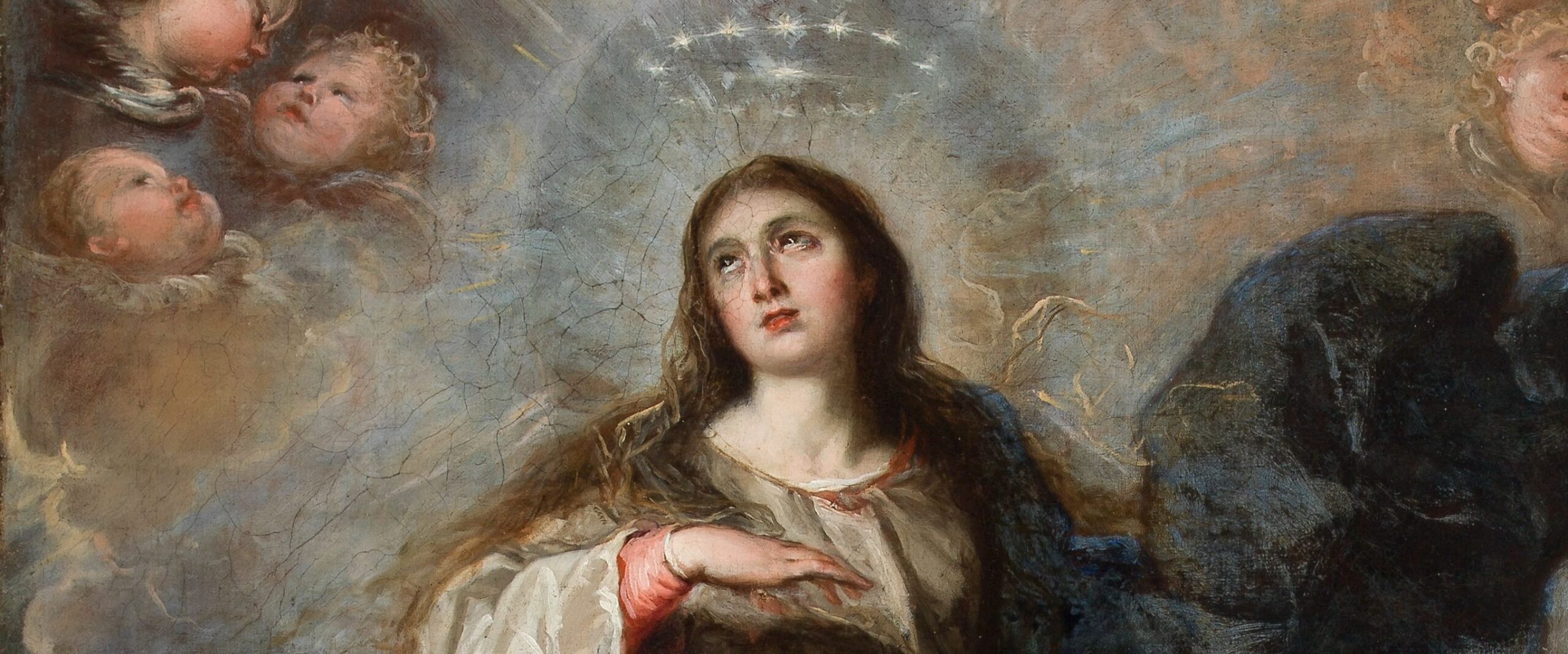
Mt 5:27-32 presents the second antithesis of the Sermon on the Mount: the radicalization of the precept against adultery down to the level of inner desire. “You have heard that it was said: You shall not commit adultery. But I say to you: Everyone who looks at a woman, desiring her, has already committed adultery with her in his heart” (Mt 5:27-28). This radicalization, on which Paul VI would comment in Humanae Vitae and which John Paul II would develop at length in the “Theology of the Body,” has implications that go far beyond the regulation of sexuality: it touches the fundamental question of how the human being looks at another, how he “sees” the other, whether as a person or as an object, as the image of God or as a means to his own ends. Mary, whom tradition celebrates as Virgin, is the model of a gaze that contemplates the other in his or her sacred dignity, without reducing the other to his or her function or usefulness.
I. The Second Antithesis: From Act to Desire
The antithesis on adultery repeats the structure of the previous one (on murder): Jesus does not abolish the precept “you shall not commit adultery”; He goes to its root. The “desire” (epithymia) that Jesus condemns is not aesthetic or affective attraction to another person; it is the gaze that “uses” the other as an object of one’s own gratification, that reduces the other to the role of a “means” without recognizing his or her dignity as an “end.” This distinction, between attraction that respects the dignity of the other and desire that instrumentalizes the other, is the key to the theology of Mt 5:28.
John Paul II’s “Theology of the Body” (1979-1984) developed this text at length: the “gaze of concupiscence” is the one that “uses” the other instead of “loving” the other. The “purity” that Jesus asks for is not affective indifference or asexuality; it is the capacity to look at the other with the “original gaze” of Adam, who saw Eve and recognized her as “bone of my bones and flesh of my flesh” (Gen 2:23): a gaze of admiration and of recognition of the other’s dignity, not of possession or instrumentalization. This “purity of the gaze” is the fruit of the conversion of heart that Mt 5:8 proclaims as a beatitude: “Blessed are the pure in heart, for they shall see God.”
The reference to the “right hand” and the “right eye” that must be cut off or plucked out if they cause scandal (Mt 5:29-30) is clearly hyperbolic; Jesus is not prescribing self-mutilation. The hyperbole serves to underline the seriousness of the matter: any sacrifice is worth making to preserve the integrity of the heart. The “eye” and the “hand” are metaphors for the ways in which disordered desire expresses itself: the gaze that objectifies and the action that exploits. The symbolic “amputation” is the ascetical discipline that deliberately refuses the occasions that feed disordered desire.
The verses on the repudiation of a wife (Mt 5:31-32), related but distinct, extend the same theme: love that respects the dignity of the person does not abandon that person when he or she ceases to be “useful” or “pleasing.” The prohibition of repudiation is grounded in the inviolable dignity of the human person, which love must protect, not instrumentalize. Jesus “exceeds” the Mosaic permission (Deut 24:1) not out of legalistic rigorism, but out of radicality in love: the love that goes “to the end” (Jn 13:1) does not repudiate; it remains.
II. Mary, Virgin: A Theology of Virginity
Mary’s virginity, professed as perpetual since the first centuries of the Church, is neither a denial of human sexuality nor a flight from the body. It is, in Catholic theology, a specific and radical form of love: the love that gives itself totally to God, without keeping back for itself any form of possession or “return.” Virginity is love in its most absolutely gratuitous and absolutely surrendered form, the love that does not calculate, does not bargain, does not ask for anything in return.
The “purity of heart” that Mt 5:8 proclaims as a beatitude finds its most radical expression in consecrated virginity. But Mary’s consecrated virginity is not merely a “marital status”; it is the sign of a total interior orientation toward God. When Mary says “I do not know man” (Lk 1:34) in response to the angel’s announcement, she is not simply indicating a biological state; she is indicating the orientation of her whole life: she who “does not know,” in the sense of the total intimate knowledge that the Hebrew Scriptures designate by yada, is the one who is oriented toward a “knowledge” of a different nature, the knowledge of God in total love.
The Mariological tradition, from the first centuries, saw in Mary’s virginity not only a personal privilege, but a sign for the whole Church: consecrated virginity is the eschatological anticipation of the “state of resurrection” (Lk 20:35-36: “they neither marry nor are given in marriage”), in which human love finds its definitive form: not possession of the other, but full communion with God in God. Mary, the Virgin, is the “sign” that humanity has a destiny that transcends the biological family, a destiny of communion with the infinite love of God.
III. Mary’s Gaze: Contemplation vs. Concupiscence
Mary “kept all these things, pondering them in her heart” (Lk 2:19, 51). This “keeping and pondering” (dietêrei and symballousa) describes Mary’s way of “looking”: not the gaze that consumes and discards, but the one that keeps, that deepens, that lets reality reveal its deepest meaning. This contemplative gaze, which is the opposite of the gaze of concupiscence, is what allows Mary to “see” in the events of Jesus’ life what others do not see: the profound meaning, the movement of God in history.
Mary’s “purity of the gaze” has an epistemic dimension that goes beyond the moral one: whoever looks at another with the “concupiscence” that objectifies cannot truly “see” the other, but sees only what he wishes to see, the projection of his own desires. Whoever looks with the “purity” that respects the otherness of the other can “see” the other as he or she really is: in his or her dignity, needs, suffering, and joy. This pure “vision” is the foundation of true compassion: seeing the suffering of the other as real suffering (not as an inconvenience to our plans) and responding to it with real love.
Contemplative Mariology has developed this theme: Mary is the model of “theôria,” the contemplation that sees reality with the “eyes of God.” This contemplation is not intellectual passivity; it is the most intense activity of the human spirit, the one that enables us to “see” the real in its depth, to “see” the other in his or her sacred dignity, to “see” events in their saving significance. It is this pure “vision” that forms the context in which the Magnificat is possible: only one who “sees” with purity can proclaim God’s action in history with the intensity with which Mary proclaims it.
Mary, whose gaze never “used” anyone but always contemplated the other in his or her sacred dignity, is the model of the purity of heart that Jesus proclaims blessed: the purity that is not the absence of love, but love in its most intense and most respectful form.
References
- John Paul II, Theology of the Body (catecheses, 1979-1984).
- Second Vatican Council, Lumen Gentium, nos. 63-65 (1964).
- J. Galot, Maria, la Donna nell’Opera della Salvezza (1984).
- U. Luz, Das Evangelium nach Matthäus, vol. I (1985).
Postgraduate Program in Mariology
Would you like to deepen your formation in Mariology? Discover the Postgraduate Program in Mariology at Locus Mariologicus – an academic formation that unites theological rigor, spiritual life, and the living tradition of the Church.
Would you like to study Mariology seriously?
This article grows out of the works in the Locus Mariologicus library. The Postgraduate Program in Mariology takes you to the same source, with academic guidance: Scripture, the Fathers of the Church, and the Magisterium, from the first dogma to contemporary questions.




Responses