Saint John Eudes and the Hearts of Jesus and Mary: “Whitewashed Tombs” and Living Hearts
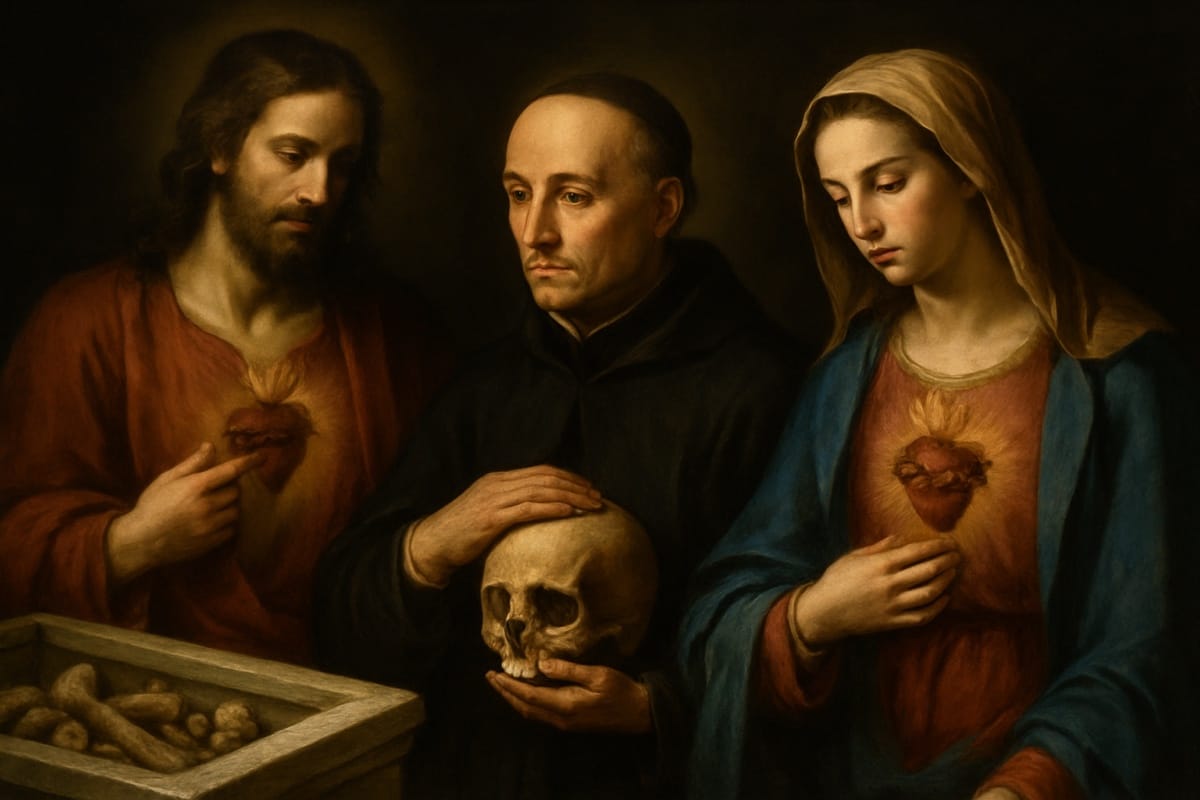
Vae vobis, scribae et Pharisaei hypocritae, quia similes estis sepulcris dealbatis, quae a foris apparent hominibus speciosa, intus vero plena sunt ossibus mortuorum et omni spurcitia.
Mt 23:27
Mt 23:27-32 presents the sixth and seventh woes of Jesus’ discourse, the most radical of the series. The sixth woe (vv.27-28) uses the image of the “whitewashed tombs”: beautiful on the outside, full of bones and uncleanness on the inside. The seventh woe (vv.29-32) accuses the scribes of honoring the tombs of the dead prophets whom their forefathers killed, thus completing the work of their fathers by rejecting the living prophet whom they have before them. The image of the tomb is not merely a metaphor of hypocrisy: it is a diagnosis of interior death. The problem of those whom Jesus criticizes is not only the performance but the absence of life, spiritual death disguised by a beautiful appearance.
On August 19 the Church celebrates the Memorial of Saint John Eudes (1601-1680), priest, founder of the Congregation of Jesus and Mary (the Eudists) and of the Sisters of Our Lady of Charity of the Refuge. John Eudes is the apostle of the liturgical cult of the Hearts of Jesus and Mary, having composed the first liturgical offices for the feasts of the Heart of Mary (1648) and of the Heart of Jesus (1670), anticipating by decades the revelations of Paray-le-Monial to Margaret Mary Alacoque. Pius X called him “father, doctor, and apostle of the liturgical cult of the Sacred Hearts of Jesus and of Mary”.
I. “Sepulcra dealbata”: The Whitewashed Tombs and Interior Death
The image of the “whitewashed tombs” (τάφοι κεκονιαμένοι) is concrete: in Jewish Palestine, tombs were whitewashed before the pilgrimage feasts so that the pilgrims would see them and avoid the ritual contact that caused impurity (Num 19:16). Tombs gleaming in the sunlight were beautiful to the eye but marked the place of death and impurity. Jesus applies the image with precision: “so you also outwardly appear righteous to men, but within you are full of hypocrisy and iniquity” (v.28).
The interior “iniquity” that Jesus diagnoses (ἀνομία, anomia, the absence of interior law) is graver than any exterior transgression: it is the death of the principle that orients from within outward, the absence of the “Law written on the heart” (Jer 31:33). The scribe who scrupulously applies the ritual law but who within has no love for God nor for his neighbor is not fulfilling the Law, he is carrying out legal gestures without the spirit that ought to animate them. These gestures without spirit are the “bones of the dead” that fill the interior of the whitewashed tomb.
The seventh woe (vv.29-32), on the tombs of the prophets, has a bitter irony: those who build beautiful monuments for the dead prophets are the same ones who will kill the living prophet. “Fill up the measure of your fathers” (v.32), Jesus anticipates the Passion: the prophetic accusation that provokes the death of the prophet, repeating the pattern of the whole history of Israel. Respect for the dead prophets is compatible with the rejection of the living prophet precisely because the dead man demands nothing, the living one disturbs, challenges, calls for conversion.
II. Saint John Eudes: Apostle of the Living Hearts
John Eudes was born in 1601 at Ri (Normandy) and entered the Oratory founded by Pierre de Bérulle in Paris, a school of spirituality that placed the Incarnation at the center of Christian life. Bérulle taught “adherence” to Jesus, the interior conformation to Jesus that begins from the contemplation of the interior dispositions (états) of the Son of God. John Eudes brought this spirituality to its most concrete expression: the cult of the Hearts of Jesus and of Mary as the synthesis of the interior dispositions of both, love, obedience, purity, humility.
His fundamental work Le Cœur admirable de la Très Sainte Mère de Dieu (1681) is a theological and devotional synthesis of the Heart of Mary in twelve books. John Eudes holds that the Heart of Mary, understood at once as a physical reality, the seat of the affections, and a spiritual disposition, is the heart most perfectly configured to the Heart of Jesus: two hearts united by the Holy Spirit in the twofold self-giving of the Incarnation. The Eudist formula “Vivat Iesus et Maria” is the epitome of this devotion of living hearts against the whitewashed tombs.
The pastoral mission of John Eudes was centered on parish retreats, weeks of intensive preaching in the rural parishes of Normandy, where he insisted on interior conversion: not only the confession of external sins but the transformation of the heart. He founded the Sisters of Our Lady of Charity of the Refuge (1641) to welcome women who had lived in prostitution, a concrete example that the “tomb” can be emptied of its “bones of the dead” by grace and become the dwelling of the living Spirit.
III. The Heart of Mary as the Antithesis of the Whitewashed Tomb
If the “whitewashed tomb” is beautiful without and dead within, the Heart of Mary is the perfect inversion: what appears simple and humble on the outside conceals the interior richness of her who is “full of grace”. The theology of the Heart of Mary that John Eudes developed proceeds from this paradoxical inversion: the ancilla humilis of Nazareth is the one who has the richest heart in human history, rich in faith, rich in love, rich in availability, rich in God. The exterior beauty of Mary’s life is the least of it, the greatness lies in the interior that the disciples gradually discover.
John Eudes identifies in the Heart of Mary the interior “states” that configure her to Jesus: humility (“learn from me, for I am meek and humble of heart”, Mt 11:29, applied typologically to Mary), obedience (“fiat mihi secundum verbum tuum”), ardent charity (the Visitation as the irruption of interior love into exterior service), compassionate sorrow (Calvary). The Heart of Mary is “living” precisely because it is full of these active dispositions, not a collection of static virtues but a heart that beats in unison with the Heart of Jesus.
Eudist spirituality proposes devotion to the Heart of Mary as the remedy for the “interior death” diagnosed by Jesus in the woes: whoever contemplates the living Heart of Mary and asks to be conformed to it is doing exactly what Jesus asks, “first cleanse the inside”. The Heart of Mary is the model and the instrument of this cleansing: model because it shows what a perfectly clean heart is, instrument because her intercession obtains the grace of interior transformation.
IV. “Vivat Iesus et Maria”: The Eudist Legacy and the Interior Life
The formula “Vivat Iesus et Maria” is theologically dense: not “let Jesus and Mary be honored” (the tombs of the prophets that are honored but not followed) but “may Jesus and Mary live”, that their life, their dispositions, their love may become life in the faithful. It is the exact antidote to the “whitewashed tomb”: where the tomb contains death, the Eudist heart contains the life of Jesus and Mary. The cult of the Hearts is not the veneration of the illustrious dead but participation in the life of those who are alive, Mary alive in heavenly glory, Jesus alive in the Eucharist.
The Eudists today continue the tradition of John Eudes in parish missions and in the formation of the clergy, areas in which John Eudes was a pioneer with his seminaries at Caen, Coutances, and Rouen. His central intuition remains current: the crisis of Christian life in its various forms is always fundamentally a crisis of interior life, the whitewashed tombs multiply when exterior practice loses contact with the heart. The answer is not to abandon the exterior but to renew the interior.
John Eudes was beatified in 1909 and canonized in 1925 by Pius XI, who included him in the group of the “reforming saints” of the Church of the seventeenth century. On August 19 the Church celebrates not merely a saint but a spirituality: the primacy of the interior life, the centrality of the Hearts of Jesus and of Mary as the model of authentic Christian life, and the mission that is born of the living heart, not of the tomb that seems alive but is dead.
Postgraduate specialisation in Mariology
Would you like to deepen your formation in Mariology? The Locus Mariologicus postgraduate programme is a specialisation that brings together theological rigour, spiritual life and the living tradition of the Church. The next class begins in 2027.
Would you like to study Mariology seriously?
This article grows out of the works in the Locus Mariologicus library. The Postgraduate Program in Mariology takes you to the same source, with academic guidance: Scripture, the Fathers of the Church, and the Magisterium, from the first dogma to contemporary questions.



Responses