Visitation: Mary Visits Elizabeth
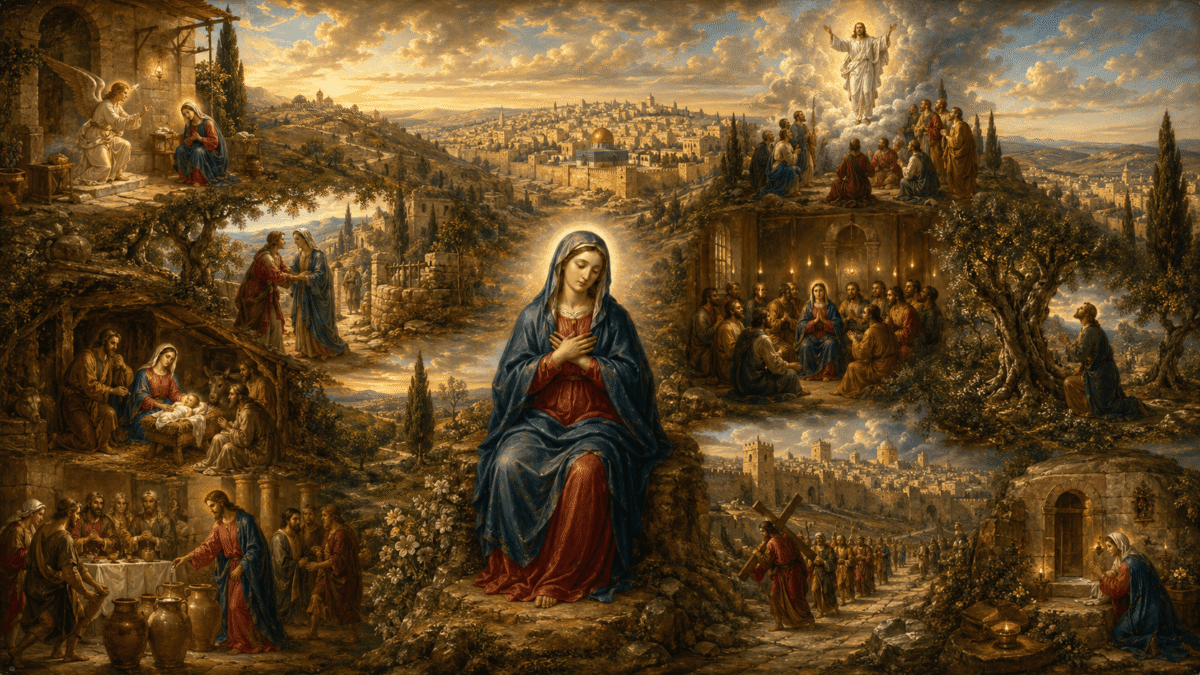
Visitation, Mary Visits Elizabeth
The Visitation (Luke 1:39-56) is Mary’s visit, after the Annunciation, to her cousin Elizabeth in Ain Karim. It is the setting of the Magnificat and one of the most theologically rich episodes of Jesus’ infancy. For the full article, see The Visitation.
Elizabeth’s Acclamation
On hearing Mary’s greeting, Elizabeth, filled with the Holy Spirit, exclaimed: “Blessed are you among women, and blessed is the fruit of your womb! And how does this happen to me, that the mother of my Lord should come to visit me?” John the Baptist leapt for joy in his mother’s womb. Elizabeth calls Jesus “my Lord” before he is born, one of the earliest acts of faith in the lordship of Christ.
Mary as Missionary
The Visitation is interpreted as Mary’s first missionary act: she brings Christ, whom she has just conceived, to Elizabeth and to John. This gesture is the model of all Christian mission: bringing Christ to others, not with words alone, but with the incarnate presence of love.
Three Months with Elizabeth
Luke notes that Mary “remained with her about three months” (Lk 1:56). This detail reveals Mary as a woman of concrete service: she did not come merely to pay a visit, but stayed to accompany Elizabeth until the birth of John. Mary’s charity is practical and persevering.
Deepen your studies: explore Mariology, Marian Theology, Marian apparitions, and the Postgraduate Program in Mariology.
Postgraduate Program in Mariology
Would you like to deepen your formation in Mariology? Discover the Postgraduate Program in Mariology of Locus Mariologicus — an academic formation that unites theological rigor, spiritual life, and the living tradition of the Church.
Would you like to study Mariology seriously?
This article grows out of the works in the Locus Mariologicus library. The Postgraduate Program in Mariology takes you to the same source, with academic guidance: Scripture, the Fathers of the Church, and the Magisterium, from the first dogma to contemporary questions.





Responses