Sicut oves in medio luporum: the promised persecution and Mary, Queen of Martyrs
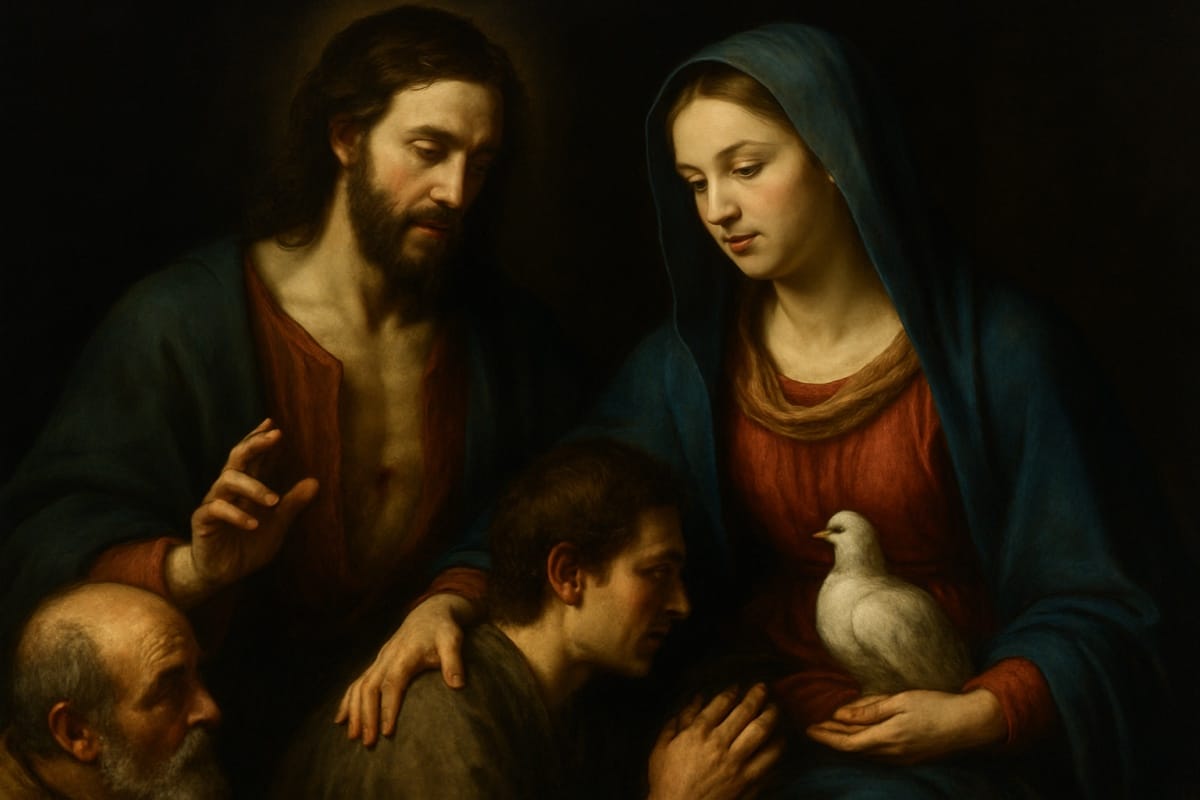
Ecce ego mitto vos sicut oves in medio luporum. Estote ergo prudentes sicut serpentes et simplices sicut columbae.
Mt 10:16
The second section of the missionary discourse (Mt 10:16-23) is one of the darkest passages in the Gospel of Matthew: Jesus announces to those He sends that they will be persecuted, handed over to tribunals, scourged in the synagogues, hated by all because of His name. This section is customarily designated the “discourse of persecution” and differs from the preceding section (Mt 10:7-15) by widening the horizon: it no longer speaks only of the immediate mission in Galilee but of a future of persecution that goes beyond the episode of the mission of the Twelve and that prefigures the experience of the Church of every age.
The transition from “go to the lost sheep of Israel” (Mt 10:6) to “you will be led before governors and kings for My sake, to bear witness to them and to the Gentiles” (Mt 10:18) is significant: the mission that begins in Israel will end before the Roman governors and the kings, before the Pilates and the Herods of the history of the Church. The persecution announced is not an accident of the mission; it is constitutive of it: to be sent by Jesus is to be sent where Jesus went, and Jesus went to the tribunal of Pilate.
I. “Prudent as serpents, simple as doves”: wisdom in persecution
“Be prudent as serpents and simple as doves” (Mt 10:16): the pairing of these two animals is one of the most memorable in the catechesis of Jesus. The serpent, in the biblical context, evokes cunning, not malice, but the capacity to distinguish danger, to navigate complex situations, not to hand over naively what is precious to the first adversary. The dove evokes the simplicity of a heart that has no hidden agenda, that does not manipulate, that does not use evil to do good.
The combination of prudence and simplicity is the Christian model of action in a hostile world: the missionary is neither naive (like the sheep that does not know it is in the midst of wolves) nor cunning for manipulative ends (like the serpent that deceives). He is prudent: he knows how to read the situation, he knows the dangers, he does not expose himself unnecessarily; and he is simple: he uses no illegitimate means, he does not resort to lying or to manipulation, he trusts the truth of the message more than his own rhetorical skill.
The history of the Christian martyrs is, in large part, the history of this combination: those who survived the persecutions without abjuring were frequently those who knew how to be prudent (not to expose themselves unnecessarily, not to provoke, to distinguish what is negotiable from what is not) and simple (when the moment of choice came, they chose the truth without calculation). The prudence of the serpent allowed them to reach the moment of choice. The simplicity of the dove allowed them to make the right choice when it came.
Mary, in the narrative of the Passion, displayed this combination: she did not provoke the Sanhedrin, she did not publicly obstruct the trial, she did not organize political resistance; she was prudent as the serpent. Yet she stood at the foot of the Cross without hiding herself, without denying her Son, without publicly dissociating herself from the condemned man; she was simple as the dove. Mary’s “prudence” did not keep her away from Calvary, and Mary’s “simplicity” did not lead her into useless gestures that would only have precipitated her own arrest without benefit to her Son.
II. “You will be hated by all because of My name”: hatred of the name
“You will be hated by all because of My name. But whoever perseveres to the end will be saved” (Mt 10:22): the promise of persecution is universal (“by all”) and permanent (to the end). There is no age in the history of the Church in which persecution has ceased completely: the martyrs of the first Roman centuries, the martyrs of the Reformations, the martyrs of the totalitarianisms of the twentieth century, the martyrs of contemporary persecutions in zones of conflict — the stream of blood of those who were “hated because of the name of Jesus” has been unbroken since the first century.
“Because of My name”: the specific character of Christian persecution is that it is not persecution for primarily political reasons (although it may take a political form) but because of the name of Jesus. Those who persecute Christians do not persecute them chiefly for economic or ethnic reasons; they persecute what the name of Jesus represents: the sovereignty of God over human power, the freedom of conscience that does not submit to the State, the identity that transcends ethnic and political identity. “Because of My name” is the confession of the persecuted that there is something for which it is worth dying.
“The Spirit of your Father will speak through you” (Mt 10:20): at the moment of judgment, Jesus promises that it will not be the disciple who speaks but the Spirit. This promise is fulfilled in the accounts of the trials of the martyrs: the Acts of the Martyrs of Carthage, the accounts of the trial of Perpetua and Felicity, the trials of the martyrs of seventeenth-century Japan, all describe an eloquence that the martyrs themselves confessed was not their own. The promise of Mt 10:20 is fulfilled in the history of the martyrs in a verifiable way.
Mary was not a martyr in the technical sense; she did not shed her blood because of the name of Jesus. But she was a martyr in the original sense of the word: “martyr” means “witness”. Mary was the most intimate witness of who Jesus was and of what happened on Calvary. Her presence at the foot of the Cross, when the “wolves” of persecution had scattered the greater part of the disciples, is the supreme act of witness: to be there, not to flee, not to deny. The Queen of Martyrs is not a martyr of blood but of presence, the one who remained when the others fled.
III. Mary, Queen of Martyrs: the sword that pierced her soul
Simeon prophesied to Mary: “A sword will pierce your own soul” (Lk 2:35). This “sword” is the specific form of Mary’s martyrdom: not of blood, but of compassionate sorrow, the sorrow of seeing her Son persecuted, condemned, crucified. Jesus’ “sicut oves in medio luporum” (Mt 10:16) describes the situation of the disciples who are sent. But before all the disciples, it was Jesus Himself who was a “sheep in the midst of wolves”, and Mary who stood beside the sheep when the wolves tore it apart.
The tradition of the “Stabat Mater”, the medieval hymn that describes Mary “standing beside the Cross, the Mother, in tears”, captures the martyrial dimension of Mary’s presence on Calvary. Mary’s “stability” on Calvary, “stabat”, she was standing, is the counterpoint to the flight of the disciples: those who had promised not to abandon Him (Peter: “I will die with you”) fled. She who had made no heroic promises remained. Mary “standing” beside the Cross is the figure of the martyr who remains in witness when the cost becomes greatest.
Mary’s intercession for the martyrs and the persecuted has a long history in Christian devotion. The Christian communities that suffered persecution, in the Japan of the Edo period, in imperial China, in the Mexico of the Cristiada, in the Soviet Union, invariably developed a strong Marian devotion as a form of spiritual sustenance in persecution. The “prudence of the serpent” and the “simplicity of the dove” of Jesus were asked of the intercessor who had stood at the foot of the Cross, who knew, by experience, what it was to remain when the cost was greatest.
IV. “Whoever perseveres to the end will be saved”: the hope that sustains
“Whoever perseveres to the end, he will be saved” (Mt 10:22): the promise that closes this section on persecution is a promise of eschatological salvation: not physical survival, not historical victory, but the final salvation of the one who perseveres. Perseverance, “hupoménōn” in Greek, literally “to remain under the weight”, is the virtue of the martyr: not heroic resistance that does not feel the weight, but fidelity that bears the weight without succumbing.
“Do not flee from this city to that one” (Mt 10:23): the instruction to flee from persecution when possible (not to demand martyrdom unnecessarily) is part of the same “prudence of the serpent”: the martyr is not the one who seeks death but the one who, when death comes, does not evade it by apostasy. Flight is lawful and even advisable. Apostasy is not. This distinction, clear in the doctrine of martyrdom since the Fathers, rejects both a fanaticism of martyrdom (to seek death) and a cowardice of apostasy (to deny the faith in order to survive).
Mary represents the “perseverance to the end” that Jesus promises to reward. From the “fiat” of the Annunciation to the “stabat” of Calvary to the “orabat” of the Upper Room, Mary persevered through all the stations of her Son’s path: in the joy of Bethlehem, in the obscurity of Nazareth, in the glory of Galilee, in the scandal of the trial, in the agony of Calvary, in the uncertainty of Holy Saturday, in the joy of the Resurrection, in the waiting for Pentecost. Mary’s “perseverance to the end” embraces her whole life; it is the model of the fidelity that is not merely resistance in a moment of crisis but constant adherence throughout the whole of existence.
Postgraduate Program in Mariology
Would you like to deepen your formation in Mariology? Discover the Postgraduate Program in Mariology of Locus Mariologicus – an academic formation that unites theological rigor, spiritual life, and the living tradition of the Church.
Would you like to study Mariology seriously?
This article grows out of the works in the Locus Mariologicus library. The Postgraduate Program in Mariology takes you to the same source, with academic guidance: Scripture, the Fathers of the Church, and the Magisterium, from the first dogma to contemporary questions.




Responses