“Vae vobis, scribae et pharisaei”: The Woes of Jesus and the Transparency of Mary
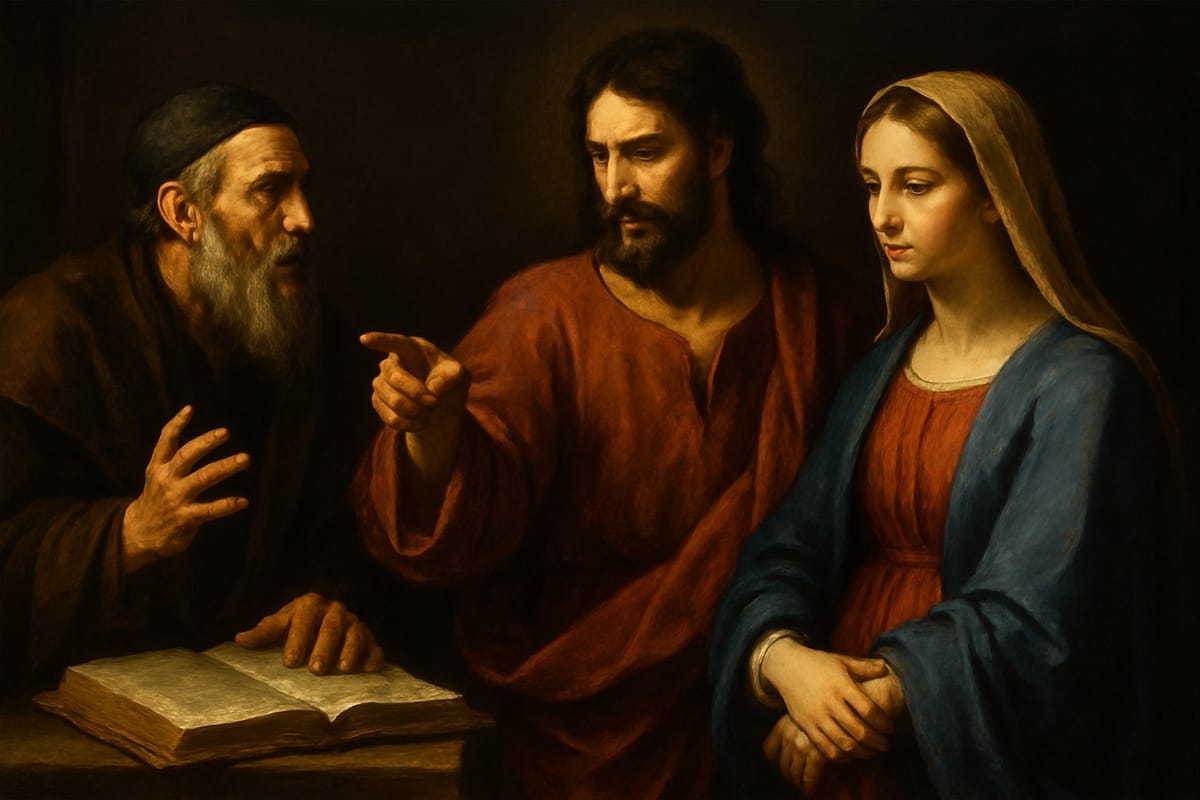
Vae vobis, scribae et Pharisaei hypocritae, quia clauditis regnum caelorum ante homines. Vos enim non intratis nec intrantes sinitis intrare.
Mt 23:13
Mt 23:13-22 opens the great discourse of the seven woes of Jesus against the scribes and Pharisees, the harshest discourse of Jesus in the Synoptic Gospels. Set within the context of the disputes in the Temple of Jerusalem (Mt 21-23), this discourse is not an attack on the Jewish people nor on the Mosaic Law, but a prophetic critique of religious hypocrisy as a permanent spiritual category: the abyss between the appearance of piety and interior reality. Jesus uses the formula “Woe to you, scribes and Pharisees, hypocrites!” as a refrain that structures seven progressive accusations. The Greek word ὑποκριτής designated the stage actor who wore a mask, someone who plays a character that he is not.
Monday of the Twenty-First Week in Ordinary Time invites the faithful to listen to the woes of Jesus not as a condemnation of others but as an interior examination of conscience: the temptation of religious hypocrisy runs through every age and every vocation. The discourse of the woes is a mirror, not a window onto the faults of others but a reflection of the mechanisms of self-deception that religious life can produce: the progressive separation between the exterior that is observed and the interior that is lived. Mary, who said “Ecce ancilla Domini” with her whole being, is the luminous counterpoint of this analysis.
I. “Clauditis regnum caelorum”: The First Group of Woes
The first woe (Mt 23:13) accuses the religious guides of “shutting the Kingdom of Heaven” against others: they do not enter themselves, nor do they allow those who wish to enter to do so. The image is that of the gatekeeper who blocks the door, a religious authority that, instead of making access to God easier, obstructs it. The scandal is not ignorance but knowledge: they know the Scriptures, they have mastered the oral Tradition, they have authority to teach, and they use all of this to hinder rather than to help. It is the specific sin of religious knowledge wrongly directed.
The second woe, on the proselytizers (v.15), accuses those who travel “sea and land to make one proselyte” and then make him “twice a son of Gehenna”. The problem is not missionary zeal but its content: a conversion to Pharisaism is a conversion to a system of perfected hypocrisy, not a drawing near to God. Jesus distinguishes between a mission that leads to God and a recruitment that leads to a human system. The criterion of discernment is always the destination of the convert: does he draw near to God or does he merely change groups?
The woes on oaths (vv.16-22) expose a casuistry that permits swearing by the Temple without obligation but swearing by the gold of the Temple with obligation. Jesus denounces the absurdity: “Blind men! Which is greater, the gold or the Temple that sanctifies the gold?” (v.17). The proliferation of subtle distinctions serves to create spaces of escape from the clear demands of the Law, under the appearance of legal rigor. This is the clearest symptom of advanced hypocrisy: the letter that kills in the name of the letter that saves, the detail that conceals the absence of what is essential.
II. Ὑποκριτής: The Theology of Hypocrisy and Its Antidote
The Greek word ὑποκριτής originally designated the stage actor who wore a mask (πρόσωπον) in order to play a character. Applied by Jesus as a theological category, it describes the performance of piety without interior substance. Augustine summed it up: “hypocrita est qui aliud gerit in facie, aliud in mente”, a hypocrite is one who displays one thing on his face and another in his mind. The gravest thing in hypocrisy is not the conscious deception of others but self-delusion: the person who has convinced himself that the mask is the face.
The patristic tradition identified three dimensions of hypocrisy: (1) the separation between what is shown and what is lived, the religious exterior without interior correspondence. (2) the instrumental use of religion, practice as a means of social prestige, wealth, or power. (3) the obstacle placed before others, the scandal of the false guide who leads the sheep into error. John Chrysostom observed that the Pharisees are not condemned for not praying but for praying in order to be seen. Not for not fasting but for disfiguring their faces so that everyone will know that they are fasting (Mt 6:16).
The Gospel antidote to hypocrisy is not declared insincerity nor the abandonment of external practices, but interior unification: the spiritual work of making the exterior an expression of the interior, not a substitute for it. Gregory the Great in the Regula Pastoralis identifies two types of clerical hypocrisy: exterior austerity meant to impress (a façade of rigorism) and interior laxity disguised as mercy (a façade of indulgence). Both are forms of performance. The alternative is what John of the Cross describes as “nada”, the stripping away of every spiritual performance.
III. Mary as the Antithesis of Hypocrisy: “Quae credidit”
Elizabeth exclaims concerning Mary: “Blessed is she who believed that what was spoken to her from the Lord would be fulfilled” (Lk 1:45). The faith of Mary is described as a perfect correspondence between what she heard and what she lived, the exact antithesis of the hypocrisy that hears the Word and does not act according to it. Mary “believed”, and the fruit of this faith was immediate: she set out “in haste” (μετὰ σπουδῆς) to serve Elizabeth. The faith of Mary does not stop at religious performance, it is transformed into concrete service. This is the criterion that distinguishes authentic faith from hypocrisy: the visible fruit that it produces.
The transparency of Mary was underscored by the patristic tradition as her specific spiritual characteristic: there is in Mary no division between what she appears to be and what she is. The Fiat of the Annunciation (Lk 1:38) is the structural antithesis of hypocrisy: where the hypocrite says “yes” with his lips and “no” with his heart, Mary says “fiat” with her whole being, “Fiat mihi secundum verbum tuum”. This “fiat” is not merely the answer to a moment but the program of a whole life: the permanent availability that does not negotiate conditions, does not create spaces of escape from the demands of God, does not use religion as an instrument of something else.
Bernard of Clairvaux (celebrated tomorrow, August 20) describes Mary as “tota pulchra” in contrast with the “whitewashed tombs” of which Jesus will speak in Mt 23:27: Mary is beautiful interiorly and exteriorly because the exterior expresses the interior. “What is within corresponds to what is without, and what is without expresses what is within”, the unity that hypocrisy fractures, Mary keeps intact. This integrity is not a natural talent but the fruit of the grace of the Immaculate Conception that preserved her from the division introduced by original sin.
IV. “Ecce Ancilla Domini”: Transparency as a Spiritual Path
“Behold the handmaid of the Lord. Let it be done to me according to your word” (Lk 1:38), Mary’s answer to the angel is the most complete affirmation of transparency in the New Testament. “Ecce” (behold), Mary presents herself hiding nothing, adding no titles of self-promotion, negotiating no conditions. “Ancilla Domini”, handmaid of the Lord, not handmaid of her own image. The transparency of Mary is so total that she has no need of a mask: she is exactly what she appears to be, and she appears to be exactly what she is.
The spiritual path proposed by the contrast between Mary and the scribes is a progressive interior unification: the work of eliminating the difference between what one shows and what one is, between religious practice and the intention of the heart. This path is not accomplished by an effort of sincerity but by exposure to the Word that scrutinizes: “the word of God is living and effective, sharper than any two-edged sword, and it penetrates even to the division between soul and spirit” (Heb 4:12). The Word that Mary welcomed did exactly this work in her: it penetrated until it eliminated every interior division.
The devotion to Mary as “Speculum Iustitiae” (mirror of justice) captures this dimension: Mary is the mirror that reflects without distortion, the face that wears no mask, the presence that corresponds perfectly to the reality of God. To contemplate Mary is to contemplate what authentic spiritual life produces: not the performance of virtue but the transparency of one who lives before God without fear of being seen. “Vae vobis, hypocritae” is an invitation, not only a condemnation: it is the cry of Jesus who wishes to free His own from the prison of the mask, so that they may live the freedom of the children of God that Mary lived in its fullness.
Postgraduate specialisation in Mariology
Would you like to deepen your formation in Mariology? The Locus Mariologicus postgraduate programme is a specialisation that brings together theological rigour, spiritual life and the living tradition of the Church. The next class begins in 2027.
Would you like to study Mariology seriously?
This article grows out of the works in the Locus Mariologicus library. The Postgraduate Program in Mariology takes you to the same source, with academic guidance: Scripture, the Fathers of the Church, and the Magisterium, from the first dogma to contemporary questions.





Responses