The garments of salvation: Is 61 and Lk 1; Our Lady of Fatima
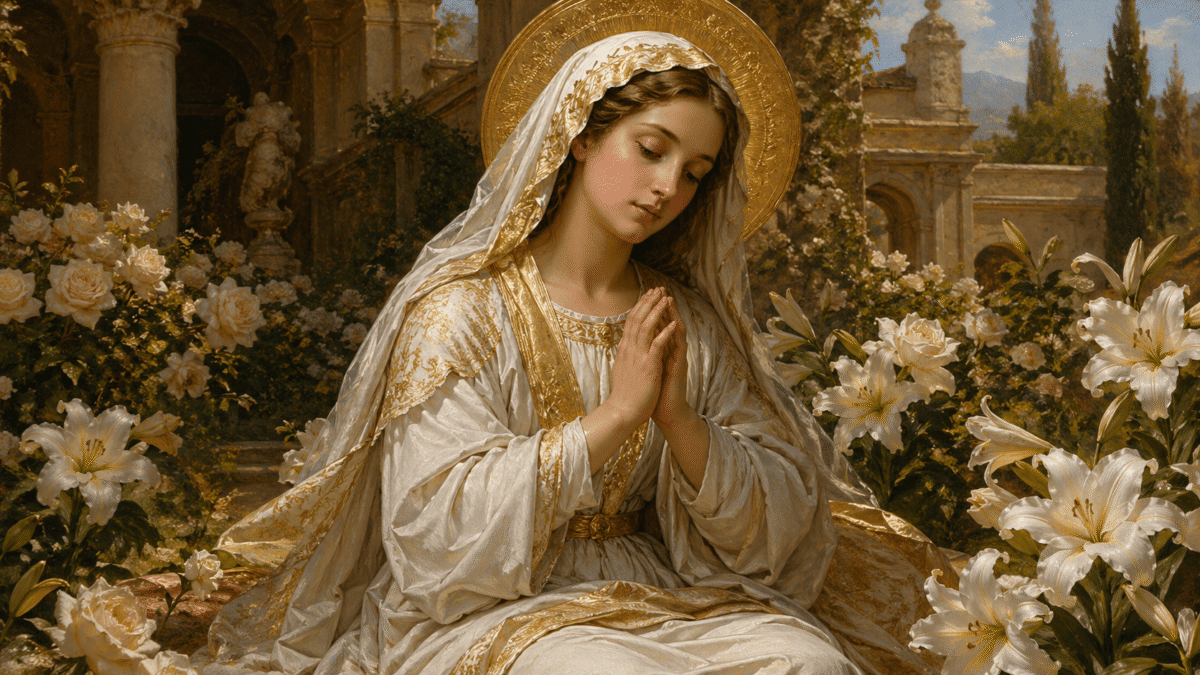
“Induit me vestimentis salutis et indumento iustitiae circumdedit me”.
“He has clothed me with the garments of salvation and covered me with the robe of righteousness”. (Is 61:10)
I. The garments of salvation: the prophet, the mission, and the shepherd children
Isaiah 61:9-11 is part of a prophetic discourse in which the one sent by God describes what the Spirit has worked in him: “My Spirit is upon me, because the Lord has anointed me” (Is 61:1). The text chosen for this memorial recounts the fruit of that anointing: “Their offspring will be known among the nations… I exult with joy in the Lord, my soul rejoices in my God, for He has clothed me with the garments of salvation, He has covered me with the robe of righteousness, like the bridegroom who adorns himself with a diadem, like the bride who bedecks herself with her jewels” (Is 61:9-10). The metaphor of the garments is not decorative. In Scripture, clothing defines identity. To be “clothed with salvation” is to be transformed by the mission that God entrusts.
This image illuminates, in an unexpected way, the experience of the three shepherd children of Fatima. Lúcia dos Santos, Francisco Marto, and Jacinta Marto were children from a village on the outskirts of Ourém, born into families of poor shepherds of the Serra de Aire. On May 13, 1917, while they were pasturing their sheep at the Cova da Iria, they received the first apparition of Mary. That experience transformed them. Not by the eloquence they acquired nor by the prestige the world conferred on them, but by the spiritual depth they radiated from that moment on. Francisco and Jacinta died young, in 1919 and 1920, victims of the pneumonia of the Spanish Flu. Lúcia became a Carmelite nun and lived until 2005. All of them were “clothed” by their mission: identified forever with the message they received.
Verse 9 declares: “Their offspring will be known among the nations, their descendants in the midst of the peoples: all who see them will recognize them as offspring blessed by the Lord”. The shepherd children of Fatima became known throughout the world. The message they transmitted crossed the twentieth century, influenced popes, prompted the consecration of the world to the Immaculate Heart of Mary by Pius XII (1942) and by John Paul II (1984), and shaped the spirituality of millions of the faithful. The “blessed offspring” of Isaiah finds, in the context of this memorial, a concrete historical resonance.
II. From the Annunciation to Fatima, the continuity of God’s initiative
The Gospel of the Annunciation (Lk 1:26-38) is read on several Marian feasts throughout the liturgical year. For the memorial of Our Lady of Fatima, its choice has a precise reason: the Annunciation is the prototype of every intervention of God in history through Mary. The narrative pattern of Luke 1 is the same one that structures the apparitions of Fatima: God takes the initiative, sends a messenger to a humble and apparently unimportant person, the messenger is received with questioning and hesitation, and the revelation is transmitted faithfully.
At the Annunciation, Gabriel was sent to a virgin of Nazareth. At Fatima, Mary was sent to three children from a village in the Serra de Aire. In both cases, the mission was entrusted neither to the great nor to the learned. It was entrusted to those whom theology calls the anawim, the poor and humble of heart who are available to God. Jesus would say later: “I thank you, Father, Lord of heaven and earth, because you have hidden these things from the wise and the understanding and have revealed them to little ones” (Lk 10:21). This principle governs both the Annunciation and Fatima.
The connection between the two events is not only structural. It is substantive. Mary, who said fiat at the Annunciation and welcomed the Redeemer Son, came to Fatima to invite the humanity of the twentieth century to welcome the fruits of that same Redemption. The Annunciation was the beginning of the plan of salvation. Fatima is an urgent appeal for its reception. “You came into the world and your own did not receive you” (Jn 1:11): the message of Fatima is the counterproposal to the contempt of Redemption, the renewed invitation to repentance and conversion.
III. “Let it be done to me”, the Fiat of Fatima
At the Annunciation, Mary said: “Behold the handmaid of the Lord. Let it be done to me according to your word” (Lk 1:38). The fiat is the free and total assent to God’s plan. In the first apparition of May 13, 1917, Mary asked the children: “Do you wish to offer yourselves to God, to endure all the sufferings He may be pleased to send you, as an act of reparation for the sins by which He is offended and of supplication for the conversion of sinners?” The children answered: “Yes, we do”. They said their own fiat.
The fiat of the Annunciation was the assent to the mystery of the Incarnation. The fiat of Fatima is the assent to the mystery of co-redemption in the broad sense: to share in the suffering of Christ for the conversion of sinners. The two fiats are inseparable. Because Christ came (the Annunciation), His Redemption can be applied (Fatima). Mary’s mission at Fatima is the temporal extension of the mission she accepted in the Cenacle of the Annunciation.
Mary’s question to Gabriel, “How will this be, since I do not know man?” (Lk 1:34), and the angel’s explanation about the action of the Holy Spirit reveal that Mary did not assent blindly to God’s plan. She questioned, she understood, and then she consented. In an analogous way, the shepherd children of Fatima did not receive the message passively. They questioned, they bore the weight of the secrets and of the disbelief of the adults, and they transmitted it faithfully. It is not servile obedience, but adult fidelity to what was revealed.
IV. The message of Fatima, prayer, penance, and hope
The message of Fatima is articulated around three axes: prayer, above all the Rosary; penance and reparation; and consecration to the Immaculate Heart of Mary. In each of the six apparitions of 1917, Mary appeared with a rosary in her hands and identified herself, in the October apparition, as “Our Lady of the Rosary”. The Rosary is not merely a devotion added to the message. It is its spirit: the contemplation of the mysteries of Christ with Mary.
Penance and reparation constitute the second axis. The first secret of Fatima was the vision of Hell, which the children contemplated in July 1917. Not in order to terrify, but in order to understand what is at stake. The message of conversion presupposes the seriousness of moral evil. Mary asked for reparation for the sins that offend God, especially the sins against her Immaculate Heart. From this spirituality was born the devotion of the Five First Saturdays, proposed by Lúcia as a response to Mary’s request.
The second secret contained the request for the consecration of Russia to the Immaculate Heart of Mary and the promise of conversion. John Paul II carried out this consecration on March 25, 1984, in Rome, in union with all the bishops of the world. Lúcia confirmed that the act fulfilled Mary’s request. The fall of the Berlin Wall (1989) and the collapse of the Soviet Union (1991) were interpreted by many as fruits of this consecration, although the Church is careful to avoid simplistic historical-theological determinisms.
The third secret, revealed by the then Cardinal Ratzinger in June 2000, showed a “Bishop dressed in White” who was climbing a steep mountain and fell dead at the summit beside a Cross. The official interpretation of the Vatican identified in this vision the attempt on the life of John Paul II on May 13, 1981, the anniversary of the first apparition. The Pope survived and attributed his survival to the intercession of Our Lady of Fatima, to whom he gave the bullet extracted from his body, which was placed in the crown of the image of the shrine.
The final note of the message of Fatima is not apocalyptic, but hopeful: “In the end, my Immaculate Heart will triumph”. This promise is not the guarantee of a political or military victory. It is the eschatological certainty that the love of God, manifested in the Heart of the Mother, will prevail over all sin and all death. Fatima is, at bottom, an oracle of hope: the same God who “clothed with the garments of salvation” (Is 61:10) has not abandoned the world. He sent the Mother of the Redeemer to remind humanity that the Redemption has taken place and is available to all who are willing to receive it.
Postgraduate Program in Mariology
Would you like to deepen your formation in Mariology? Discover the Postgraduate Program in Mariology at Locus Mariologicus – an academic formation that unites theological rigor, spiritual life, and the living tradition of the Church.
See the complete list of Marian apparitions recognized by the Church.
Would you like to study Mariology seriously?
This article grows out of the works in the Locus Mariologicus library. The Postgraduate Program in Mariology takes you to the same source, with academic guidance: Scripture, the Fathers of the Church, and the Magisterium, from the first dogma to contemporary questions.




Responses