Vos autem quem me esse dicitis: Peter, Mary, and the Confession of Faith
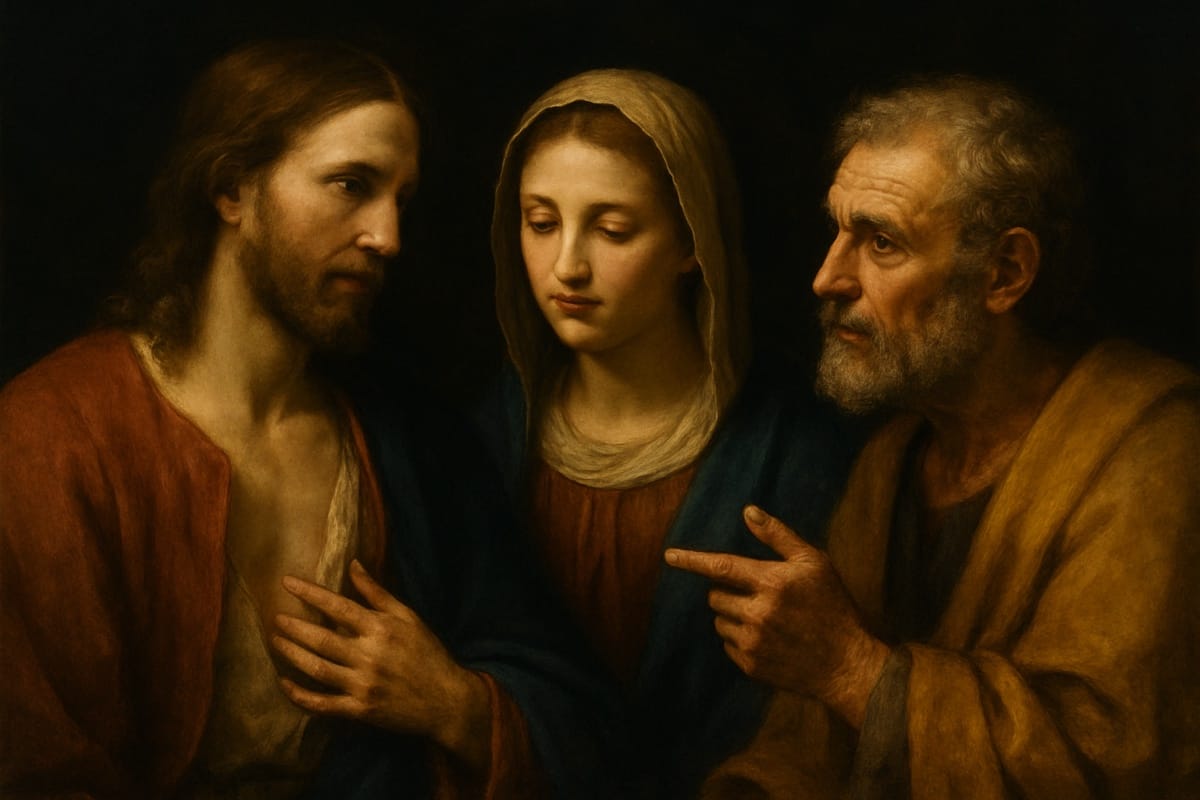
Vos autem quem me esse dicitis? Respondens Simon Petrus dixit: Christum Dei.
Lk 9:20
The Twelfth Sunday in Ordinary Time, Year C, has at its center the great scene of Peter’s confession at Caesarea Philippi (Lk 9:18-24), one of the densest pericopes of Jesus’ entire public ministry. The question that Jesus asks, first about the opinion of the crowds (“who do the people say that I am?”) and then about the conviction of the disciples (“but you, who do you say that I am?”), is the question that defines discipleship: it is not possible to be a disciple without having answered it personally. Peter’s answer, “the Christ of God,” is recognized by Jesus as correct, and it is followed by a revelation about the suffering to come and by the radical invitation to discipleship: “let him take up his cross daily and follow me” (Lk 9:23).
The liturgical context is rich: the readings of the Twelfth Sunday of Year C include Zech 12:10-11; 13:1 (“they shall look on Me, the one whom they have pierced, and they shall mourn for Him as one mourns for an only son”), a prophecy of the Passion that tradition has applied to Calvary, and Gal 3:26-29 (“there is neither Jew nor Greek, neither slave nor free, neither man nor woman, for you are all one in Christ Jesus”), one of the most explicit formulations of eschatological unity in Christ. Peter’s confession is therefore framed by the prophecy of the pierced one and by the vision of the unity of all in Christ: the “Christ of God” whom Peter confesses is the One who was pierced and who unites all in Himself.
I. “But you, who do you say that I am?”: The Defining Question
Jesus’ question in Lk 9:20 is the most personal and most demanding question in the Gospel: not “what do others think?” but “what do you think?” The answer cannot be delegated, whether to tradition, to the authority of teachers, or to the opinion of the majority. Discipleship demands a personal answer that, once given, defines the identity of the disciple as much as it defines the identity of Jesus. “You are the Christ of God” is at once a statement about Jesus and a declaration about oneself: “I know who You are, and therefore I know who I am, someone who follows You.”
The Christological tradition elaborated this answer over centuries of debate: the Councils of Nicaea (325), Ephesus (431), and Chalcedon (451) articulated in philosophical language what Peter expressed in everyday language. “Christ of God,” the promised Messiah, the Anointed of the Lord, does not yet capture the full depth of what Jesus revealed about Himself, but it is the correct starting point. The history of dogma is the history of the deepening of this answer: from “Christ of God” to “Son of God consubstantial with the Father” (Nicaea) to “one person in two natures” (Chalcedon). Jesus’ question continues to merit ever more precise answers, but each deepening presupposes Peter’s initial answer.
Mary was the first to answer the question “who is Jesus?” with the whole of her existence, before the question had been explicitly formulated. The fiat of the Annunciation is an implicit Christological answer: by consenting to be the Mother of the Son of the Most High, Mary affirmed who Jesus is before Jesus began to reveal Himself publicly. This priority of Mary’s faith, a faith that precedes the public revelation and grounds the disciples’ following of Christ, is what tradition describes when it affirms that Mary is the “first believer.” She answered Peter’s question before Peter had heard it.
The phenomenology of Peter’s confession in Lk 9, in contrast with the version in Mt 16, is more sober: there is no declaration about the rock and the keys of the Kingdom, no promise of the primacy. Luke presents the confession as a moment of discernment on the path of discipleship, without the ecclesiological implications that Matthew will develop. This difference of emphasis between Luke and Matthew is theologically fruitful: the confession of faith in Jesus is not only the foundation of the ecclesial structure (Matthew); it is also the moment of personal clarification on the path of discipleship (Luke). Both dimensions are necessary and complementary.
II. Peter’s Confession: Foundation and Limit
What immediately follows Peter’s confession in Lk 9:21-22 is disturbing: Jesus “commanded them to tell this to no one” and announced the suffering to come, “the Son of Man must suffer many things, be rejected by the elders, by the chief priests, and by the scribes, be killed, and on the third day rise.” The Peter who had correctly confessed the identity of Jesus was about to fail to understand the mission of Jesus: the Matthean version (Mt 16:22) makes explicit what Luke omits, namely that Peter wanted to reject the announcement of the Passion, and Jesus called him “Satan.”
This dialectic, correct confession and immediate incomprehension, is the most honest portrait of human faith that the Gospels draw: it can be correct in its affirmation and limited in its implications. To confess “You are the Christ” is a beginning, not an arrival. It is the gateway into a process of progressive understanding of the identity and mission of Jesus, which the disciples will travel throughout the whole public ministry and will complete only at Easter. Peter’s limitation does not invalidate his confession, but it reveals that the confession of faith is the beginning of a path, not the conclusion of a journey.
The comparison with Mary is illuminating here: Mary, too, did not fully understand what the “fiat” implied. The episodes of Lk 2, “did you not know that I must be in my Father’s house?” (Lk 2:49), and of Jn 2, “my hour has not yet come” (Jn 2:4), show moments in which Mary did not completely understand her Son’s mission. But the difference between Mary and Peter is the difference in their response to incomprehension: Peter wanted to reject what he did not understand. Mary “kept in her heart” (Lk 2:51) what she did not understand and let it mature. This difference in attitude, the open heart that awaits understanding versus the ego that rejects what challenges it, is the difference between Marian discipleship and Petrine discipleship at its moment of greatest fragility.
The Magisterium of Pope Francis has insisted on the figure of Peter as a model of the imperfect discipleship that God uses: not the glorious Peter of the confession, but the Peter who denied Him and who was reinstated in his mission by the Risen One’s “do you love me?” (Jn 21:15-19). This insistence has an implication for the understanding of the Petrine primacy: its authority rests not on the personal perfection of the historical Peter or of his successors, but on the election of God, who uses the weak to accomplish His purposes. The same principle holds for all discipleship: an authentic confession of faith does not require prior perfection, but the willingness to learn along the way what the confession implies.
III. “Let him take up his cross”: Discipleship and Kenosis
The instruction that immediately follows the announcement of the Passion in Lk 9:23 is one of the most radical in the Gospel: “if anyone wants to come after me, let him deny himself, take up his cross daily, and follow me.” The specifically Lucan “daily” is absent from Mark and Matthew: Luke transforms the single act of taking up the cross into a daily habit, a disposition that marks every day of discipleship, not only moments of crisis. Following Jesus takes the form of a daily kenosis, a self-emptying that is not self-destruction but liberation from the prison of the ego.
The theology of the Cross as kenosis, developed from Phil 2:6-11 (“he emptied himself, taking the form of a servant”), is the heart of Pauline Christology and has a fundamental Mariological dimension: Mary shared in the kenosis of the Son throughout her whole life, not only on Calvary. The “yes” of the Annunciation was an act of kenosis: the surrender of her own autonomy in favor of the will of God. The Visitation was kenosis: the service that empties one of self for the benefit of another. Calvary was the most extreme kenosis, the renunciation of her own Son, the emptying of her motherhood in the service of the redemptive mission.
The instruction “let him take up his cross daily” has a concreteness that the spiritual tradition has worked out in many forms. The “daily” cross is not necessarily the great Cross of martyrdom; it is the daily renunciation of selfishness, patience with the irritations of the day, fidelity to one’s responsibilities when fatigue invites negligence, forgiveness of the family member who has caused hurt, presence to the elderly person when strength is failing. This pedagogy of the daily cross, the ordinary asceticism of everyday life, is, according to John Paul II in Salvifici Doloris (1984), the most universal form of participation in the redemptive suffering of Christ.
Gal 3:26-29, the second reading of the Twelfth Sunday of Year C, links following the cross to eschatological unity in Christ: “there is neither Jew nor Greek, neither slave nor free, neither man nor woman, for you are all one in Christ Jesus.” The kenosis that discipleship demands is precisely the renunciation of the identities that divide, of the privilege of being a Jew, of the privilege of being free, of the privilege of being a man, in favor of the unity that Christ makes possible. Mary, who lived kenosis in an exemplary way, is the model of this unity: she is venerated in every culture, in every Christian tradition, on every continent, precisely because her total availability to God made her available to all humanity.
IV. Mary, First Confessor and Model of Discipleship
Peter’s confession, “You are the Christ of God,” is the explicit confession that Peter makes after two years of following Jesus. Mary’s confession, implicit in the fiat and explicit in the Magnificat, precedes the public mission of Jesus. This priority of Mary’s faith over Peter’s faith is not an ecclesiological rivalry; it is a complementarity: the faith that grounds discipleship (Mary) and the faith that structures the ecclesial community (Peter) are the two pillars of the Christian life.
The Magnificat, which is sung at Vespers every day in the Church, is Mary’s confession in its most developed form: a theology of salvation in the first person, expressed in the language of praise and prophecy. “My soul glorifies the Lord and my spirit rejoices in God my Savior” is Mary’s answer to the question “who is Jesus?”: He is the Savior, the Mighty One who has fulfilled His promises, the Holy One who has filled the hungry with good things. The Magnificat is the first Christology of the New Testament: not an academic reflection on the identity of Jesus, but a canticle born of the experience of salvation.
The prophetic dimension of the Magnificat, “from now on all generations will call me blessed” (Lk 1:48), has been fulfilled in a way that surpasses any human expectation possible at the moment when Mary sang it. Over two thousand years, in every language and culture, the generations have called Mary “blessed.” This historical fulfillment of the prophecy of the Magnificat is a verifiable “fruit,” by the criterion of Mt 7:16, of the authenticity of Mary’s mission: the tree that has produced this fruit of universal veneration and of faith sustained in millions of lives over two millennia is, by its fruits, a good tree.
The Twelfth Sunday in Ordinary Time invites each believer to renew their answer to Jesus’ question: “But you, who do you say that I am?” The liturgical tradition proposes Mary as the model of this renewal: not the abstract answer of scholastic theology, but the existential answer of the fiat: “You are the Lord of my life and I am Your handmaid. Let it be done to me according to Your word.” This answer, which Mary gave at the Annunciation, which Peter gave at Caesarea, and which every Christian is invited to give every Sunday, is the foundation of all authentic Christian life: the rock on which is built the house that storms do not destroy.
Postgraduate Program in Mariology
Would you like to deepen your formation in Mariology? Discover the Postgraduate Program in Mariology at Locus Mariologicus – an academic formation that unites theological rigor, spiritual life, and the living tradition of the Church.
Would you like to study Mariology seriously?
This article grows out of the works in the Locus Mariologicus library. The Postgraduate Program in Mariology takes you to the same source, with academic guidance: Scripture, the Fathers of the Church, and the Magisterium, from the first dogma to contemporary questions.




Responses