You are the salt of the earth and the light of the world: Is 58, 1 Cor 2 and Mt 5.
Vos estis lux mundi. Non potest civitas abscondi supra montem posita.
Mt 5:14
The Fifth Sunday in Ordinary Time of Year A brings together three texts around the vocation of the disciple as light and salt in the world. Is 58:7-10 presents the works of mercy as the condition for the light of the faithful to shine like the dawn. 1 Cor 2:1-5 describes Paul’s preaching as resting radically not on human wisdom but on the power of the Spirit, so that the faith of the Corinthians may rest on God and not on men. Mt 5:13-16 proclaims the disciples as the salt of the earth and the light of the world: their light must shine before men so that they may see their good works and glorify the heavenly Father. The three texts describe the same dynamic of light that comes from within and illuminates what is outside: the mercy that illuminates (Is), the power of the Spirit that illuminates (1 Cor), and the life of the disciple that illuminates (Mt).
I. The First Reading: Is 58:7-10
Isaiah announces the conditions for the light of the faithful to shine: “Is this not what I want, that you share your bread with the hungry and bring into your house the poor who have no shelter, that when you see someone naked you cover him and do not hide yourself from your neighbor?” (Is 58:7). And then the promise: “Then your light shall break forth like the dawn, your healing shall spring up quickly. Your justice shall go before you and the glory of the Lord shall follow you” (v. 8). And if you share your bread with the hungry and satisfy the afflicted, “your light shall rise in the darkness and your gloom shall be like midday” (v. 10). Isaiah makes the connection that Jesus’ Sermon on the Mount presupposes: the works of mercy are the condition of the light. The light of the disciple does not come from solitary contemplation: it comes from the concreteness of sharing, from hospitality to the poor, from the clothing of the naked. The dawn that Isaiah promises is not spiritual in an evasive sense: it is the radiance that emanates from a life of active love.
II. The Second Reading: 1 Cor 2:1-5
Paul reminds the Corinthians of the way in which he preached to them: “I did not come to proclaim to you the testimony of God with sublimity of words or of wisdom” (1 Cor 2:1). The reason: “For I decided to know nothing among you except Jesus Christ, and Him crucified” (v.2). And the disposition: “I was among you in weakness, in fear and much trembling” (v.3). His preaching was not with persuasive words of wisdom, but with a demonstration of the Spirit and of power (v.4). The purpose: “So that your faith may not be founded on the wisdom of men, but on the power of God” (v.5). Paul articulates the paradox of weakness as the condition of authenticity: the light of the Gospel shines more intensely when it is not competing with the brightness of human constructions. Preaching that is poor in rhetoric is the preaching in which the Spirit has more room.
III. Evangelium: Mt 5:13-16
Jesus continues the Sermon on the Mount with two images that define the identity of the disciple. “You are the salt of the earth” (Mt 5:13): salt that has lost its flavor is good for nothing except to be thrown out and trampled underfoot by men. “You are the light of the world” (v.14): a city set on a mountain cannot be hidden. No one lights a lamp and puts it under a bushel, but on the lampstand, and so it gives light to all who are in the house (v.15). “So let your light shine before men, that they may see your good works and glorify your Father who is in heaven” (v.16). The two images have in common a vocation that reaches beyond itself: salt exists to give flavor to what is outside it, light exists to illuminate what is around it. The disciple who closes in on himself has betrayed his vocation. The purpose of good works is not self-affirmation but the glorification of the Father, exactly what 1 Cor 2 expresses in terms of preaching: not one’s own wisdom, but the power of God.
IV. Mary and the Dawn of the Light
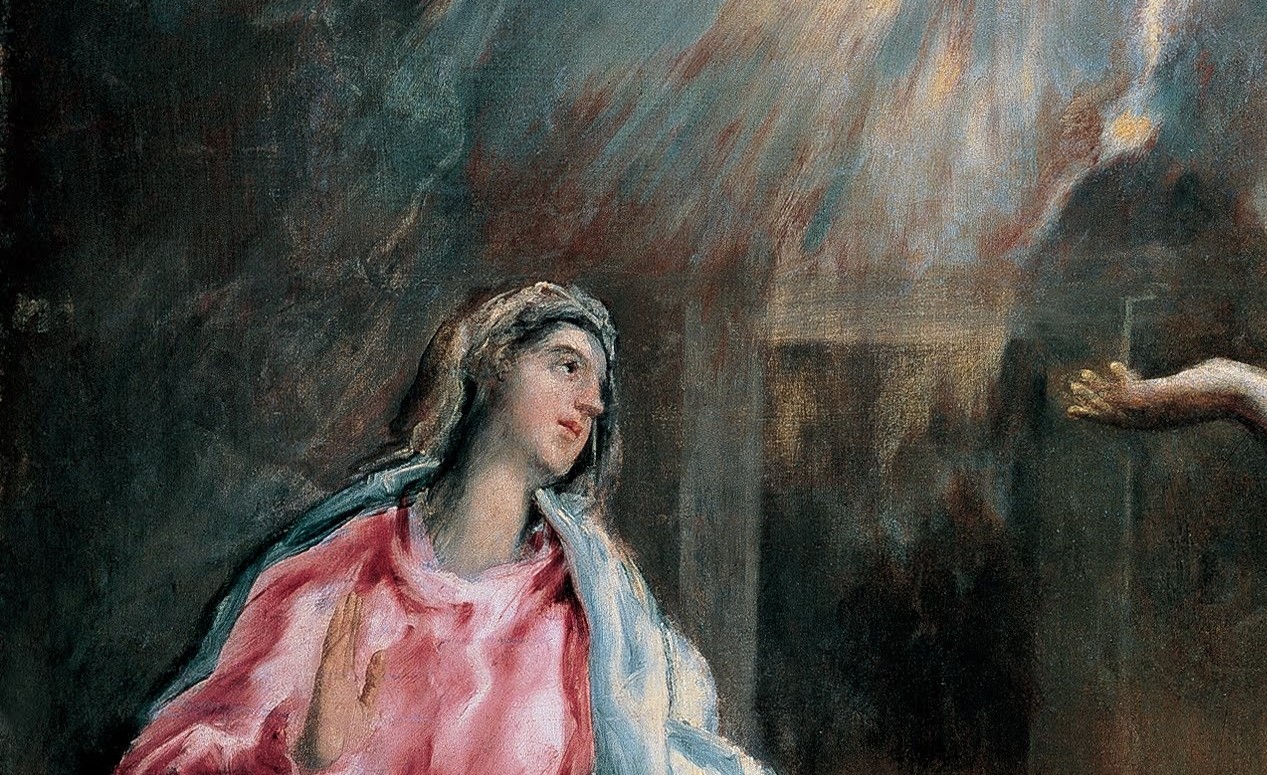
Is 58 promises that the light will shine like the dawn for the one who shares his bread and welcomes the poor. The liturgical tradition sings of Mary as the “dawn,” the one who precedes the Sun of Justice and announces the day. This image is not merely poetic: it articulates the role of Mary in the economy of salvation. She is the creature who lived most fully what Is 58 describes: the Visitation is Mary’s hastening to the hill country to serve Elizabeth, the active and bodily sharing of one who goes out to meet another in need. The canticle that resounds in Elizabeth’s house, the Magnificat, is the dawn that shines before the birth of Jesus. 1 Cor 2 describes Paul preaching in weakness, without wisdom of words: Mary is the supreme model of this preaching by silence. The Gospels record few words of hers, the fiat, the Magnificat, “do whatever He tells you” (Jn 2:5). Her testimony is not rhetorical: it is ontological. She is what she proclaims. Mt 5 says that the light of the disciple must shine so that men may glorify the Father: the life of Mary is exactly that, a transparent existence that leads whoever meets her to glorify God, not Mary. Like the salt that dissolves in the food, giving it flavor without making itself seen, Mary is the invisible seasoning of the Gospel.
Postgraduate Program in Mariology
Would you like to deepen your formation in Mariology? Discover the Postgraduate Program in Mariology of Locus Mariologicus – an academic formation that unites theological rigor, spiritual life and the living tradition of the Church.




Responses