The Symbolic Depth of Marian Representations in the Roman Catacombs

It falls to us to pause and contemplate the iconographic richness of the Marian representations that emerge from the recesses of the Roman catacombs. These images, often relegated to the funerary sphere, are in fact an eloquent testimony of early Christian faith and of the veneration of the Virgin Mary.
The archaeological context of the representations of Mary in the catacombs
Although most of these representations are of Roman origin, we should not let ourselves be misled by this apparent geographical limitation. Recent archaeological discoveries, especially in Egypt and the Middle East, continue to enrich our understanding of the Mariological figurative repertoire, demonstrating a surprising homogeneity in its representation.
The Virgin Mary and the infancy of Jesus in the catacombs
The scenes in which the Virgin Mary is frequently depicted belong to the so-called “cycle of the infancy of Jesus”. These include the Adoration of the Magi, the Annunciation, and the Nativity. These images often coexist with other representations that evoke the salvific acts of God, from both the Old and the New Testament. Such coexistence is not mere coincidence, but a profound theological articulation that links the Virgin Mary to the divine plan of salvation.
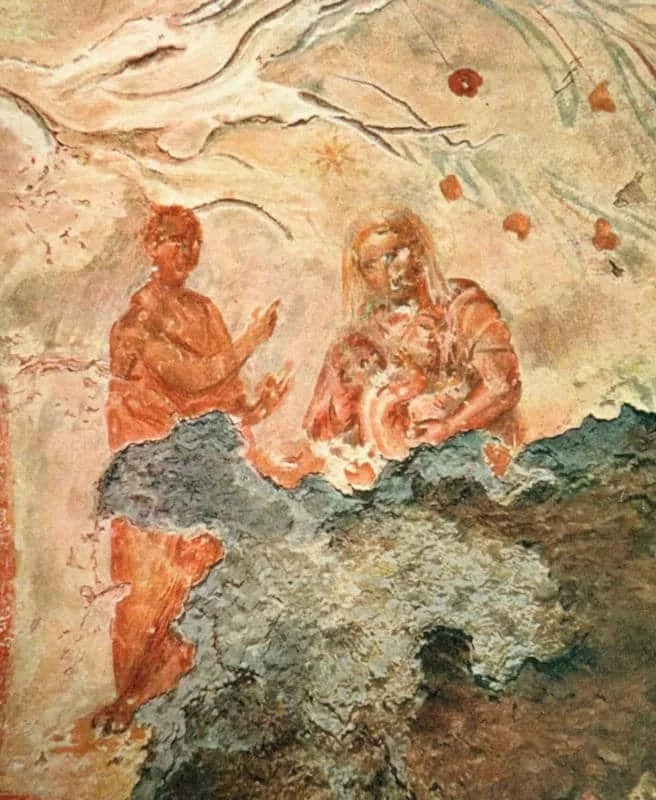
The symbolism of Mary’s clothing in the catacombs
The Virgin’s clothing in the catacombs is particularly revealing. While the married women of ancient Rome traditionally covered their heads in public, Mary is frequently depicted with her head uncovered, a powerful symbol of her virginity and purity. This detail is not trivial. It invites the reader to reflect on Mary’s virginal integrity, as highlighted by theologians such as Tertullian and proclaimed by the faith of the Church as the dogma of Perpetual Virginity.
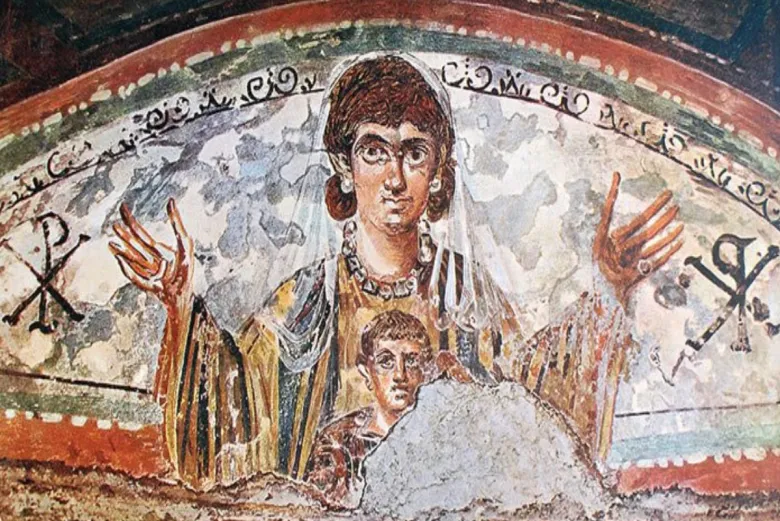
The adoration of the Magi as an interpretive axis of Marian art
The scene of the Adoration of the Magi in the catacombs of Priscilla serves as an interpretive axis for other scenes of salvation. The arrangement of the figures, the dynamism, and the location of the scene emphasize the universality of the salvation brought by Jesus Christ, Son of God born of the Virgin Mary. This is the summit of the theophany, the visible manifestation of the God who saves. This image depicted in the catacombs was common at the time.
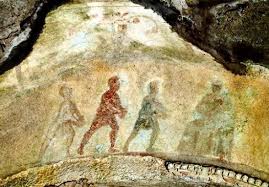
The evolution of the representation of Mary in early Christian art
Over time, the representation of the Virgin Mary in art evolves toward a more central and frontal posture, as seen in examples from the fourth century. This development foreshadows the type of the “Majesty of the Mother of God with the Child” that will become prevalent in the subsequent centuries.
Mary in the catacombs and the origin of Marian art
The Marian representations in the Roman catacombs, and especially in the Catacombs of Priscilla, are more than mere images. They are visual narratives that articulate a rich and complex theology. They invite the reader to a profound meditation on the Virgin Mary, not only as the mother of Jesus, but as a figure intrinsically bound to the mystery of salvation and to the first Christians. In studying this artistic and spiritual legacy, we are called to “Know Mary Better in Order to Love Her More”, a mission that resounds across the centuries and remains vital for the Christian faith today.
Marian art in the catacombs is the beginning of a long tradition contemplated in the encyclical Redemptoris Mater (John Paul II), which deepens the role of Mary in the faith of the Church from the first centuries of Christianity.
Deepen your studies: explore Mariology, Marian Theology, Marian apparitions, and the Postgraduate Program in Mariology.
Postgraduate Program in Mariology
Would you like to deepen your formation in Mariology? Discover the Postgraduate Program in Mariology at Locus Mariologicus, an academic formation that unites theological rigor, spiritual life, and the living tradition of the Church.
Discover the oldest Marian image in the Catacomb of Priscilla.
Would you like to study Mariology seriously?
This article is born of the works in the library of Locus Mariologicus. The Postgraduate Program in Mariology takes you to the same source, with academic guidance: Scripture, the Fathers of the Church, and the Magisterium, from the first dogma to contemporary questions.




Responses