“Let us be diligent like little children”: Teresa, the little way and Mary
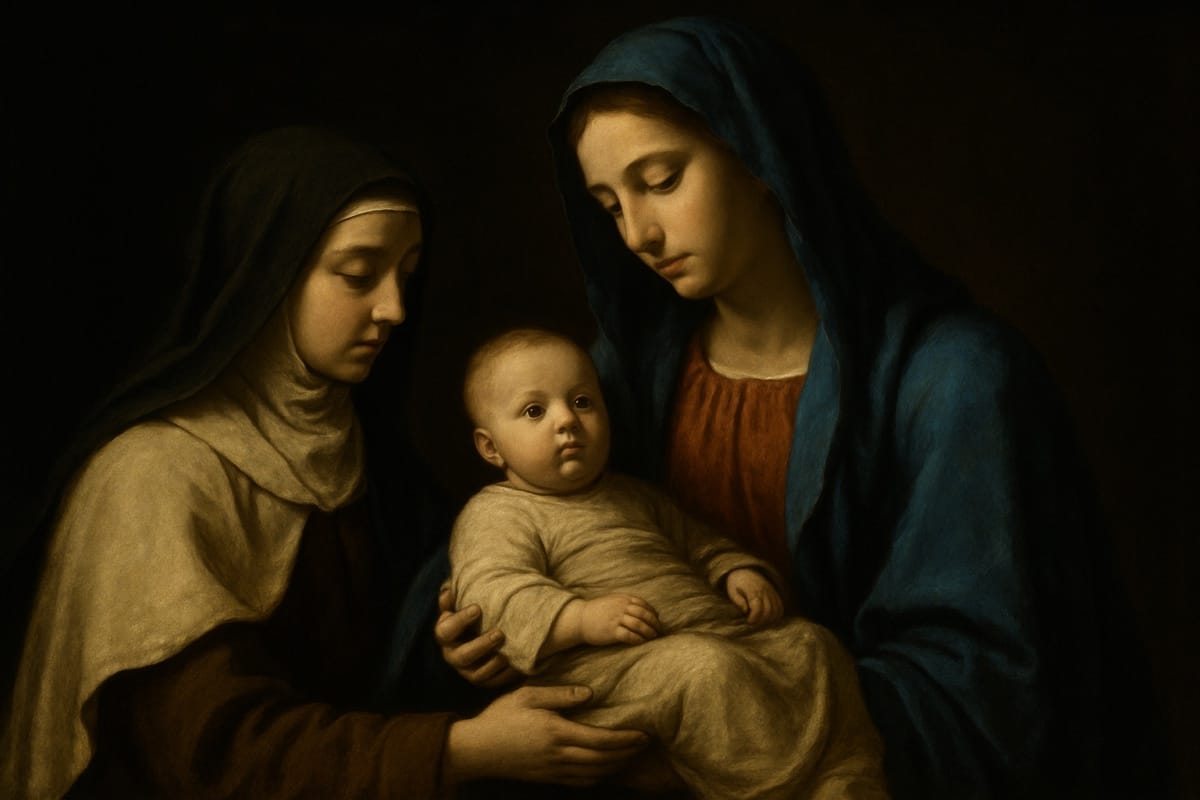
“Unless you turn and become like little children, you will not enter the kingdom of heaven.” (Matthew 18:3)
The feast of Saint Theresa of Child Jesus (Doctor of the Church, October 1st) connects Isaiah 66 with the maternal tenderness of God who consoles like a mother consoles her child, to Matthew 18, where Jesus places a child as a model of the disciple of the Kingdom. Theresa’s “little way” is the lived synthesis of both texts: spiritual infancy that recognizes God as a Father-Mother who consoles. Mary, who sang the Magnificat, is the consoling mother and the model of the spiritual child who receives.
I. The First Reading: Isaiah 66:10-14c
Isaiah 66 concludes with one of the most tender images of God in the entire Old Testament: “Like a mother consoles her child, so I will console you” (v.13). Jerusalem-mother who nurses her children and God who consoles like a mother: the image is deliberately maternal. The tenderness that Theresa discovered in God has deep biblical roots: the God she called “Abba” was not her invention but the God of Isaiah 66.
“You will see and your hearts will rejoice” (v.14): the consolation Isaiah promises is not simply emotional but transformative. Theresa, who died of tuberculosis at 24, lived this promise in the most paradoxical way: consoled by the tenderness of God amidst her physical decline. The joy the prophet promises and that the saint experienced is the joy that does not depend on circumstances but on the presence of the Mother-God who consoles.
II. The Gospel: Matthew 18:1-5.10
The disciples’ question, “Who is the greatest in the kingdom of heaven?” (v.1), and Jesus’ response with the child, form the evangelical parallel to the image from Isaiah 66. To become like children (v.3) is not a regression to psychological immaturity but the spiritual disposition of total dependence on God the Father. The child Jesus places in the midst is not a symbol of purity but a symbol of one who receives because he has no status to demand.”Whoever receives one of these children in my name receives me” (v.5): the child is the model of the disciple who receives the Kingdom as a gift. Teresa’s “little way” is the synthesis of this verse: to receive each day as a child receives, without calculating merits, without comparing with others, without demanding guarantees. The angels of the child who “always see the Father’s face” (v.10) are the intercessors of the spiritual childhood that Teresa discovered.
III. The Little Way: Teresa Between Isaiah and Matthew
Teresa synthesized in her “little way” what Isaiah and Matthew describe from two perspectives: the divine tenderness that consoles (Is 66) and the spiritual childhood that receives (Mt 18). Her discovery that holiness is not a heroic ascent but a confident descent into the arms of God the Father is the lived exegesis of both texts. Not to climb the difficult ladder of perfection but to take the divine mercy elevator.
The image Teresa used of the elevator that lifts the small child instead of the stairs that the strong climb is the precise synthesis of Mt 18:3. To become like a child means to accept the mercy elevator instead of insisting on climbing by one’s own strength. Isaiah, who promises God’s maternal consolation, and Jesus, who places the child at the center, are the two scriptures that Teresa lived during years of tuberculosis and faith’s night.
IV. Mary: Supreme Model of the Little Way
Mary is the supreme model of Teresa’s “little way”: the “servant of the Lord” who received the Incarnation not as the fruit of her merits but as a gift of grace that “filled” her. The Magnificat is the song of one who receives like a child receives: “he looked upon his handmaid’s humility” (Lk 1:48). Mary’s greatness in the Magnificat is not the greatness the disciples disputed but the greatness God gives to the small.
The Teresa’s feast invites us to recognize in Mary the mother-figure of Isaiah who consoles and the child-figure of Matthew who receives. Mary, who consoled the disciples after the Cross (Acts 1:14), practiced the maternal tenderness of Isaiah. Mary, who said “Be it done” to the Annunciation, practiced the spiritual childhood of Matthew. Teresa, who chose Mary as her model, discovered in her the synthesis that the feast proposes: the smallness that receives the greatness God gives.
Postgraduate Program in Mariology
Would you like to deepen your formation in Mariology? Get to know the Postgraduate Program in Mariology from Locus Mariologicus – an academic formation that combines theological rigor, spiritual life, and the living tradition of the Church.



Responses