Mary, a Free Woman Because She Is Christian

Introduction
Concluding the Encyclical Letter Fides et Ratio, Pope John Paul II writes about Mary as follows:
My last thought is turned to Her whom the prayer of the Church invokes as ‘Seat of Wisdom’. Her own life is a true parable capable of shedding light upon the reflection I have carried out. In fact, one can glimpse a profound consonance between the vocation of the Blessed Virgin and that of legitimate philosophy. Just as the Virgin was called to offer her whole humanity and femininity so that the Word of God might take flesh and become one of us, philosophy too is called to offer its work, rational and critical, so that theology, as understanding of the faith, may be fruitful and effective. And just as Mary, in giving her consent to Gabriel’s announcement, lost nothing of her true humanity and freedom, so philosophical thought, in receiving the questioning that comes to it from the truth of the Gospel, loses nothing of its autonomy, but sees every one of its inquiries driven toward the highest achievement. This was well understood by the holy monks of Christian antiquity, when they called Mary ‘the intellectual table of the faith’. In her they saw the coherent image of true philosophy and they were convinced that they ought to philosophize in Mary. In Mary the Pope sees the marvelous synthesis of the relationship between faith and reason, harmoniously correlated and inseparable in her life as a truly free woman and an authentic Christian. For this reason, the Virgin is the model of the homo novus and of the complete human being, in whom the consistency of faith never enters into conflict with human and intellectual fullness, nor is dissociated from it, and who, by consciously welcoming the transforming newness of faith, opens himself with his intelligence and heart to reciprocity and to the encounter with Truth, God in Christ in the Spirit.
Indissoluble relationship between faith, reason, and freedom
Faith and reason are two vital dimensions for the human being who sets out to seek the Truth honestly and to find valid answers to the fundamental questions of his existence. For this reason, they cannot be separated or set against each other, but must interact together, as “the two forces that lead us to knowledge“.
Saint Augustine suggests two formulas that also sum up the point of arrival of his intellectual and spiritual journey: “I believe in order to understand“, because faith opens the way to enter the gates of truth. “I understand in order to believe“, because understanding leads to finding God and to believing. This harmony between faith and reason means, above all, that God is not distant but, on the contrary, is close to every human being, both in his heart and in his reason.
Therefore, given that “faith and reason are like the two wings by which the human spirit rises to the contemplation of Truth“, every human person has the need and the duty to travel the road that leads to this contemplation, with faith as well as with reason. In fact, faith demands to be thought, both because Revelation, by reason of its contents, asks to be thought, and because the ontological nature of human assent requires that the Christian make of his faith a thought.
The object of Revelation, in fact, is God Himself, who, through Jesus Christ, communicates to man salvation, which is life itself. For this reason, if God is the ultimate end of our existence, He cannot be attained unless He is fully known, because man, as Thomas Aquinas affirmed, can attain his end only through a free choice that proceeds from the full exercise of reason. And this is so because faith is not merely trusting in something vague, indistinct, or abstract, but rather adhering to Someone, that is, to Christ, the revealer of the Triune God: it is to penetrate ever more deeply into the knowledge of His Person, to listen ever more intelligently and completely to His teaching, to relate to Him, to be with Him in an intimate and personal relationship.
Faith would not truly be faith if it were only an adherence to generic principles or an empty emotion devoid of rational content and of conscious openness to an interpersonal relationship. Christian revelation, in the last analysis, requires that we fully accept the mystery of the Word in our lives and demands, with respect for the autonomy and freedom of the creature, the commitment to open oneself to dialogue with Transcendence. If faith calls upon reason in order to be complete, reason, for its part, cannot ignore this call without renouncing being itself and without arbitrarily limiting itself in its capacity and vocation to respond to the radical questions that concern the destiny of man.
The search for truth to which man is naturally called is not the acquisition of partial knowledge, but of the total and totalizing Truth, capable of explaining the meaning of life itself, and it is therefore a search that can find success and satisfaction only in openness to the Absolute. For this reason, according to Pope Ratzinger: “the truly philosophical attitude [is that of] looking beyond the penultimate things and seeking the ultimate and true ones”.
Ultimately, the invocation of faith is born of reason itself, which asks whether there is a right to hope for a fullness of life for every man and whether there is a final meaning to the whole of human history. The answer of faith generates in man a confidence in reason and a taste for research, since he is already able to open himself to the light of the Definitive. Consequently, Faith and Reason, though with different means and contents, are bound to walk together in order to lead man to the contemplation of Truth and to the authentic encounter with it in Christ, thus freeing him from the snares of integralism and of false freedoms.
Mary, a complete woman: rational and Christian
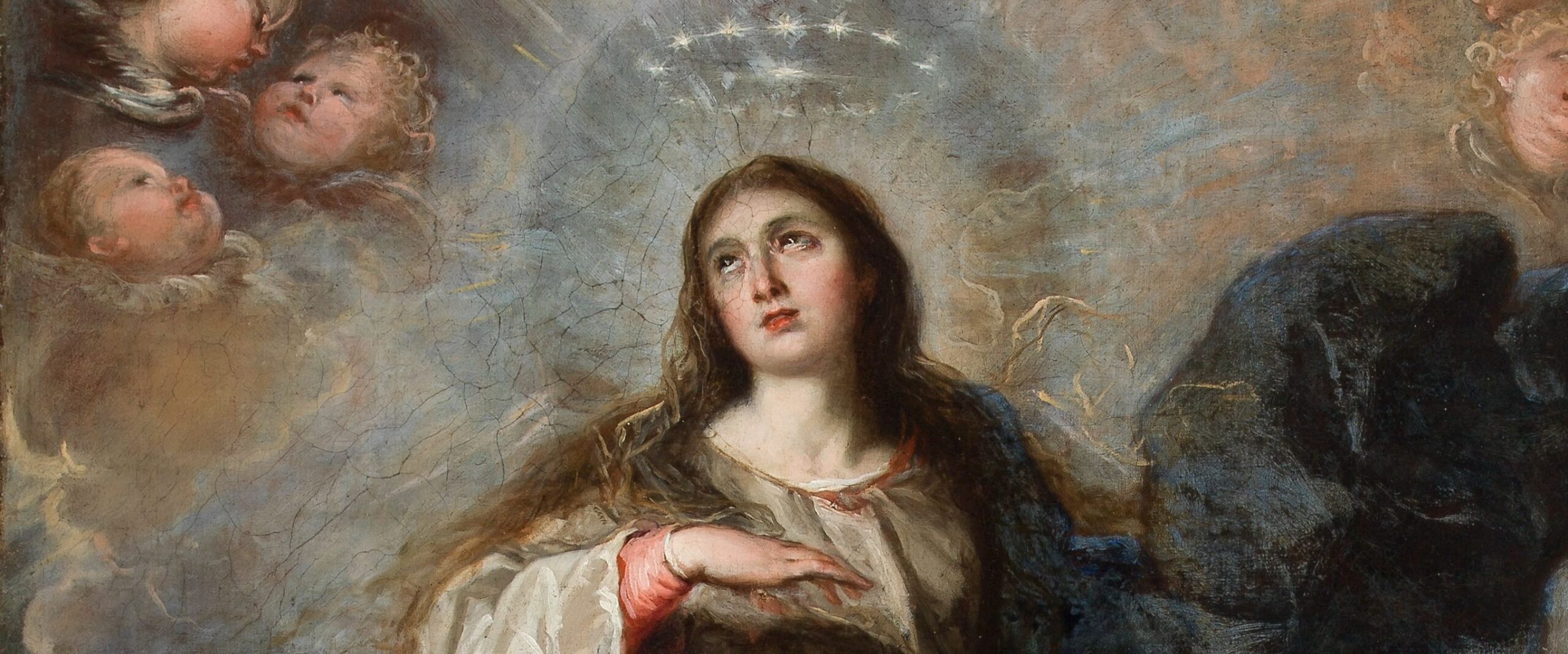
In the Apostolic Letter Mulieris Dignitatem, John Paul II defines Mary as the archetype of woman, since she is a complete and extraordinarily modern woman, profoundly bound to the human family, present at the crucial point of history as the one place where faith and reason meet through her conscious, free, and full acceptance in mind, in heart, in faith, and in body of the God who paradoxically desires to enter into history. The event of Nazareth, the “fullness of time“, in which the Word-Logos becomes flesh, after the Father had entered into dialogue with a woman, appears to be the most significant moment and the highest point of human and feminine consciousness.
- It did not oppress her freedom.
- It did not threaten her identity as a woman.
- It did not paralyze her femininity.
- It did not represent a risk to the autonomy and maturity of her personality.
On the contrary, it helped her to be fully herself. For this reason, in opening herself to the totality of faith, Mary gives herself to God with full and serene joy, thus fulfilling herself as a truly free and Christian woman. Not without reason did Edith Stein, a great philosopher and a great Christian, analyzing the whole of Mary’s experience, especially her way of believing and of freely accepting God’s plan for her life, call her our “traveling companion” and “prototype of true femininity“.
John Paul II, for his part, writes textually: “the figure of Mary of Nazareth sheds light on woman as such, by the very fact that God, in the sublime event of the incarnation of the Son, entrusted Himself to the free and active ministry of a woman. Therefore, it can be affirmed that woman, by looking to Mary, finds in her the secret of living her femininity with dignity and of achieving her own true advancement”.
Responding with her conscious faith to God’s call, Mary realized without reservation the true and authentic relationship of man and woman with God. She perceived what the true secret of her “identity” and true “self-realization” was, assuming, as an authentic, free, and Christian woman, full responsibility for an answer that would affect the future of all men, because it had to do with the history of their salvation.
Mary, being the Mother of Jesus, is the Mother of the one human-divine Person of the Word, to whom she gives the human nature that in Him is united, in a profound and perfect manner, ‘without division’ and ‘without confusion’, as the Council of Chalcedon affirms (cf. DH 302), with the divine nature. Mary is truly the Mother of God (cf. DH 251-252). God was able to accomplish this in her through her free consent to the divine plan prepared from all eternity: ‘let it be done to me according to your word‘ (Lk 1:38). At the same time, Mary, because she was conceived by God as the one who sums up the whole of creation, opened to creation the possibility of giving birth to God. Thus it is that, with her and in her, the freedom of man attains its true fullness.
Deepen your studies: explore Mariology, Marian Theology, Marian apparitions and the Postgraduate Program in Mariology.
To deepen your reflection on Mary as a free woman in the Christian faith, consult the Encyclical Redemptoris Mater of Pope John Paul II.
Postgraduate Program in Mariology
Would you like to deepen your formation in Mariology? Discover the Postgraduate Program in Mariology of Locus Mariologicus – an academic formation that unites theological rigor, spiritual life, and the living tradition of the Church.
Would you like to study Mariology seriously?
This article is born of the works in the library of Locus Mariologicus. The Postgraduate Program in Mariology takes you to the same source, with academic guidance: Scripture, the Fathers of the Church, and the Magisterium, from the first dogma to contemporary questions.




Responses