“Everything has its time: Caesar’s question and the hour of Cana”
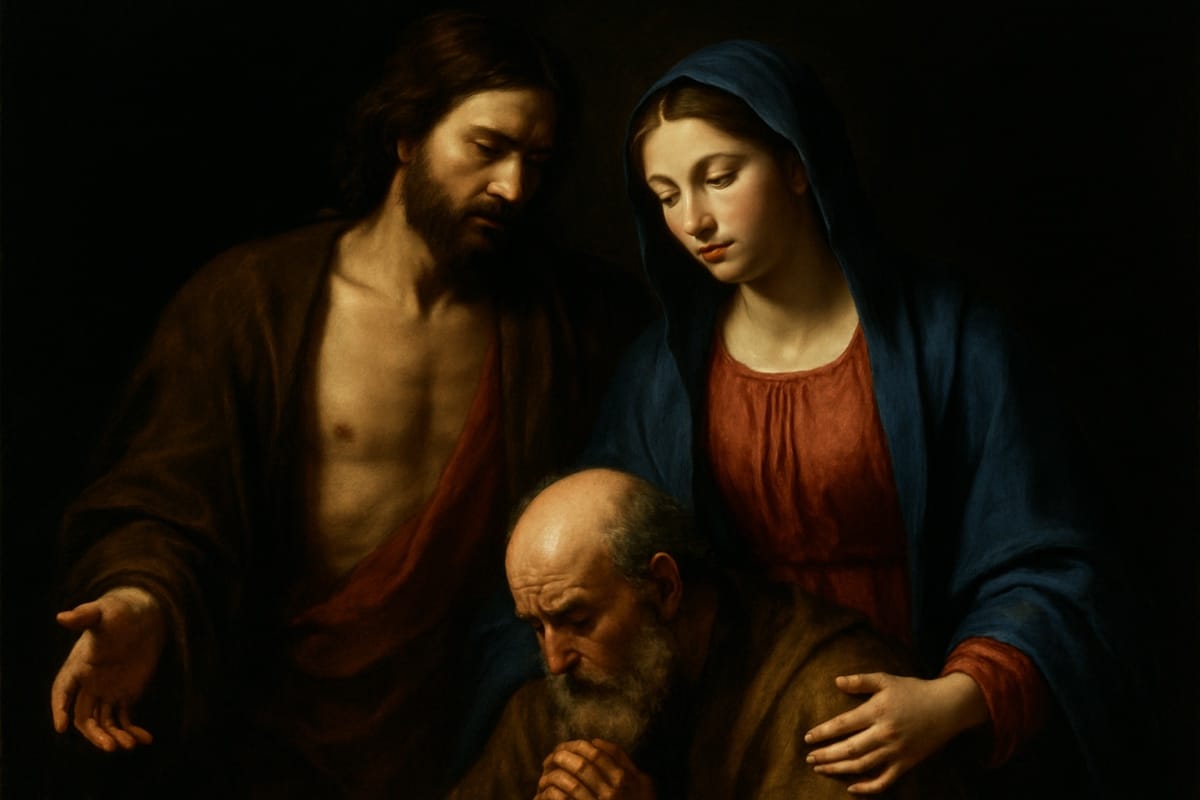
“Everything has its time, and there is a season for every activity under the heavens. […] But as for you, who do you say I am?”
Ecclesiastes 3:1 and Luke 9:20
The Friday of Week XXV in Ordinary Time joins the most famous poem from Ecclesiastes with the decisive question from the Gospel of Luke. Coeleth lists fourteen pairs of opposing times and concludes that God has put the succession of ages in the heart of man but has not given him the key to understand it. Jesus, after praying alone, asks the disciples who they say he is, receives the correct answer from Peter, and immediately corrects it with the announcement of the Passion. A text says that there is a time for everything. The other shows that recognizing the Messiah is not the same as accepting his time.
I. The first reading: Ecclesiasticus 3:1-11
The poem is constructed with an unwavering symmetry. «Everything has its time, and everything under heaven has its moment» (v.1), and follow pairs: birth and death, planting and uprooting, killing and healing, tearing down and building, weeping and laughing, mourning and dancing, silence and speech, love and hate, war and peace. There is no moral preference here. The wise man is not saying that it is better to laugh than to weep, he is saying that both have their time and that the time is not chosen by us.
The true center of the passage comes at the end and is one of the densest phrases in the Old Testament: God «has put all things under his power and has given man understanding of the times and seasons, yet he has not granted him the power to know the work of God from beginning to end» (v.11). The Hebrew term translated as «succession of ages» is olam, which also means eternity or duration without end. God has put in man the sense of the whole, and denied him the vision of the whole. This is the source of human inquietude, which is not a defect to be corrected but the mark of a creature made for more than what he can grasp.
II. The Gospel: Luke 9:18-22
Luke precedes the scene with a note that only he provides: «Jesus was praying alone, with only his disciples present» (v.18). Great questions in this Gospel always arise from prayer. And the question comes in two stages, first «who do the crowds say that I am?», then, without transition, «and what do you say?» (v.20).
The answers from the crowd are the same as Herod heard a few verses earlier, John the Baptist, Elijah, one of the ancient prophets. Peter breaks the series: «you are the Messiah, the Son of God». And then comes what is not expected. Jesus strictly forbids them to say it to anyone, and explains why by adding the first announcement of the Passion: «the Son of Man must suffer greatly, be rejected by the elders, the princes, and the scribes, be killed, and on the third day rise» (v.22).
The order of silence does not protect a secret, it protects meaning. The word Messiah, said at that moment and in that context, would evoke a political liberator. Before it could be spoken in public, it had to be corrected by the cross. Peter hit the mark with the title, but he didn’t yet know what it contained.
The Time That Does Not Precede
Both readings tell, in different ways, that man does not command God’s calendar. Ecclesiastes witnesses to this from the perspective of wisdom, observing the cycles of life. Jesus asserts it from the side of revelation, delaying the announcement until it can be understood without ambiguity.
This has a spiritual application that is gradually learned. There are truths that are possessed before they are understood, and announcing them too early is to distort them. There are sufferings that are not explained at the time they occur. And there are consolations that only come after the hour has passed. What God placed in the heart of man, according to Ecclesiastes, was the sense of the whole without the map of it, and the life of faith consists in large part in bearing this disparity without artificially resolving it.
IV. Mary, Who Kept the Times Without Forcing Them
If there is anyone in Scripture who lived all the pairs of Ecclesiastes without anticipating any of them, it is the mother of Jesus. She had time to dance when Elizabeth proclaimed her blessed, and she responded with the Magnificat (Luke 1:46-55). She had time to be silent during the thirty years of Nazareth summarized in the Gospels in a single line. She had time to weep, standing by the cross (John 19:25). She did not confuse the hours, and that is what distinguishes faith from religious impatience.
The Gospel of John preserves the scene where this is best seen. At Cana, Mary notices the lack and presents it, “They have no wine” (John 2:3). The Son’s response is initially a stop, “My time has not yet come” (John 2:4). She does not insist nor argue. She tells the servants, “Do whatever he tells you” (John 2:5) and exits the scene. She presented the need and surrendered the time. This is the precise definition of Christian intercession, and it is the opposite of prayer that demands a deadline.
Regarding the question, “Who do you say I am?”, Mary responded before she was made and without using titles. She answered with, “Be it done to me according to your word” (Luke 1:38), which is a confession of faith in the form of availability. The Council reminds us that she faithfully preserved the union with the Son until the cross (LG 58), which means her response included what Peter could not yet hear. She said yes to the Messiah before knowing the cost, and she continued to say yes after knowing it.
Therefore, the Friday of the 25th Week leaves a task that is not intellectual. It is not a matter of discovering God’s plan before time. It is about recognizing the hour that is running and not exchanging it for another.
Postgraduate Program in Mariology
Would you like to deepen your formation in Mariology? Get to know the Postgraduate Program in Mariology at Locus Mariologicus – an academic formation that combines theological rigor, spiritual life, and the living tradition of the Church.
Would you like to study Mariology seriously?
This article draws on the works of the Locus Mariologicus library. The Postgraduate Program in Mariology takes you to the same sources with academic guidance: Scripture, the Church Fathers and the Magisterium, from the first dogma to contemporary questions.




Responses