Holy Mary, Mother of God
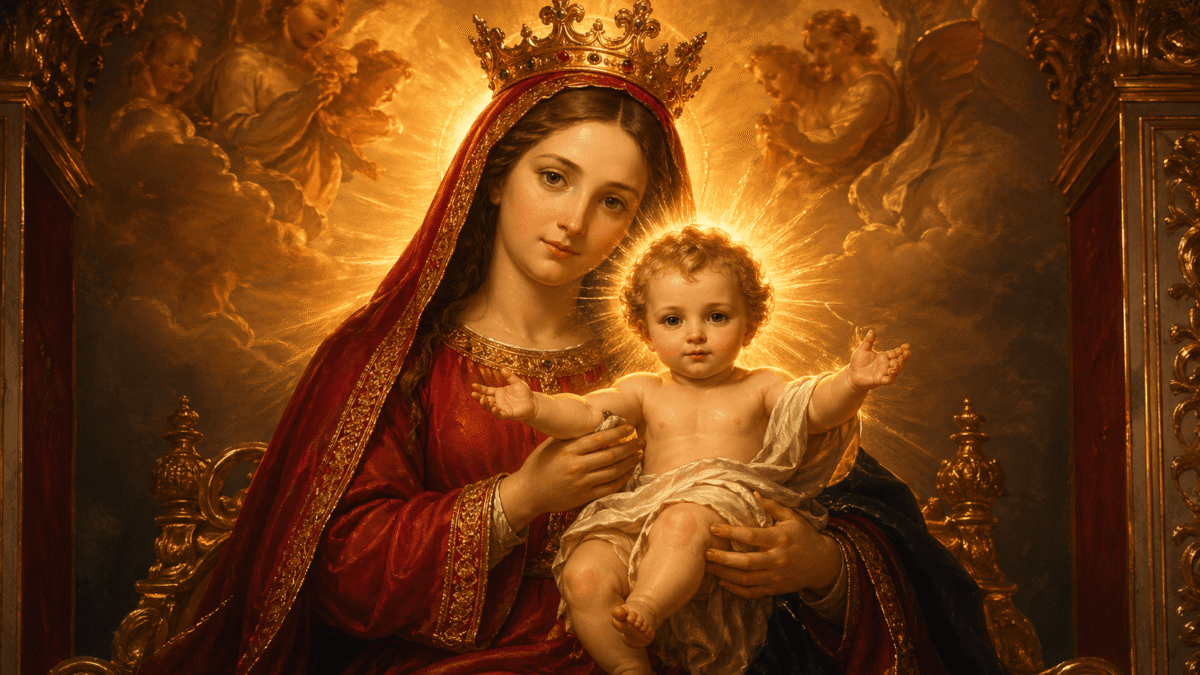
Misit Deus Filium suum, factum ex muliere.
Gal 4:4
Holy Mary Mother of God: “God sent His Son, born of woman” (Gal 4:4). This dogmatic truth, defined at Ephesus (431), articulates the whole of Catholic Mariology around the title Theotokos.
I. “Born of woman”: the theological density of the Incarnation
Within the horizon of Holy Mary Mother of God, the Pauline synthesis of the economy of salvation in the Letter to the Galatians possesses a concision that makes it one of the densest and richest Mariological texts in all of apostolic Scripture. “But when the fullness of time came, God sent His Son, born of woman, born under the Law, to redeem those who were under the Law, in order to confer upon us filial adoption” (Gal 4:4-5). Every word of this sentence carries a theological weight that the tradition of the Doctors of the Church has not finished exploring. “The fullness of time” indicates that the Incarnation was neither a chance event nor a premature one: it was the moment that God inscribed in the fabric of history from creation onward, the moment toward which the whole divine pedagogy was oriented. History has a direction because it has a center, and that center is the coming of the Son in the flesh.
The expression “born of woman”, the cornerstone of the title Holy Mary Mother of God, is of a disconcerting sobriety. Paul does not name Mary. He gives her no title at all. He limits himself to indicating the maternal condition of the Son’s birth. But it is precisely in this sobriety that the theological depth of the text resides: Paul affirms that the Son of God entered human existence exactly as all human beings do, through a woman. The Incarnation was not an apparition or a superficial manifestation: it was a real birth, with all the conditions and consequences that a birth implies. In affirming that the Son was “born of woman”, Paul affirms the full humanity of Jesus and, consequently, the real divine motherhood of Mary: if what she conceived and bore is truly the Son of God, then she is truly the Mother of God.
II. Holy Mary Mother of God: from theology to contemplation with the shepherds
The reading of Holy Mary Mother of God continues with the passage from the Pauline reflection on the Incarnation to the Lucan account of the shepherds’ visit to the stable of Bethlehem, a passage that effects an essential transition in the spirituality of this Mass: from the theological density of the Letter to the Galatians we descend to the concrete and silent ground of the night of Bethlehem. This downward movement is itself a law of Christian spirituality: revealed truth is not meant to be contemplated only on the plane of ideas, but to be encountered in the concrete mystery of history. The shepherds do not arrive at the knowledge of the Incarnation through philosophical speculation: they arrive through an angelic announcement and a nocturnal visit to a stable. Their experience is the archetype of all Christian mysticism: to find the Son of God where He chose to place Himself, in fragility and in marginality. The shepherds arrive intuitively at the faith that Ephesus will confess: Mary is Theotokos, Mother of God made a child.
Holy Mary Mother of God stands at the center of this encounter, yet she remains in silence. It is not she who speaks to the shepherds, it is not she who explains the mystery: it is she who keeps it. The contrast with the shepherds is telling: they departed, they told what they had seen, and all were amazed. Mary, on the contrary, “kept all these things in her heart” (Lk 2:19). Mary’s interiority is not passivity: it is the most profound form of welcoming the mystery, the way proper to one who has received the fullest revelation and understands that it exceeds every possibility of adequate expression.
III. Holy Mary Mother of God kept all things in her heart
The second chapter of Luke offers, in the key of Holy Mary Mother of God, one of the most intimate and most beautiful portraits of Mary in all of Scripture. The night of Bethlehem is described with the precision of one who was a witness or who heard the account of witnesses: the birth in the stable, the absence of room in the inn, the swaddling clothes and the manger. When the shepherds arrive, overflowing with the angelic vision and the announcement of the Savior, Mary and Joseph receive them in silence. The shepherds speak, they narrate, they grow excited. Mary listens and keeps. This meditative silence is the heart of the Theotokos who welcomes the mystery before handing it over to the Church.
In the perspective of Holy Mary Mother of God, the Greek verb synetērei, translated as “kept”, has a special resonance in the biblical tradition: it is the verb of vigilant custody, of the treasure carefully protected. Mary lets nothing of what happens escape her: neither the words of the shepherds, nor the presence of the Son in the manger, nor the wonder of all who listened. And “pondering them in her heart” indicates that her heart is a space of prayerful reflection, where events are set against the promises and the promises against the events, in a faithful reading of history that is built up progressively. Mary is the first theologian, in the most proper sense of the term: not because she systematizes doctrines, but because she meditates on the facts in the light of God and comes progressively to understand the mystery that she herself inhabits.
IV. Holy Mary Mother of God: Mary Theotokos, the confession that sums up everything
The fourth Mass of the Collection of Our Lady celebrates the highest and most controverted title of Christian Mariology: Mother of God. The Council of Ephesus, in 431, solemnly defined that Mary is Theotokos, Dei Genetrix, Mother of God, against the proposal of Nestorius, who wished to limit the title to Christotokos, Mother of Christ. The distinction was not merely verbal: at stake was the unity of the person of Christ. If Mary is only the mother of the humanity of Jesus, then divinity and humanity in the Son of God are not united in a single person. If Mary is the mother of Jesus Christ who is one single person, divine and human, then she is truly the Mother of God.
The definition of Ephesus was received with a popular joy that surprised contemporary observers: the streets of Ephesus lit with torches, the people celebrating, the bishops acclaimed. This popular joy was not an excess of sentimentality: it was the correct intuition that the definition of Ephesus safeguarded not only a privilege of Mary, but the heart of the Christian mystery, the full reality of the Incarnation. The Letter to the Galatians, in affirming that the Son was “born of woman”, already grounded this intuition. The liturgy of this Mass unites the two moments: the apostolic synthesis of Paul and the evangelical contemplation of Luke in a single celebration of the divine motherhood of Mary, which is, at the same time, the celebration of the Incarnation in its fullness and in its historical concreteness.
Postgraduate Program in Mariology
Would you like to deepen your formation in Mariology? Discover the Postgraduate Program in Mariology of Locus Mariologicus – an academic formation that unites theological rigor, spiritual life, and the living tradition of the Church.
Would you like to study Mariology seriously?
This article grows out of the works in the Locus Mariologicus library. The Postgraduate Program in Mariology brings you to that same source, with academic guidance: Scripture, the Fathers of the Church, and the Magisterium, from the first dogma to contemporary questions.





Responses